 Plant
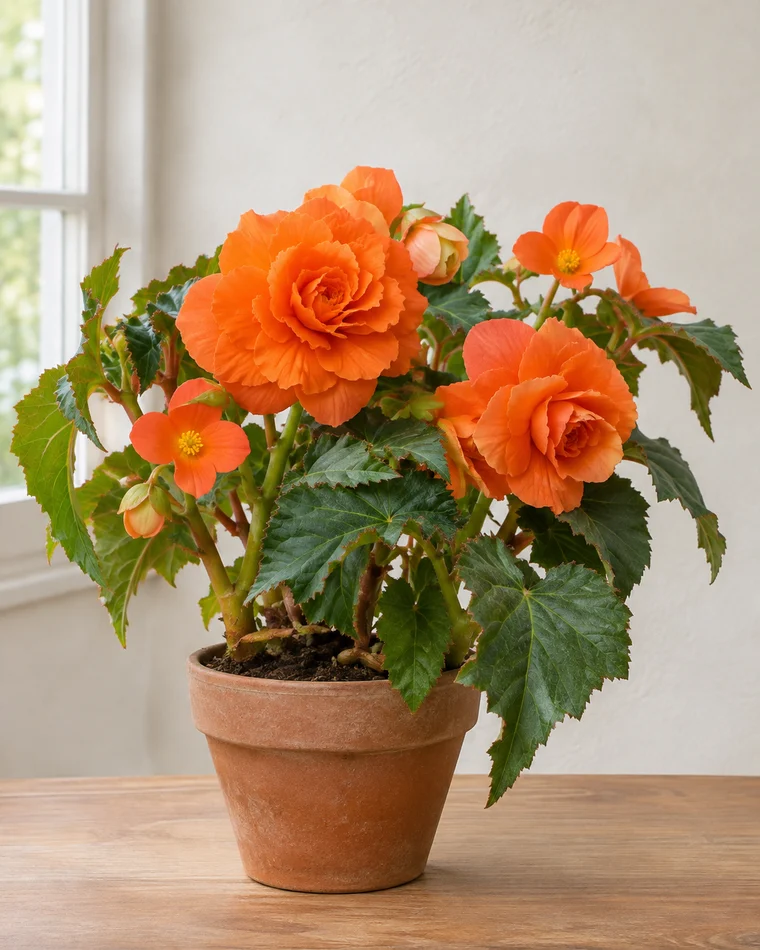
Tuberous begonia.
Begonia × tuberhybrida
Tuberous begonia offers generous flowers for a bright, sheltered growing season, then retreats into a resting tuber. Begonia × tuberhybrida describes a cultivated hybrid group with many upright and cascading forms. It is best approached as a seasonal flowering plant rather than permanent evergreen décor. Learning when to support active growth, when to reduce water and how to preserve the tuber makes the next season’s display possible.
How to help it thrive.
Checked:
Quick care reference
- Identity: Begonia × tuberhybrida, a cultivated tuberous hybrid group.
- Provide bright indirect or dappled light and shelter from intense midday sun.
- Water active plants when the mix becomes slightly dry; avoid complete repeated drought.
- Start tubers hollow side up near the surface without water pooling in the hollow.
- Use a light draining mix and protect brittle stems from wind or rough handling.
- Plan for a seasonal resting tuber rather than year-round evergreen foliage.
- Store cured tubers cool, frost-free and protected from wetness; inspect them periodically.
- Begonias are toxic to cats and dogs; stored underground parts need particular protection.
Seasonal flowers supported by a resting tuber
Tuberous begonia is a cultivated group of flowering begonias, usually labeled Begonia × tuberhybrida or Tuberhybrida Group. Its complex parentage means there is no single wild homeland to assign to the hybrid group. The familiar display combines soft, asymmetrical foliage with conspicuous flowers above a fleshy underground storage organ. That tuber allows the plant to pause and start again, rather than maintaining an unchanged leafy display all year.
Treat this as a seasonal flowering project for a bright, sheltered position. A healthy plant can be enjoyed indoors during active growth, but its natural rest should be planned from the start. A flower-filled summer pot and a labeled dormant tuber are two stages of the same plant. If you need permanent evergreen foliage on a shelf, this group will not meet that expectation as reliably as a foliage houseplant.
[1][2][3]Identify the growth group before applying its calendar
A typical tuberous hybrid has fleshy, easily bruised stems, leaves with unequal sides and a rounded, often flattened tuber. Flowers may be single or double and range through white, yellow, orange, pink and red; exact shape and size belong to the cultivar. A purchased plant’s label is valuable because large flowers alone do not reliably distinguish tuberous hybrids from other flowering begonias.
Wax begonias, cane begonias, rex begonias and winter-flowering hybrids are not interchangeable care categories. In particular, do not impose a dry tuber-storage routine on a plant whose identity or storage organ is unconfirmed. Keep the cultivar name with a picture of its flowering habit. When repotting becomes necessary, observe the base gently instead of digging repeatedly through a healthy root ball simply to prove that a tuber exists.
[1][7]Bright light with relief from intense midday heat
Choose a position with plentiful indirect or dappled light. Gentle early or late sun can be suitable, but hot midday exposure can scorch the tender foliage and flowers. Indoors, a lightly filtered bright window may be more useful than either a dark room or an exposed hot pane. The aim is enough light to build sturdy stems and flowers without overheating the soft leaves.
Watch how light changes as the season progresses. An overhang that shaded the plant in one month may allow a strong beam to reach it later. Move or shade the pot gradually when the leaf surface is receiving harsh sun, and maintain air movement around the canopy. Thin stretched growth may point toward insufficient light, but do not react by moving a shaded plant straight into intense outdoor sunshine.
[2][3]Water differently at sprouting, flowering and rest
An actively growing tuberous begonia is not drought-tolerant. Let the container mix become slightly dry before watering, then drain it well; repeated complete drying can interrupt growth and spoil the display. Check baskets and sheltered porch containers directly because rainfall nearby may never reach their root zones. Water at substrate level so it does not collect among flowers or in the hollow of an emerging tuber.
A newly started tuber has few working roots and cannot use water at the rate of a full leafy plant. Keep its starting mix modestly moist, never saturated, and increase supply only as roots and shoots develop. When seasonal yellowing leads into dormancy, progressively reduce watering and stop the active-growth routine. A resting leafless tuber is not a pot of foliage waiting for its normal weekly drink.
[2][4]Pot around the tuber rather than burying it deeply
Start a sound tuber with the concave or bud-bearing face upward, near the surface of a light, draining growing medium. A thin covering is sufficient; water must not pool in its hollow. Allow room for roots around the tuber without surrounding a small specimen with an unnecessarily large mass of wet mix. A peat-free container substrate opened with a suitable coarse component is preferable to dense garden soil in a pot.
As roots and shoots establish, move the plant carefully into its growing container without packing the young roots tightly. Keep drainage holes open and leave access for watering around the stems. If support is needed, position a stake clear of the tuber instead of driving it blindly through the center. Large-flowered upright plants and cascading basket forms need different physical support even though both depend on an aerated root environment.
[2][3]Moderate warmth and shelter for brittle growth
Warm conditions help a dormant tuber resume growth: published guides commonly start it around 18–21°C. That range is a practical starting guide, not a promise that every tuber will sprout on the same day. Protect new shoots from cold nights and frost. When moving a plant outdoors, acclimatize it and wait until local frost risk has passed rather than copying planting dates from another country.
Prolonged high heat can be difficult for tuberous begonias, especially when roots dry while the leaves are hot. Provide shade from intense sun and ventilation without exposing brittle stems to strong wind. A sheltered, moderately warm place is more appropriate than a stagnant hot enclosure. During storage, the tuber needs a cool frost-free environment; it should not remain on a hot radiator shelf or be subjected to freezing conditions.
[1][2][3]Feed established growth without burning new roots
The tuber supplies reserves during its first awakening. Avoid treating a bare newly planted tuber as a mature flowering basket that immediately needs strong fertilizer. Once roots and leaves are growing well, use a suitable flowering-container fertilizer at the labeled rate, allowing for any nutrients already included in the potting mix. Healthy flowering growth benefits from nutrition, but fragile new roots are easily damaged by excess.
Different guides favor balanced feeding or a higher-potassium product during flowering; these are cultivation approaches, not a reason to combine several feeds. Choose one appropriate program and observe the plant. Heavy fertilizer will not compensate for deep shade, overheated leaves or a decaying tuber. Reduce and stop feeding as the plant winds down toward rest, and record what was used so next season’s care is not based on guesswork.
[1][3]Manage the display without breaking the stems
Growth habit depends strongly on the cultivar: some tuberous hybrids form upright flowering plants, while others spill over a basket rim. Their stems can break under handling, wind or the weight of large flowers. Support an upright plant early enough that ties can be loose and unobtrusive, and leave space around a trailing plant so its stems do not catch on furniture or neighboring pots.
Removing a damaged or spent flower can keep the display tidy, but elaborate shoot thinning is optional exhibition practice rather than a universal requirement. A basket selected for many smaller blooms should not automatically be thinned like a large-flowered show specimen. Avoid stripping healthy leaves as the season ends: they contribute to replenishing the tuber while they remain active. Size and yearly vigor depend on cultivar, tuber condition and the growing season.
[1][2]Take young stem cuttings instead of treating tubers like potatoes
For home propagation, choose a healthy young basal stem during active growth and prepare it with clean tools. RHS describes cuttings about 10 cm long with a small heel of tuber tissue, rooted in an airy cuttings mix at about 18–21°C. Removing a heel also wounds the parent, so work conservatively and do not sacrifice the only strong shoot on a weak plant. Bright indirect light and controlled moisture support rooting.
Maintain humidity around the cutting without leaving its base waterlogged, and introduce normal room air gradually once it is established. Look for roots and sustained new growth rather than relying on an exact week count. Tuber division is a more demanding option: guidance differs, and cut pieces can rot. Do not slice a dormant tuber into arbitrary chunks as though each were a potato eye. Seed propagation is possible, but offspring may not preserve a named hybrid’s traits.
[1][2]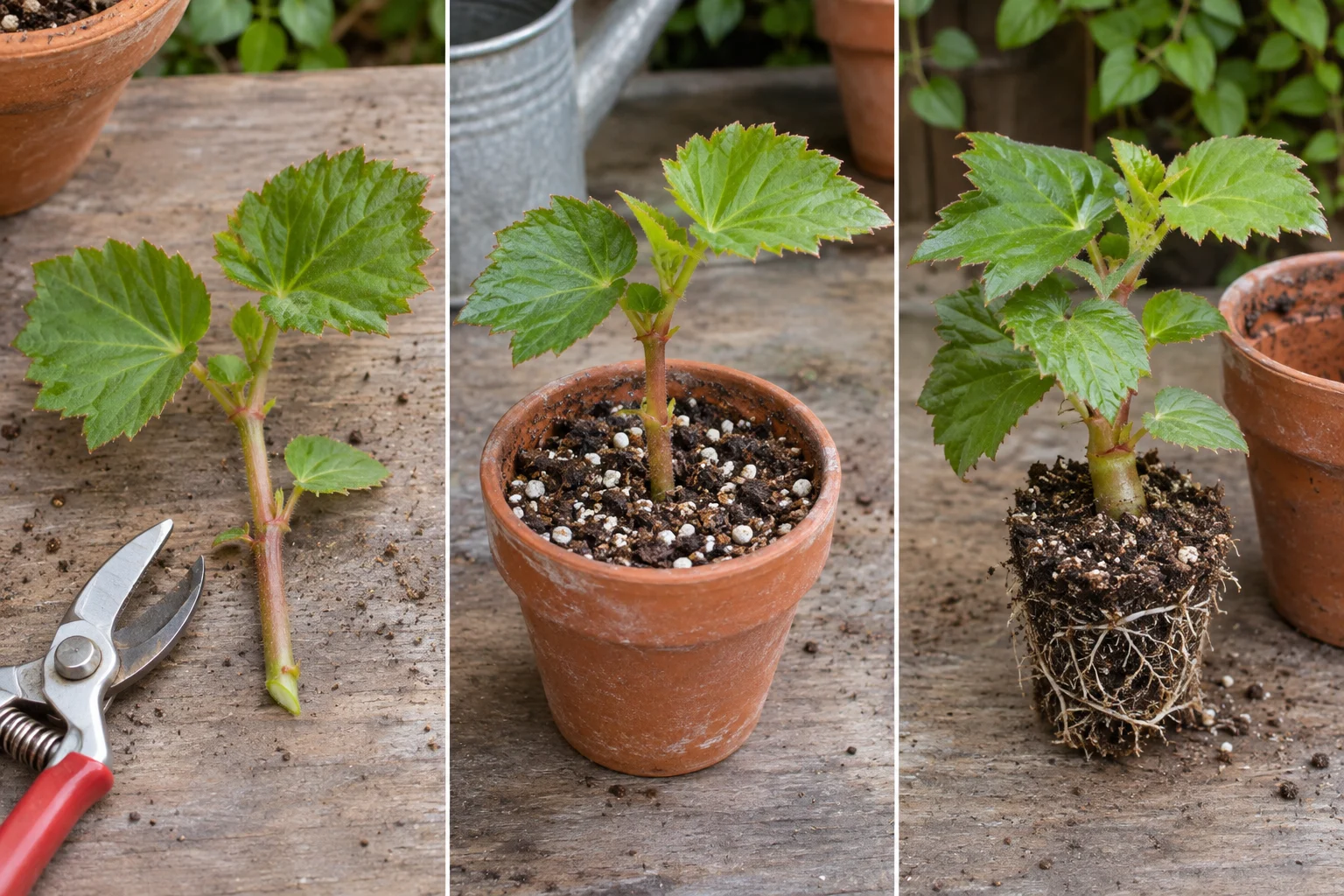
Panels, from left to right
- Select a healthy young basal stem during active growth and prepare an approximately 10 cm cutting carefully.
- Insert it into airy moist propagation mix in bright indirect light, with gentle warmth around 18–21°C.
- Once roots and sustained growth develop, acclimatize and pot up without damaging the young roots or developing tuber.
Keep petals and soft stems out of damp congestion
Tuberous begonias can suffer from powdery mildew, gray mold and other leaf or stem diseases. White powdery patches, browning wet petals or a collapsing stem base deserve inspection, but a photograph alone does not establish which organism is involved. Fallen flowers held against damp leaves create a particularly unhelpful environment. Remove loose dead material carefully and give the canopy enough space for air to circulate.
Check new plants and cuttings before introducing them to the collection, including leaf undersides and the base where pests or damage may be hidden. Isolate a suspect specimen and identify the problem before treating it. Begonia tissue can be sensitive to improvised mixtures, so avoid household pesticide recipes. If treatment is needed, follow a locally permitted product label suitable for the identified problem and setting, or seek a plant diagnostic service.
[5][6]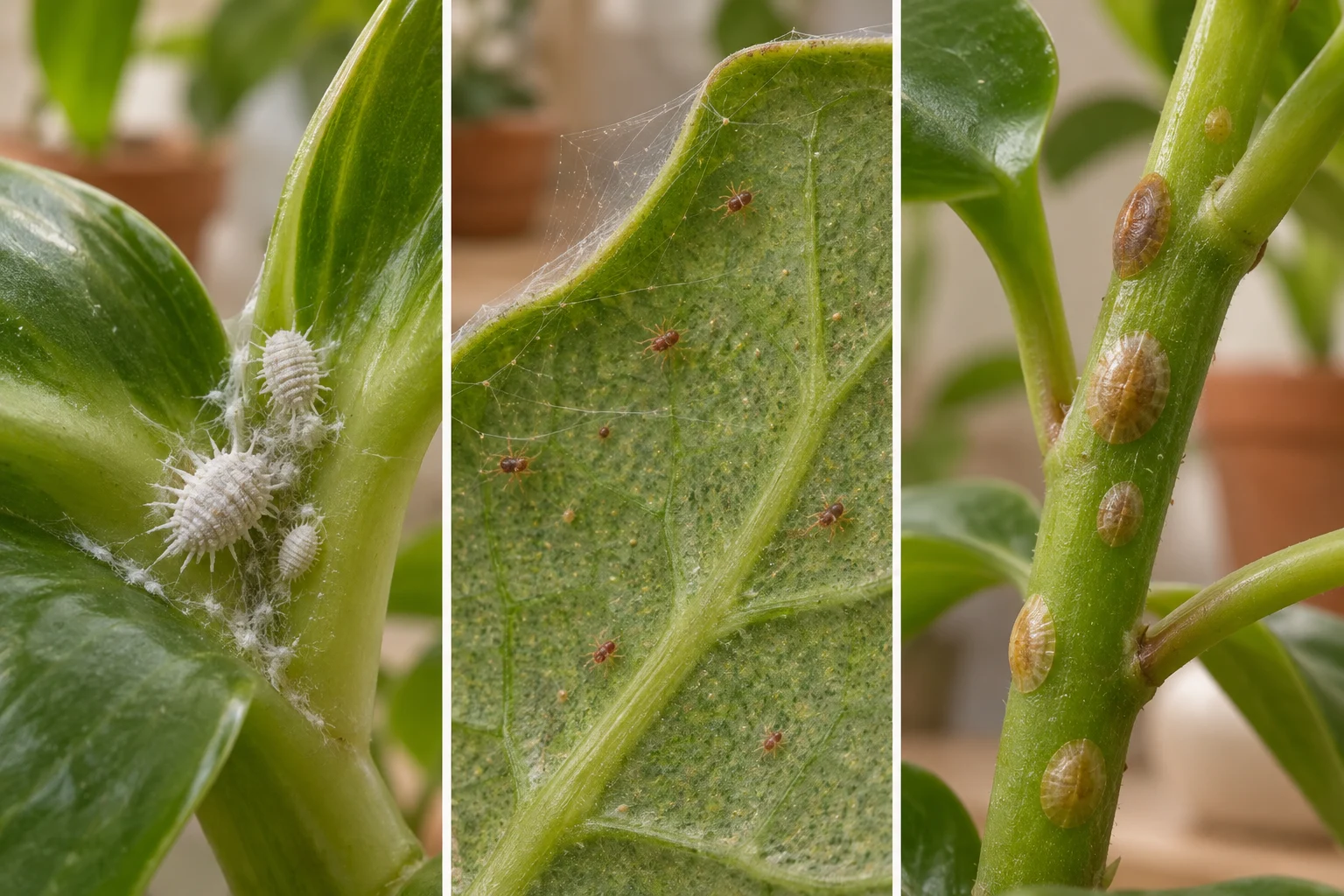
Panels, from left to right
- Mealybugs
- Spider mites
- Scale insects
Separate seasonal yellowing from a failing tuber
Gradual late-season yellowing across a plant can signal preparation for rest. Sudden collapse of one stem in actively growing conditions, particularly beside a wet substrate or soft tuber, is a different pattern. Compare the season, recent watering and the condition of the base. More water is not the automatic remedy for a drooping begonia; first determine whether the root zone is actually dry or already excessively wet.
Bud loss or scorched margins can follow uneven moisture, excessive heat or a sudden change of position. Make one useful correction based on the evidence and watch newly developing tissue, since damaged leaves will not become pristine again. A foul, soft or spreading basal lesion needs prompt attention and separation from healthy plants. Preserve the cultivar label and care history when asking for help so the adviser knows this is a tuberous hybrid.
[4][5][6]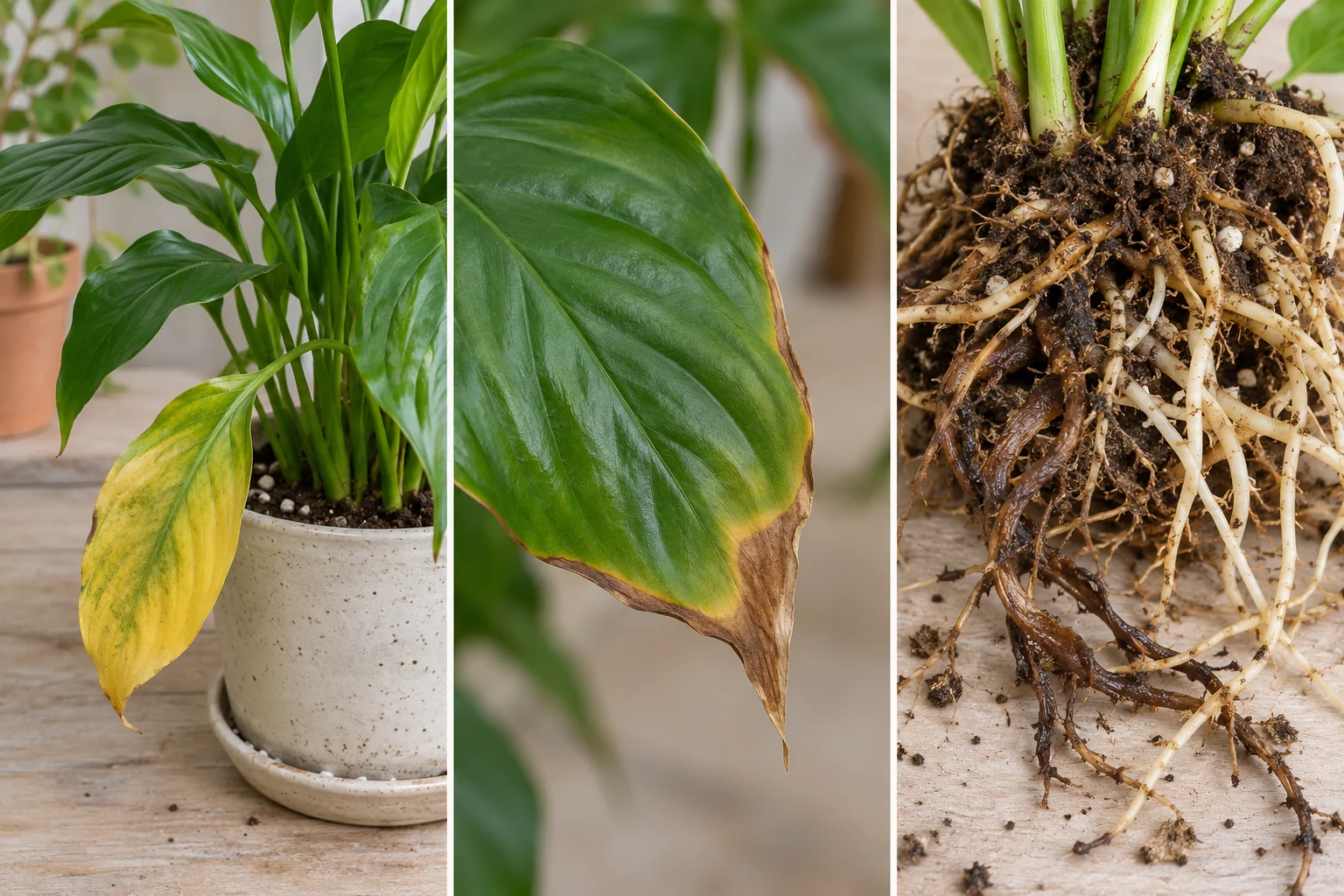
Panels, from left to right
- Yellowing foliage
- Brown leaf edges
- Damaged roots
Leaves yellow as the season ends
- Possible causes
- Normal preparation for tuber rest is possible; root damage can also cause yellowing.
- What to check
- Compare the timing and gradual whole-plant change with substrate moisture and tuber firmness.
- Next step
- If the tuber is sound and seasonal rest is developing, reduce water and prepare labeled storage.
A stem collapses beside wet mix
- Possible causes
- Basal decay or a damaged tuber may be involved; extra irrigation may worsen the problem.
- What to check
- Inspect the stem base, drainage and nearby tissue for soft spreading damage.
- Next step
- Separate the plant, stop unnecessary watering and seek a diagnosis before attempting treatment.
White powdery patches spread on leaves
- Possible causes
- Powdery mildew is a possibility, but residues and other surface changes can look similar.
- What to check
- Inspect both leaf surfaces and neighboring plants, noting whether new patches are appearing.
- Next step
- Improve spacing, isolate suspect material and obtain identification before using a suitable labeled treatment.
Store the living tuber after the display ends
As leaves naturally yellow and stems finish, reduce watering and allow the plant to wind down. Protect it from frost rather than deliberately waiting for freezing weather to force dormancy. Cure lifted tubers in a dry, sheltered place until remaining stem pieces loosen, then remove loose debris without tearing the tuber or washing it into a wet state. Keep each tuber labeled so dormant specimens remain identifiable.
Store cured tubers cool and frost-free with ventilation, protected from persistent moisture. UMN gives about 4–10°C and RHS about 7°C as useful storage conditions; these are guides, not a precise survival boundary. Methods differ between dry packing and a barely moist surrounding medium, so inspect periodically for shriveling and rot instead of watering on a schedule. Separate deteriorating tubers, and restart firm healthy ones when the next growing season approaches.
[2][1][4]A large double bloom and a smaller flower can belong together
Tuberous begonias produce male and female flowers on the same plant. In many showy hybrids the large double flower is male, with smaller female flowers nearby. Different flower forms therefore do not necessarily mean the pot contains mixed plants or that the plant is reverting. Cultivar genetics determine much of the display, including upright or trailing presentation, petal edges and color patterns.
Exhibition growers sometimes remove female flowers to emphasize a larger central bloom, but this is unnecessary for an ordinary home display. Prioritize stable moisture, adequate light and sound stems over maximizing an individual flower’s size. A seasonal reduction in flowers can accompany the approach of rest. The name Nonstop describes a cultivated series and its flowering performance; it should not be read as a promise of endless winter bloom in a dim room.
[1][3][8]The stored tuber needs the same safety attention as the plant
NC State classifies Begonia species as toxic to cats and dogs, identifying soluble calcium oxalates and noting that underground parts are particularly hazardous. Ingestion can cause signs such as vomiting and salivation. This is genus-level guidance, not a safe-dose calculation for a particular hybrid. Keep foliage, dropped flowers, cuttings and especially stored tubers beyond the reach of pets and children.
Label tuber bags clearly and keep them separate from edible bulbs, potatoes and food storage. A dormant tuber may look unremarkable, but losing the leaves does not make it safe to eat. After suspected ingestion, contact a veterinarian, poison-information service or appropriate medical professional promptly and provide the plant’s name or photograph. Do not attempt a home antidote or assume that ornamental begonias are suitable for tasting.
[10]Plan the next season while the cultivar is identifiable
Before the foliage disappears, photograph the flowers and record whether the plant was upright or trailing, how much light it received and what interrupted its display. Pair those notes with the tuber label. That information is more useful next spring than judging a dormant tuber by size alone. A larger tuber does not guarantee a particular flower size, and an unfamiliar stored tuber may belong to a different cultivar.
Day length affects tuber formation and rest, and commercial production can modify flowering with controlled lighting. Home growers should not copy a production lighting schedule without a reason and suitable equipment. Modern hybrids differ in their responses, so treat the plant’s observed seasonal behavior as evidence. For most households, supporting a healthy growing season and managing the resting tuber is a more practical objective than trying to eliminate its seasonal rhythm.
[9][2]Choose the form that suits the available space
Large-flowered upright forms suit sheltered pots with careful support, while cascading types such as the Illumination Series are selected for hanging displays. Compact Nonstop types offer another habit. These names describe horticultural selections rather than separate wild species with different native ranges. Buy a labeled cultivar when growth habit, flower form or future identification matters.
Do not use a generic begonia picture to assume that all begonias form dormant tubers. Begonia boliviensis hybrids, wax begonias and winter-flowering hybrids may appear beside this group in shops but need their own identification and care context. This profile focuses on the familiar tuberous flowering hybrids. Choose among them for your actual light, ventilation and storage space, including where the plant will rest after the decorative season.
[1][8][7]Frequently asked questions
Can I keep a tuberous begonia leafy all winter just by bringing it indoors?
Do not plan on it as an evergreen houseplant. Traditional tuberous hybrids normally enter a resting phase even under cover, and day length as well as temperature influences that transition. Modern cultivars and production lighting can alter timing, but moving the pot indoors does not remove the need to recognize and manage its seasonal behavior.
[2][4][9]Which face of a bare begonia tuber belongs on top?
The concave, hollow or visibly bud-bearing face points upward. Set it near the surface with only a thin covering of an airy mix, and avoid letting irrigation collect in the hollow. If orientation remains uncertain, look for emerging buds rather than burying the tuber deeply and hoping shoots will find their way.
[2][3]Why did a newly planted tuber rot before it produced a full plant?
An unrooted or barely rooted tuber uses little water and is vulnerable in saturated mix. A large wet container or water sitting in its hollow can contribute. Assess firmness and signs of decay before restarting care; watering it like a mature flowering basket is inappropriate. Begin with a sound tuber and modest, controlled moisture.
[2][3]Does a large tuber guarantee giant double flowers?
No. Flower form belongs to the cultivar, and the number of growing shoots and the quality of the season also affect the display. A large tuber can support substantial growth, but it does not change a small-flowered cascading selection into an exhibition type. Choose the desired cultivar rather than buying by tuber diameter alone.
[2][3]Why does my double begonia also carry little single flowers?
Male and female flowers can occur together on the same plant. Many hybrids have a conspicuous double male flower accompanied by smaller female flowers. This pattern is normal and does not by itself indicate a mixed pot or deteriorating cultivar. The smaller flowers may be left for a natural, abundant display.
[1][3]Must I remove the female flowers to keep the plant healthy?
No. Removing them is an optional show-growing technique aimed at emphasizing selected blooms, not a health requirement. For a home pot, attention to moisture, light, support and spent material is more useful. Avoid breaking a brittle stem while attempting to manipulate every flower cluster.
[1]Should I thin a hanging begonia as heavily as a show specimen?
Usually that defeats the purpose of the basket form. Cascading selections are often valued for many flowers rather than a few exceptionally large ones. Follow the cultivar’s growth habit and remove only what is needed for health or shape. Exhibition instructions for upright large-flowered plants should not be applied automatically to every tuberous begonia.
[2][3]Can I divide a dormant begonia tuber like a seed potato?
Do not cut it into arbitrary dormant pieces. Successful division requires carefully chosen growing material and carries a rot risk; published advice differs on its suitability for home growers. Young stem cuttings are the preferred method here. A whole healthy tuber kept for next season is often more valuable than several wounded pieces that fail.
[1][2]Why did my saved seed not produce the same flower color?
Tuberous begonias are complex hybrids, and seedlings do not necessarily reproduce the parent’s exact combination of color, petal form and habit. A cultivar label describes selected material, not a guarantee about every seed it produces. Use vegetative propagation when retaining those specific traits is more important than exploring variation.
[2][3]Are yellowing leaves at the end of the season a reason to discard the tuber?
Not automatically. Gradual seasonal yellowing can mark the normal transition into dormancy. Reduce active-growth care and examine the tuber’s condition when preparing it for storage. A firm sound tuber is different from one that is soft or rotting; the distinction depends on condition, not simply on the disappearance of leaves.
[4][2]Can a stored tuber stay in its original pot?
In a suitable dry, frost-free place, some growers store dormant tubers in their pots. Others lift, cure and pack them separately, which makes labeling and inspection easier. The essential issue is preventing prolonged wetness and monitoring deterioration. Do not keep watering the pot because other houseplants nearby still need irrigation.
[4]Should I pull off stems that remain attached during curing?
Wait until they loosen naturally rather than tearing them from the tuber. A firmly attached stem can indicate that curing is not complete, and force may create a wound. Keep the material sheltered and dry while checking for decay. Remove loose debris carefully once it releases, then place the labeled tuber into appropriate storage.
[4][2]Is Nonstop a promise that this begonia never rests?
No. It is the name of a horticultural series, not an assurance of continuous flowering under every indoor condition. Light duration, temperature and cultivar affect development, and dim winter rooms are not equivalent to controlled production environments. Observe the actual plant and manage a resting tuber when growth winds down.
[8][9]Can I store begonia tubers beside potatoes where pets can reach them?
Keep them clearly labeled, separate from food and inaccessible to pets and children. NC State identifies the underground parts of begonias as particularly hazardous and lists the genus as toxic to cats and dogs. A leafless tuber is not harmless because it is dormant. Seek professional advice promptly if it is swallowed.
[10]Compare related plants
- Ivy geranium: Ivy geranium also offers a trailing flowering display, but prefers considerably more sun and does not use the same dry tuber-storage cycle.
- Moth orchid: Moth orchid is another indoor flowering option, but its evergreen leaves, exposed crown and orchid potting medium require a different approach from a seasonal begonia tuber.
Care reminders with PlantPal
Keep the cultivar name, bloom photographs and tuber-storage notes together in PlantPal for a clearer restart next season.
Save this begoniaSources and fact checking
- RHS: begonias outdoors, including tuberous hybrids
- University of Minnesota Extension: tuberous begonias
- American Begonia Society: growing tuberous begonias
- American Begonia Society: storing tuberous begonias for winter
- Penn State Extension: begonia diseases
- Cornell Greenhouse Horticulture: begonia diseases
- Clemson Extension: begonia
- RHS: begonia Nonstop Series
- University of Alaska Fairbanks: photoperiod and Nonstop tuberous begonias
- NC State Extension: Begonia safety
- NC State Extension: tuberous begonias