 Plant
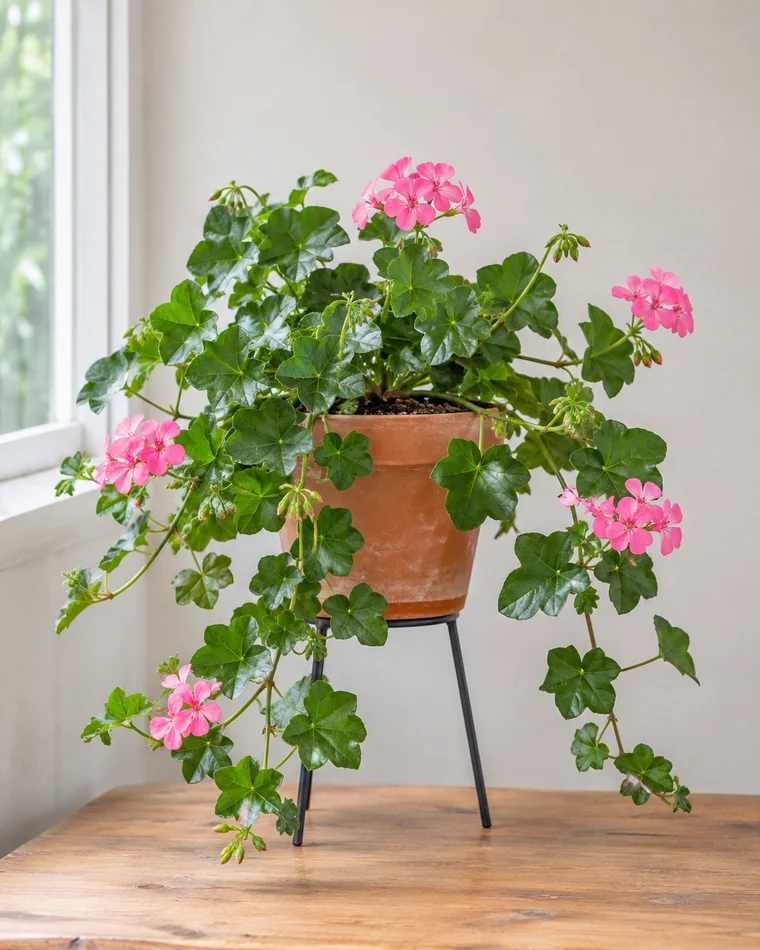
Ivy geranium.
Pelargonium peltatum
Ivy geranium combines trailing stems, glossy lobed leaves and colorful flower clusters. Pelargonium peltatum is a frost-tender South African species behind many cultivated ivy-leaved selections. It can grow indoors when the window is sunny enough, or spend the warm season outside before returning to protection. Its most useful care clues are flower production, the spacing of new growth and the condition of leaf undersides, where moisture-related blisters may appear.
How to help it thrive.
Checked:
Quick care reference
- Botanical identity: Pelargonium peltatum, not Hedera ivy or hardy Geranium.
- Provide strong light and direct sun, with protection from scorching heat behind glass.
- Allow a drying interval between moderate waterings and drain the container fully.
- Use an airy potting mix and a secure basket or raised pot with inspection access.
- Protect from frost; a bright cooler winter position can reduce weak growth.
- Pinch for branching deliberately, then allow shoots to develop flower clusters.
- Corky leaf blisters may be oedema; inspect for mites and other look-alikes.
- Pelargonium is toxic to cats and dogs and may irritate sensitive skin.
A flowering trailer for a sunny position
Ivy geranium is Pelargonium peltatum, a South African member of the geranium family, Geraniaceae. Its fleshy, ivy-shaped leaves and trailing stems make it well suited to a raised pot or hanging basket. Despite the familiar common name, it is neither English ivy nor a frost-hardy cranesbill geranium. The wild species also contributes to many cultivated ivy-leaved pelargoniums, so a retail plant may be a named selection or a hybrid.
Indoors, light is the deciding limitation. A sunny window or conservatory can support an attractive plant, while a dim shelf is likely to produce long stems and few flowers. Think of it as a sun-loving flowering container plant that can be grown or overwintered inside when conditions fit. Planning its winter light and usable trailing space matters as much as choosing a flower color.
[1][2][10]Look for shield-like leaves on trailing stems
The leaves are rounded and shallowly lobed, often with a glossy or somewhat fleshy feel. Their stalk attaches within the leaf blade rather than simply at its edge; this shield-like attachment is the feature described by the name peltatum. Flower clusters stand above the foliage on stalks. White, pink and red are familiar colors, with single, semi-double and double forms represented among cultivated plants.
A dark leaf zone or a particular flower shape may belong to a cultivar, so neither feature alone proves the exact species or parentage. Compare the whole growth habit with the label. English ivy has a different botanical identity and should not inherit this plant’s flowering or safety advice. Keep the purchased cultivar name if available, especially when replacing a successful basket or sharing cuttings with someone who needs accurate identification.
[2][3]Enough sun to make flowers, with protection from scorching heat
Provide strong light with substantial direct sun. A bright window is useful only if the plant actually receives light at leaf level; a basket hung high above the window may be much darker than the glass below it. Low light promotes stretched stems and disappointing flowering. If the available position cannot supply sun, supplemental lighting may help, but this is not a naturally low-light houseplant.
Acclimatize a plant that has been grown under cover before placing it into stronger outdoor sunshine. In a very hot window or conservatory, protect it from scorching midday exposure while maintaining overall brightness and airflow. Partial shelter during the harshest heat is different from moving it into deep shade. Observe new growth and flower production over time rather than interpreting one hot afternoon’s drooping as proof that all sunlight is unsuitable.
[2][3][4]Moderate watering with a real drying interval
Let the container mix dry between waterings, then wet the root ball evenly and allow excess water to escape. An established ivy geranium can withstand some dryness, but repeated severe drought reduces the quality of a flowering display. Its fleshy leaves are not a reason to leave a small sun-exposed basket unattended indefinitely. Check the substrate and the weight of the pot rather than relying on leaf gloss alone.
Reduce watering as light, temperature and growth decline. Cool, cloudy conditions can leave the roots taking up more water than the leaves lose, contributing to oedema in susceptible plants. That is a reason to review the whole environment, not to impose extreme drought. Water into the mix without repeatedly wetting flower clusters, and ensure a decorative outer container does not trap runoff around the root ball.
[2][3][7]A draining container that can carry trailing growth
Use an aerated container mix with dependable drainage. A suitable peat-free multipurpose or loam-based potting medium can work; dense garden earth compressed into a hanging basket is a poor substitute. Match the container to the established roots and the weight of the trailing plant. Light basket mixes and secure supports make practical sense, but no mixture can compensate for a pot with no drainage outlet.
Repot when roots and the condition of the medium justify it, often as active growth resumes. Maintain the previous planting level around the stem base and avoid surrounding a small root ball with a large volume of wet mix. Before hanging the pot, check the hook, hanger and watering access. The arrangement should let you inspect the foliage undersides and remove spent clusters without tugging stems or spilling drainage onto another plant.
[3][2]Frost protection and a bright, cooler winter option
Ivy geranium is a tender perennial. Bring an outdoor plant into protection before frost, and acclimatize it again when returning it outside after cold weather. A cool, bright indoor position can be easier to manage in winter than a dark heated room, because warmth without enough light encourages weak growth. University guidance for indoor pelargoniums includes roughly 16–18°C as a useful cool-room range, not an exact survival boundary.
Keep leaves off cold window glass and avoid placing the basket directly in hot, drying air from a heater. At the other extreme, a poorly ventilated sunroom can overheat even when the outdoor air seems moderate. Temperature, light and watering must be considered together. Do not use the winter treatment of hardy outdoor Geranium species as evidence that this Pelargonium can safely remain outside through freezing conditions.
[3][4]Support flowering without feeding a light-starved plant
Established ivy geraniums in active growth benefit from an appropriate container-plant fertilizer. A balanced product can support new growth; flowering programs often use a higher-potassium feed once buds develop. Follow the product’s label and take account of nutrients already included in the mix. More fertilizer does not provide the energy that a poorly lit window fails to supply.
Feed in proportion to actual growth rather than automatically continuing a summer program after the plant moves inside. A cool plant that is barely growing needs much less, and a deliberately rested plant should not be fed. If a formerly productive basket stops blooming, examine sunlight, pruning history, moisture and root condition before increasing nutrition. Keep a record of the product and application so salt buildup or overlapping feeds do not become invisible variables.
[3][4]Encourage branching while keeping a trailing outline
Pinching young shoot tips can encourage side branches and a fuller basket. Do it while the plant is actively growing and leave enough healthy foliage to support recovery. Long trailing stems are part of the plant’s habit, so the goal is balanced growth rather than forcing it into an upright shrub. Remove broken or declining material carefully without tearing the adjacent stems.
Regular removal of spent flower clusters helps maintain the display. A substantial prune changes the flowering timetable because new shoots must grow before they carry flowers; do not combine constant tip removal with an expectation of uninterrupted bloom. An older plant may become woody or awkward, and healthy cuttings can provide a smaller replacement. No fixed number of years determines when every ivy geranium must be discarded.
[3][2]Root healthy shoots to preserve a favored selection
Take an approximately 8–10 cm tip cutting from a healthy, preferably nonflowering shoot during active growth. Remove lower leaves and any flower buds so the base can enter the propagation medium cleanly. Use clean cutting tools and allow the fresh cut surface to air-dry before insertion, as advised for Pelargonium by Illinois Extension. Do not confuse this short preparation with leaving a leafy cutting unwatered until it becomes severely wilted.
Insert the base into an airy, lightly moist rooting medium in a draining container and place it in bright indirect light. Maintain enough humidity to prevent severe wilting while avoiding stagnant, saturated conditions; any cover needs ventilation and must stay out of direct sun. Pot on after a usable root system and continuing growth develop. Never take replacement cuttings from a plant with unexplained progressive spotting or collapse, because infected material can carry disease forward.
[5][6][9]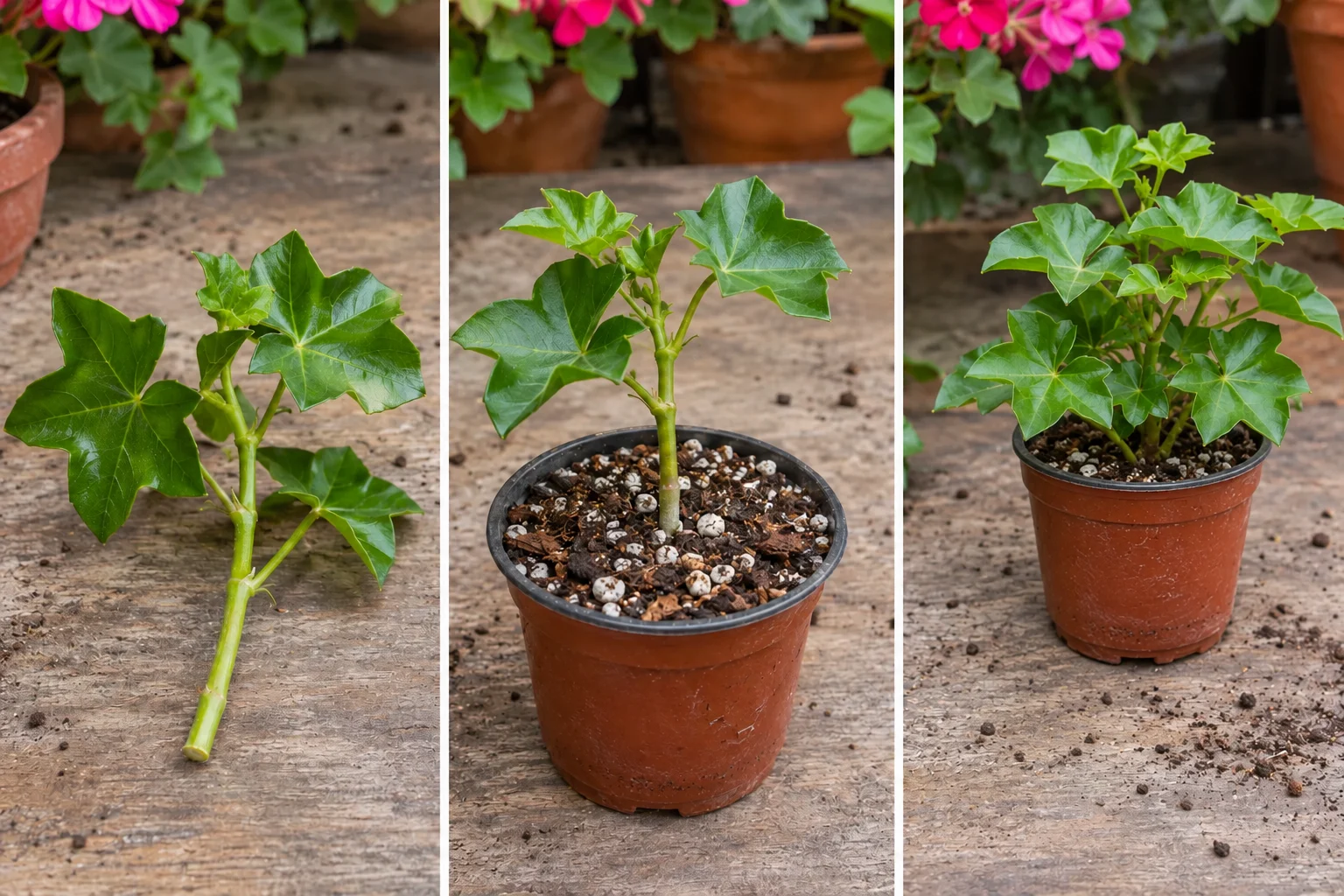
Panels, from left to right
- Prepare a healthy nonflowering tip cutting about 8–10 cm long and remove its lower leaves and buds.
- Let the cut surface air-dry, then insert the base in airy lightly moist rooting mix under bright indirect light.
- After roots and sustained growth establish, pot individually and introduce stronger light gradually.
Check for pests before explaining every blemish as oedema
Spider mites, mealybugs and other insects can affect ivy geraniums, and outdoor plants may also attract leaf-feeding caterpillars. Inspect leaf undersides and growing tips when bringing a basket indoors. On this plant, mite damage can resemble oedema rather than showing the familiar pattern seen on some other houseplants. A hand lens and a search for the organisms themselves are more informative than assuming the cause from one photograph.
Separate a suspect plant and keep fallen flowers and dead leaves out of crowded foliage. Fungal and bacterial problems also occur, so do not spray for insects merely because a leaf is discolored. Identify the pest or disease and use only a suitable labeled treatment when needed. Repeated improvised sprays risk damaging leaves while allowing the real problem, such as contaminated propagation stock or poor airflow, to continue.
[2][8][9]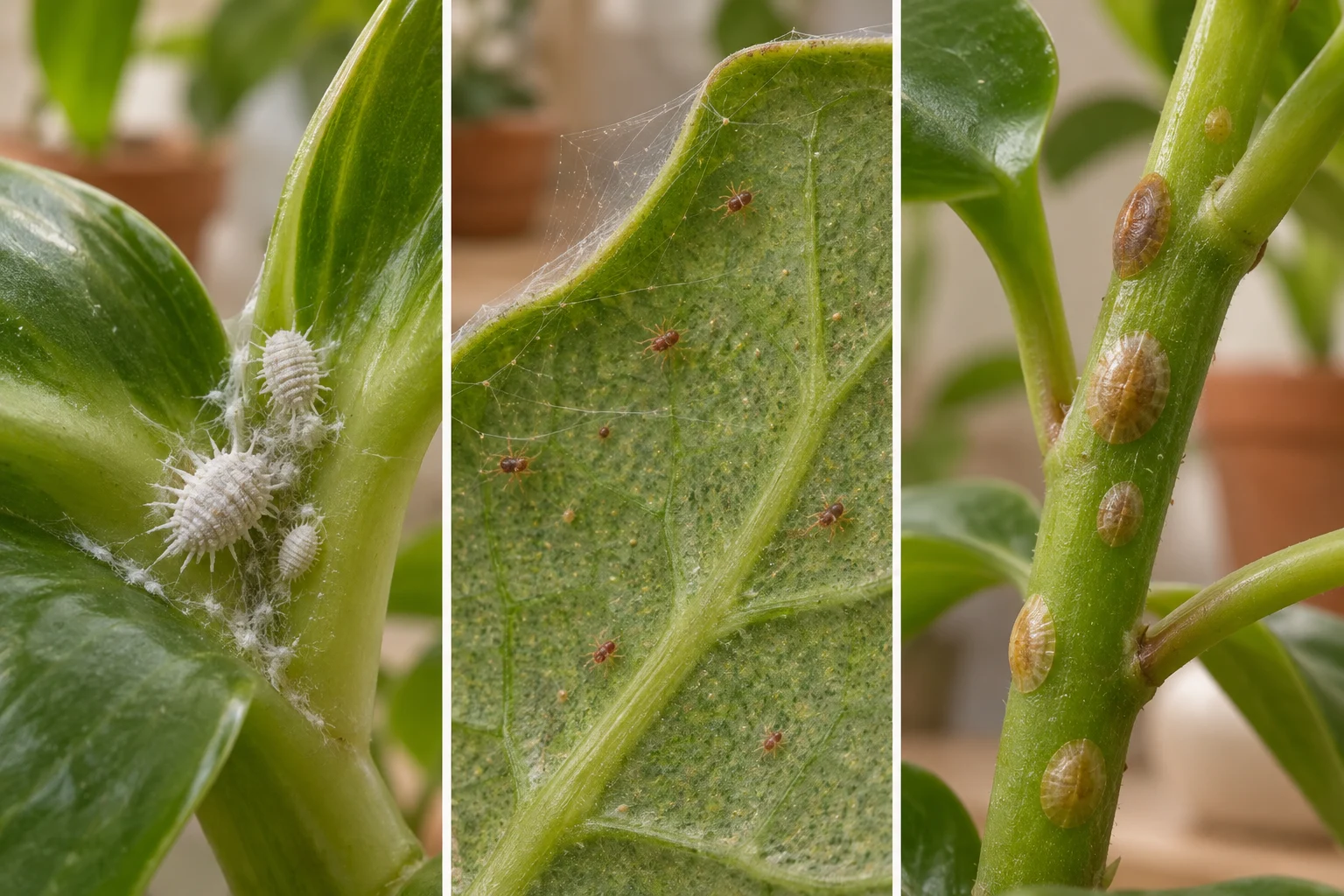
Panels, from left to right
- Mealybugs
- Spider mites
- Scale insects
Corky blisters need an environmental and pest check
Oedema begins as small swollen areas, often on the undersides of leaves, that may become tan or brown and corky. It results from a mismatch between water uptake and water loss and is not itself a contagious infection. Cool humid air, limited light and poor ventilation can contribute. Cultivars differ in susceptibility, and the condition cannot be reduced to one universal rule about how wet the mix must be.
Similar-looking injury can be caused by mites or thrips, while progressive spotting and decline can involve disease. Examine the youngest leaves and undersides, review recent conditions and avoid scraping blisters as if they were scale insects. Existing corky scars will remain; judge improvement by healthier new foliage. If spots spread rapidly or stems deteriorate, isolate the plant and seek a reliable diagnosis rather than continuing to assume a harmless physiological cause.
[7][8]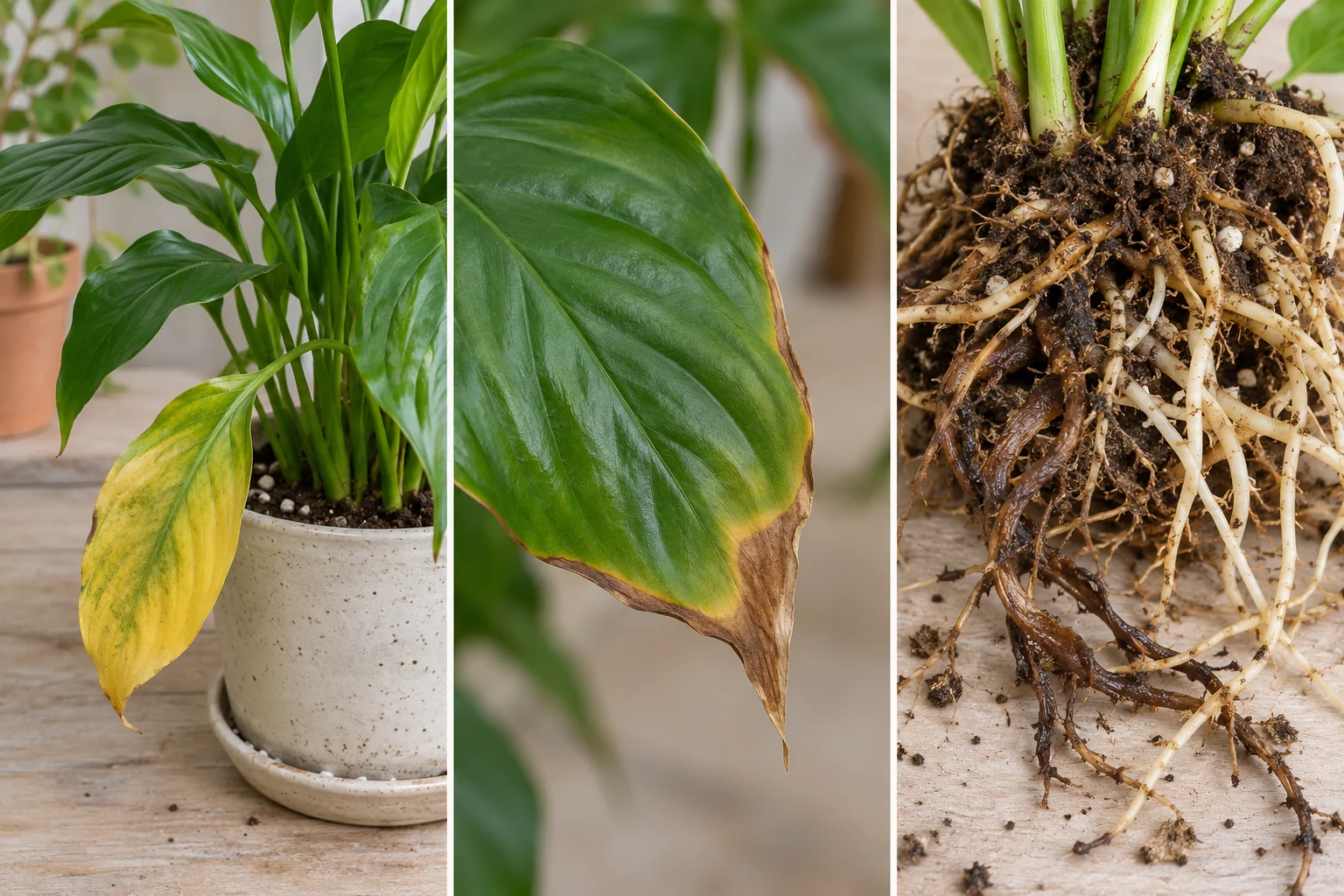
Panels, from left to right
- Yellowing foliage
- Brown leaf edges
- Damaged roots
Corky blisters under leaves
- Possible causes
- Oedema is possible, but mite or thrips injury can resemble the same pattern.
- What to check
- Examine the undersides and newest leaves with magnification and review cool humid conditions.
- Next step
- Identify any pests, improve airflow and adjust watering to current growth; assess recovery on new leaves.
Long trails with few flowers indoors
- Possible causes
- Insufficient light or repeated tip removal may limit flowering; root stress is another possibility.
- What to check
- Measure the actual exposure of hanging foliage and review pruning and moisture history.
- Next step
- Provide a sunnier suitable position gradually and allow healthy shoots time to develop buds.
Progressive spotting with stem decline
- Possible causes
- A disease problem may be involved, including bacterial infection; appearance alone cannot confirm it.
- What to check
- Inspect the pattern across the plant and note whether neighboring plants or cuttings show changes.
- Next step
- Isolate the plant, avoid taking cuttings and seek a diagnostic assessment before treatment.
Choose an overwintering strategy before the basket comes inside
Before moving an outdoor plant indoors, inspect the entire basket and select a bright location with space around the trailing stems. Keep it growing if light is sufficient, adjusting irrigation to the slower indoor drying cycle. Alternatively, maintain it more quietly in a cool, light, frost-free place with sparing water. Neither approach means leaving an actively leafy plant in a dark, wet corner.
Healthy rooted cuttings can occupy less winter space than a large old basket, but they still need adequate light and careful watering. When the next growing season arrives, resume feeding and more active watering in response to new growth. Trim for shape if needed and acclimatize to outdoor exposure after frost danger passes. Use your local season and the plant’s activity rather than treating Northern Hemisphere month names as universal instructions.
[3][4]Flower clusters depend on light and growing shoots
Cultivated ivy geraniums can produce a long warm-season display, with flower clusters held above their trailing foliage. Single, semi-double and double selections provide different visual effects. Indoors, continued flowering depends strongly on adequate light; a plant moved from a bright balcony into a dim room may retain foliage while producing few new buds. That change is not automatically a nutrient deficiency.
Remove spent clusters without repeatedly cutting away all new growing tips. If the plant has recently been pruned, allow time for replacement shoots to develop. Sustained drought, a poorly functioning root system or excessive heat can also interfere with the display. There is no fixed age at which every cutting must flower and no guarantee of year-round indoor bloom, even for a cultivar that performs for months outdoors.
[2][3]Keep trailing foliage away from pets and food
NC State lists Pelargonium species as toxic to cats and dogs, with geraniol and linalool identified as toxic principles. Reported effects include vomiting, reduced appetite, lethargy and skin irritation. NC State also notes contact dermatitis. Do not infer safety from the familiar word geranium, from the pleasant reputation of scented pelargoniums or from the absence of a strong fragrance on this plant.
A hanging basket can still be reached by a climbing cat, and its dropped leaves or pruning waste may fall within a pet’s reach. Place it thoughtfully, collect cuttings and wear gloves if your skin is sensitive. Do not use unidentified ornamental leaves in food or homemade remedies. After suspected ingestion or a concerning reaction, contact a veterinarian or appropriate medical professional and provide the botanical name; avoid home antidotes.
[2]Compare new leaves before changing several variables
Record the position of affected leaves, the date of watering and whether a spell was cool and cloudy. On an oedema-prone ivy geranium, that history may explain why damage appeared even though the same watering amount worked during sunny weather. Include close photographs of the underside and newest leaves when asking for advice, since pest injury and physiological blisters can overlap visually.
For an indoor display, evaluate the light at the height where the leaves actually hang rather than at the windowsill below. Adjust one practical limitation at a time and monitor subsequent growth. If recurring problems belong to a particular cultivar despite sound care, choosing a less susceptible selection may be more effective than endless environmental fine-tuning. Keep healthy propagation stock separate from plants being investigated for unexplained disease.
[8][9]Distinguish ivy forms from interspecific pelargoniums
Ivy-leaved selections range from simple flowers on long trails to fuller double blooms on more compact plants. Pelargonium peltatum is an important parent of this horticultural group, while modern interspecific cultivars may combine ivy and zonal ancestry. A seller’s common label does not establish exact parentage. Retain the cultivar name and use breeder information when a claim about compactness, heat tolerance or disease resistance matters.
This account should not be transferred wholesale to regal pelargoniums, scented-leaf collections or hardy cranesbill geraniums. Choose a form whose mature trailing habit fits your window or basket, and allow for access to the pot throughout the season. A flower color alone is not a reliable identification feature. Keeping the botanical group clear helps explain why two plants both sold as geraniums may behave quite differently in winter.
[3][4][10]Frequently asked questions
Is ivy geranium a type of English ivy?
No. Ivy geranium is Pelargonium peltatum in Geraniaceae; the ivy reference describes the leaf shape. English ivy belongs to Hedera and has different growth and care characteristics. Use the botanical label when comparing advice, particularly for flowering, overwintering and pet safety. A similar leaf outline does not make the two plants interchangeable.
[1][2]What does peltatum describe on the leaf?
It refers to a shield-like, or peltate, leaf attachment: the leaf stalk joins within the blade rather than simply at its margin. Look at the underside of an intact leaf without bending the brittle stalk. This feature, together with trailing stems and the flower clusters, helps distinguish the ivy-leaved form from other plants sold as geraniums.
[2]Why did my balcony basket stop flowering after moving to the living room?
The reduction in light is a likely factor, especially if new stems are longer and more weakly spaced. Ivy geranium needs strong light to flower well, and an indoor position can be much dimmer than a balcony. Review light at the leaves, recent pruning and root moisture before increasing fertilizer in an attempt to restore blooms.
[2][3]Can a basket hung above a sunny window still be too dark?
Yes. The room may look bright while leaves above or beside the glass receive little direct light. Check the actual position of the trailing foliage at different times of day. Lower or relocate the basket safely, or provide appropriate supplemental light, while keeping enough space to inspect and water it without damaging stems.
[2][4]Are corky bumps under ivy-geranium leaves always scale insects?
No. Oedema can create blisters that later become brown and corky, and mite or thrips injury can look similar. Use a hand lens to look for actual pests and review whether conditions have been cool, humid or poorly ventilated. Do not scrape the leaf surface or apply an insect treatment solely because the bumps resemble shells.
[7][8]Can oedema spread from my ivy geranium to the next plant?
Oedema itself is a physiological response, not a contagious pathogen. However, a similar-looking symptom may have another cause, including pests or disease. Confirm the problem before assuming neighboring plants are unaffected. Improving the environment can prevent new damage, but the old corky marks generally remain and should not be used alone to judge recovery.
[7][8]Why should I inspect for mites even without obvious pale stippling?
On ivy geraniums, spider-mite injury may resemble oedema and can affect the youngest leaves. The familiar fine pale stippling seen on other hosts is not a dependable requirement here. Examine leaf undersides with magnification and look for the mites themselves. A negative guess based only on the absence of one textbook pattern can miss an infestation.
[8]Should I force the pot bone-dry to cure leaf blisters?
Severe drought is not an appropriate universal cure. Review light, air movement, humidity and the drying interval, and confirm that pests are not responsible. Oedema reflects the balance between uptake and loss of water, with cultivar differences also involved. Adjust irrigation to current conditions while still supporting a functioning flowering plant and evaluating healthy new leaves.
[8][7]Will constant pinching make my ivy geranium flower continuously?
Pinching encourages branching, but repeatedly removing every growing tip also delays the shoots that would carry flowers. Shape the plant deliberately during active growth, then allow new branches to develop. Remove spent flower clusters separately. A fuller basket and uninterrupted bloom are not achieved by treating every fresh shoot as something that must be cut off.
[3][2]Can I renew an old woody basket with its own cuttings?
Yes, if the parent is healthy and correctly identified. Young stem cuttings can preserve a favored selection and occupy less space while overwintering. Avoid taking material from a plant with unexplained progressive spotting, blackening or decline, because infected stock can pass disease to new plants. A smaller replacement still needs strong light once established.
[3][5][9]Why let an ivy-geranium cutting’s cut surface dry before potting?
Illinois Extension includes Pelargonium among plants whose fresh cut surface should air-dry before insertion to reduce the risk associated with a wet wound. This is a preparation step, not a request to desiccate the leafy cutting for a long period. Then use an airy rooting mix with controlled moisture and observe actual root development.
[6]Can I take cuttings from the healthy-looking side of a sick plant?
That is risky when the cause of decline is unknown. Some pelargonium pathogens can be present beyond the visibly damaged part, and propagation can carry them into a new collection. Isolate and diagnose the parent first. For replacing a valued cultivar after a confirmed disease problem, healthy nursery stock may be more reliable than salvaging uncertain shoots.
[9][11]Does the word geranium mean it can survive a freezing winter outside?
No. The hardy cranesbills belong to Geranium, whereas ivy geranium is a frost-tender Pelargonium. Protect it before frost and provide a bright indoor or greenhouse position. An outdoor planting calendar written for hardy geraniums is not a suitable overwintering plan for this trailing flowering plant.
[3][2]Will seeds from my double ivy-geranium cultivar look identical to the parent?
Do not assume so. Many commercial plants are selected cultivars or hybrids, and seed does not necessarily preserve the same flower form, color or habit. Healthy stem cuttings are the practical route when retaining a specific selection is the aim. Keep its original label so a similar-looking replacement is not mistaken for the same cultivar.
[3][4][10]Is an unscented ivy geranium safe for a cat to nibble?
No. A weak or absent fragrance does not override the NC State classification of Pelargonium species as toxic to cats and dogs. Geraniol and linalool are the listed toxic principles. Keep trailing stems and dropped leaves inaccessible, and contact a veterinarian after suspected ingestion rather than using smell as a test of safety.
[2]Compare related plants
- Tuberous begonia: Tuberous begonia can also create a cascading floral display, but generally needs filtered light and a separate dormant-tuber storage phase.
- Chinese hibiscus: Chinese hibiscus is another light-demanding flowering container plant, with a more upright woody habit and a different moisture pattern from trailing ivy geranium.
Care reminders with PlantPal
Record bloom periods, winter placement and any underside leaf blisters in PlantPal to connect changes with growing conditions.
Track ivy geraniumSources and fact checking
- Kew: accepted name Pelargonium peltatum (Royal Botanic Gardens, Kew; accessed 2026-11-19)
- NC State Extension: Pelargonium peltatum
- RHS: growing pelargoniums
- University of Minnesota Extension: growing geraniums
- Iowa State Extension: taking geranium cuttings
- University of Illinois Extension: houseplant cuttings
- Iowa State Extension: blisters under ivy-geranium leaves
- UConn Extension: oedema and intumescences
- UConn Extension: bacterial diseases on geraniums
- Stellenbosch University Botanical Garden: Pelargonium peltatum
- Penn State Extension: bacterial blight of geranium
- NC State Extension: Pelargonium safety