 Plant
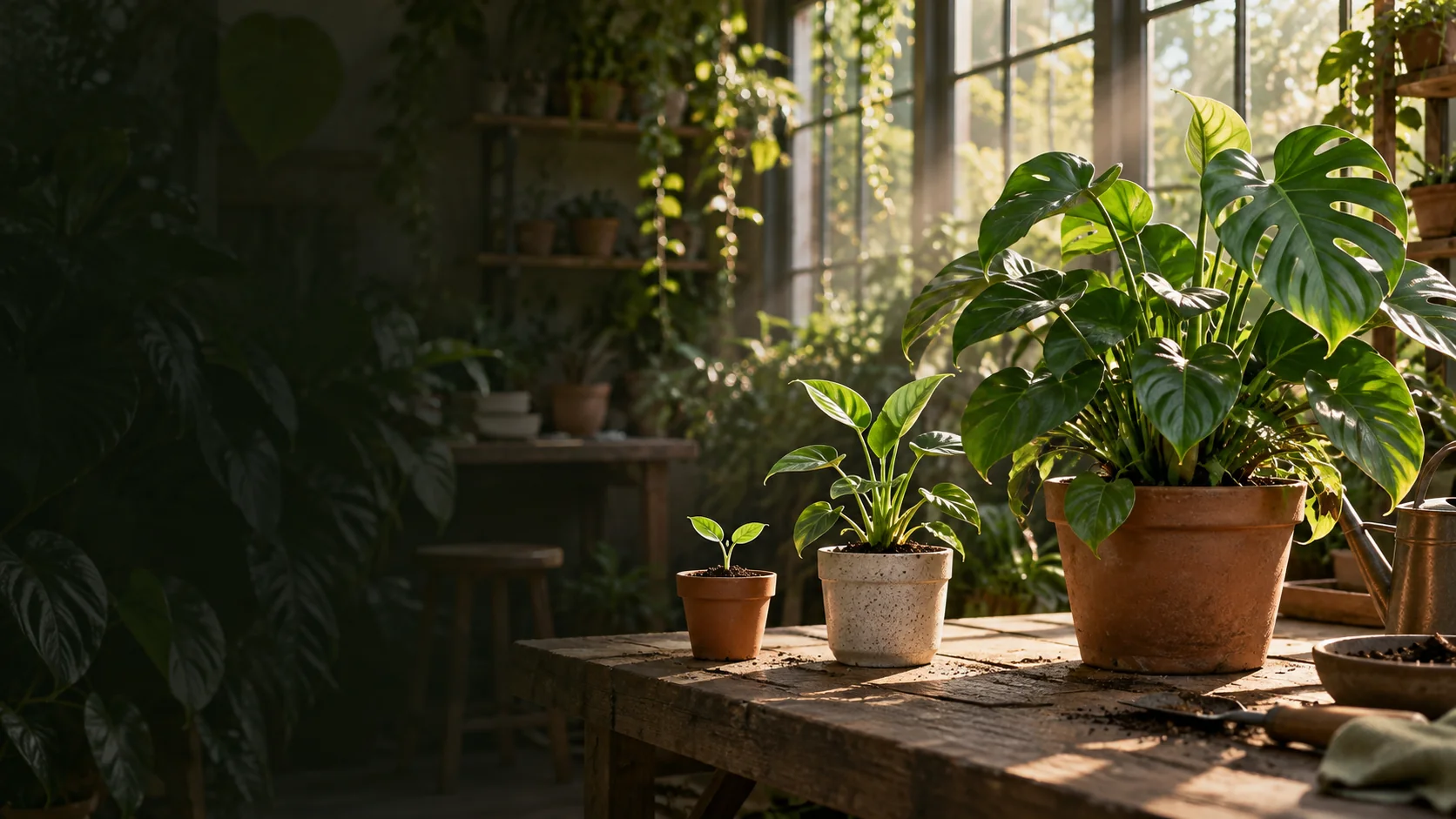
Houseplant care for beginners: a first-year routine that actually works
A grower’s starter plan for new plant owners: match plants to measured light, water by drying depth, keep the nursery pot, and hold off feeding until roots settle.
4 min readRead guide Plant careHow to water houseplants: check the pot before you pour
Learn when to water houseplants, check moisture below the surface, wet the root ball evenly, and adjust your routine as growing conditions change.
4 min readRead guide Plant careBright indirect light: how to find the right spot for houseplants
Understand bright indirect light, check the light reaching your plant, and adjust its position as windows, seasons and growth change.
4 min readRead guide Soil & fertilizerPotting mix vs. garden soil: what to use for houseplants
Choose a suitable houseplant potting mix, understand bag labels and ingredients, and avoid drainage mistakes without relying on a universal soil recipe.
4 min readRead guide Plant problemsOverwatering vs. underwatering: how to tell two wilts apart
A wilting plant can be bone dry or drowning. Use pot weight, moisture 5 cm down, smell and leaf texture to diagnose it in a minute and apply the right fix.
4 min readRead guide Plant careRepotting houseplants: when to do it, what size pot and how
Repot only for a real reason, in spring, into a pot 2–5 cm wider. A grower’s guide to the signs, pot sizing, root handling and the aftercare that prevents root rot.
4 min readRead guide Soil & fertilizerFertilizing houseplants: how much, how often and when to stop
Feed houseplants every 2–4 weeks in spring and summer, pause in low winter light, and never feed dry or damaged roots. A grower’s guide to dose, timing and warning signs.
3 min readRead guide Soil & fertilizerNPK numbers explained: what a fertilizer label really tells you
What 10-10-10 or 3-1-2 really means: percent N, P₂O₅ and K₂O by weight, how to convert to elemental nutrients, and why ratio and dilution matter more than size.
3 min readRead guide Soil & fertilizerPerlite vs. pumice: choosing the right mineral for your potting mix
Perlite is light, cheap and floats; pumice is heavier, holds some water in its pores and never breaks down. Compare them for aroids, succulents and large pots.
3 min readRead guide Soil & fertilizerCoco coir vs. peat moss: how each behaves in your pots
Peat is acidic and holds 10–20× its weight in water; coir is near-neutral but can carry salts. Compare pH, rewetting, nutrition and sustainability for houseplant mixes.
4 min readRead guide Soil & fertilizerLiquid vs. slow-release fertilizer: choosing a feeding system for houseplants
Liquid feed gives precise control; coated slow-release prills feed for 3–9 months but speed up in warm rooms. How each works, when to use it, and why not to stack them.
4 min readRead guide Plant problemsYellow leaves on houseplants: read the pattern to find the cause
Which leaves yellow, and how, points to the cause: old-leaf turnover, wet roots, low light, cold, pests or nutrients. A pattern-by-pattern diagnostic guide.
4 min readRead guide Plant problemsRoot rot in houseplants: diagnosis, rescue and prevention
Root rot starts with oxygen-starved roots in wet mix and ends with Pythium or Phytophthora. How to confirm it, cut it out, save cuttings and stop it coming back.
4 min readRead guide Plant problemsBrown leaf tips: causes, fixes and how to trim them
Brown tips mark where water and salts run out at the leaf’s edge. Trace the cause — salts, fluoride, dry air, irregular watering or damaged roots — and fix it.
4 min readRead guide Plant problemsFungus gnats: how to break the four-week breeding cycle in potting mix
Fungus gnat larvae live in the top 5 cm of damp potting mix. Learn their life cycle, how to find the source pot, and how to combine drying, BTi and sticky cards.
4 min readRead guide Plant problemsSpider mites on houseplants: catch them before the webbing
Two-spotted spider mites complete a generation in 7–10 days in warm, dry rooms. Learn the early stippling signs, how to confirm them, and a treatment schedule that works.
4 min readRead guide Plant problemsFertilizer burn in houseplants: diagnose it, flush it, recover
Brown leaf margins, dead root tips and a white crust on the mix point to soluble-salt injury. Learn how fertilizer burn happens, how to leach a pot and when to repot.
4 min readRead guide Plant careBottom watering houseplants: how long to soak and when to top water instead
Bottom watering rewets a dry root ball evenly from below. Learn soak times, which plants benefit most, why salts build up, and when top watering works better.
3 min readRead guide Plant careHow to use a plant light meter: lux readings that mean something
Lux readings help only if you take them the same way every time. Learn where to hold the sensor, what the numbers mean for plants, and the limits of phone meters.
3 min readRead guide Plant careHouseplant humidity: what actually raises it, and what doesn’t
Heated homes often drop to 20–35% humidity in winter. Learn which houseplants really need more, why misting and pebble trays barely help, and how to run a humidifier.
3 min readRead guide Plant guidesLow-light houseplants: what “tolerant” really means, in lux
Low light means roughly 500–2,500 lux, not a windowless hallway. See which houseplants truly tolerate it, how their care changes, and when to add a grow light.
4 min readRead guide Tips & tricksVacation plant care: how to prepare for one, two or four weeks away
How to prepare houseplants for a week, a fortnight or a month away: pre-trip watering, moving plants out of hot windows, tested wicks, and clear sitter instructions.
4 min readRead guide Tips & tricksQuarantine new houseplants: a four-week inspection routine
New plants are the main way pests reach a collection. How to inspect before you buy, set up a 2–4 week quarantine, and what to check weekly with a 10× hand lens.
4 min readRead guide Tips & tricksOrganize houseplants by zone: group by light, not just by room
Grouping houseplants into care zones by light, temperature and drying speed turns plant care into a quick weekly circuit. Here’s how to map your home into zones.
3 min readRead guide Soil & fertilizerTerracotta vs. plastic pots: how pot material changes watering
Unglazed terracotta loses water through its walls and dries much faster than plastic. Learn which plants suit each, why salts crust on clay, and how to adjust watering.
3 min readRead guide Soil & fertilizerAroid potting mix: a starting recipe and how to tune it
Monstera, philodendron and pothos roots need air as much as water. A 1:1:1 starting blend of potting mix, bark and perlite, and how to adjust it for your pot and light.
4 min readRead guide Tips & tricksSelf-watering pots: how wicking planters work and which plants suit them
Self-watering planters feed water up from a reservoir by capillary wicking. Learn how they work, which plants and mixes suit them, and how to avoid soggy roots.
3 min readRead guide Plant guidesMonstera deliciosa care: bright light, an airy mix, and a pole to climb
Grow Monstera deliciosa well: 10,000–20,000 lux, water when the top 3–5 cm is dry, a chunky bark mix, a moss pole, and the conditions that trigger split leaves.
4 min readRead guide Plant guidesPothos care: light, watering, and pruning for full, leafy vines
Grow a full pothos: 2,500–15,000 lux (more for variegated cultivars), water when the top quarter of the mix dries, prune above nodes, and root single-node cuttings.
4 min readRead guide Plant guidesSnake plant care: CAM, deep drying, and how to prevent base rot
Snake plant care from a grower: why CAM makes it drought-proof, watering only when 75–100% of the mix is dry, gritty soil, a 10 °C floor, and how to stop base rot.
4 min readRead guide Plant guidesZZ plant care: rhizomes, flexible light, and very little water
ZZ plant care: how its potato-like rhizomes store water, when to water (mix 75–100% dry), a 10 °C floor, light from 500 to 15,000 lux, and slow leaflet propagation.
4 min readRead guide Plant guidesPeace lily care: even moisture, clean water, and more flowers
Peace lily care: water when the top 1–2 cm dries, give 5,000–15,000 lux for flowers, keep it above 15 °C, and fix brown tips caused by salts, fluoride, or wilting.
4 min readRead guide Plant guidesRubber plant care: bright light, steady conditions, and branching
Ficus elastica care: 10,000–20,000 lux, water when the top 3–5 cm is dry, stay above 12 °C, and prune or notch to make it branch, plus how to diagnose leaf drop.
4 min readRead guide Soil & fertilizerCommon houseplant fertilizers compared: liquids, granules and organic feeds
How liquid concentrates, ready-to-use pumps, controlled-release granules and organic feeds differ in nutrient delivery, salt risk and effort indoors.
4 min readRead guide Soil & fertilizerMiracle-Gro Indoor Plant Food: a label-based guide to the 1-1-1 pump
What the 1-1-1 analysis of Miracle-Gro Indoor Plant Food means in practice, how to fit the pump bottle into a feeding program, and when to leave it on the shelf.
3 min readRead guide Soil & fertilizerEspoma Organic Indoor! plant food: using a 2-2-2 concentrate well
A label-based look at Espoma Organic Indoor! 2-2-2 liquid concentrate: how organic nitrogen behaves in potting mix, measuring dilutions, and when to hold off.
3 min readRead guide Soil & fertilizerMiracle-Gro Indoor Potting Mix: what its label means for watering and feeding
A label-based overview of Miracle-Gro Indoor Potting Mix: a coir-based, compost- and bark-free blend with starter feed, and how it changes your care routine.
3 min readRead guide Tips & tricksHow to propagate pothos from node cuttings in water or substrate
Step-by-step pothos propagation: choosing nodes, cut length, water versus substrate, 20–25 °C for rooting in 2–4 weeks, and potting up at 2–5 cm of root.
3 min readRead guide Tips & tricksHow to clean houseplant leaves without damaging them
Why dust starves leaves of light, how to clean smooth, hairy and waxy foliage safely, and why leaf shine, mayonnaise and milk do more harm than good.
3 min readRead guide