 Plant
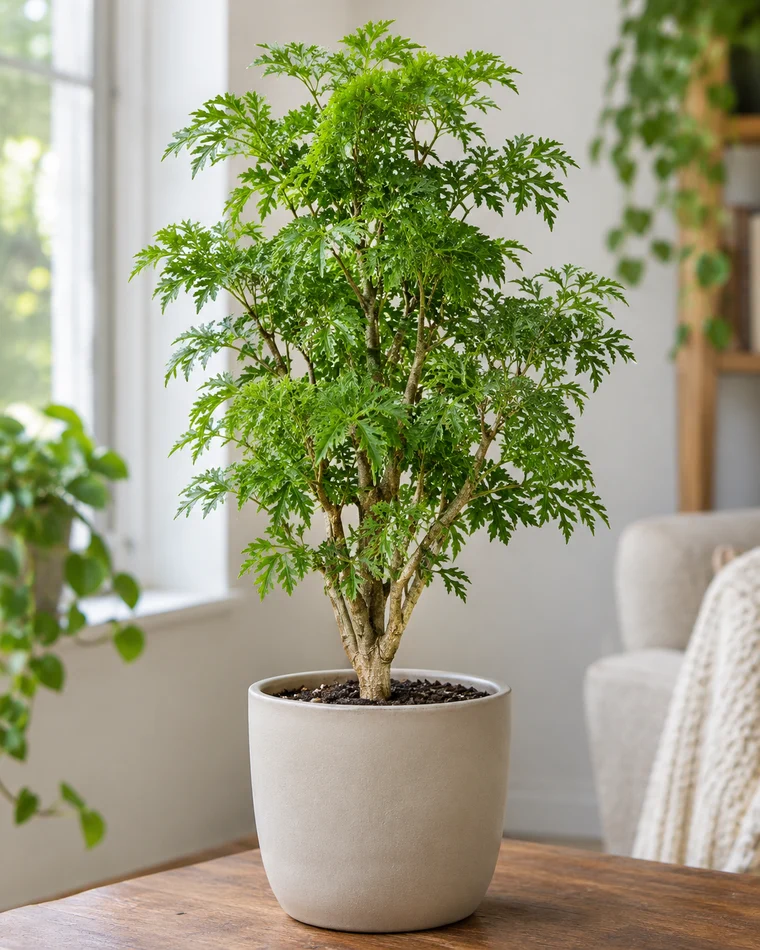
Ming aralia.
Polyscias fruticosa
Ming aralia combines a woody, upright framework with clouds of finely divided green foliage. Polyscias fruticosa rewards a stable bright position and careful root-moisture checks; its delicate outline should not be mistaken for a fern or for a plant that needs permanently wet compost.
How to help it thrive.
Checked:
Quick care reference
- Name: Polyscias fruticosa, a cultivated tropical treelet.
- Leaf structure: divided compound foliage rather than fern fronds.
- Light: bright indirect exposure across the branch tips.
- Roots: neither a saturated base nor prolonged severe drought.
- Atmosphere: steady warmth away from heating and cold draughts.
- Shape: selective tip pruning preserves the woody framework.
- Propagation: choose healthy stem nodes instead of loose leaflets.
- Pets: keep the fine clippings and dropped leaves out of reach.
A cultivated tropical treelet
Polyscias fruticosa belongs to Araliaceae. Kew describes its origin as a cultigen from Central Malesia to the Southwest Pacific, reflecting a long relationship with cultivation rather than a neatly defined untouched wild range. It forms an evergreen shrub or small tree with woody stems and foliage concentrated toward branch ends. That architecture makes a mature specimen useful as a narrow indoor accent.
Indoor size depends on the selection, light and shaping. NC State describes houseplants reaching roughly 1.8–2.4 metres, but compact nursery forms and pruned specimens can stay much smaller. Avoid buying only for the current tabletop size if you want an unpruned plant. Its relatively measured growth means a damaged crown may take time to rebuild; steady care is usually more useful than repeated drastic interventions.
[2][1]Compound leaves, not fern fronds
The airy canopy consists of compound leaves divided into many narrow, toothed or lobed leaflets. A single leaf can be branched several times, giving it a fernlike appearance. Follow the central leaf stalk back to the woody stem before deciding which part you are examining. Losing one compound leaf can look like the sudden loss of many small leaves.
False aralia, Plerandra elegantissima, has a different arrangement of long fingerlike leaflets, and other Polyscias can have much rounder blades. Ming aralia is not identified by the word aralia alone. Young shoots, older branches and compact selections may differ in fineness, so use the complete leaf structure and reliable label together. A brown woody trunk is normal; newly soft, discoloured tissue is a separate concern.
[1]Keep the fine canopy close to useful daylight
Bright indirect light supports a dense crown. Place the plant where daylight reaches the branch tips without a sudden burst of hot sun on foliage raised in shade. Its light, lacy appearance can tempt placement deep inside a room, but visual delicacy is not evidence of low-light tolerance. Watch whether fresh growth remains compact or stretches toward one side.
Outdoor tropical descriptions may include sun or partial shade; those conditions are not interchangeable with a dim interior followed by abrupt window exposure. If using a grow light, give the whole narrow crown useful coverage and a regular dark period. Evaluate new shoots over several weeks. Moving the pot repeatedly to chase an immediate response makes it harder to identify which location actually works.
[1]Keep moisture between saturation and drought
Ming aralia performs best when its roots are neither continually wet nor allowed to dry severely. NC State suggests letting approximately the upper 5 centimetres dry before watering, but that is a starting point for an established pot, not a rigid rule for a shallow cutting container. Check deeper moisture and pot weight before applying a measurement mechanically.
When watering is needed, moisten the root zone and allow complete drainage. A decorative cover pot can hide the very water that keeps a woody base too wet. Fine foliage may wilt when roots are dry, but may also decline when wet roots no longer function well. Establish which situation you have before adding water. The goal is a repeatable observation routine, not a permanently damp surface.
[1]Match the pot to the slow-moving root system
A well-drained mix that retains moderate moisture is appropriate. Fine dense soil can remain wet around the roots, while an extremely coarse, fast-drying succulent mix may create repeated drought in a warm room. Choose a structure that lets you water thoroughly without leaving the base saturated for long periods. Container drainage is part of the system, not an optional accessory.
Repot when the roots and substrate give a reason: crowding, unstable drying or a deteriorated mix. A modest increase in size is easier to manage than a deep oversized pot around a small root mass. Preserve the planting depth and handle the woody base gently. A treelet recently moved to a new home may benefit from settling before another major change, unless an active drainage problem requires action.
[1][4]Stability matters to this tropical crown
Warm air and moderate to high humidity suit Ming aralia. Keep it away from cold entrance draughts and direct blasts from heating or air-conditioning. A brief room reading can miss the conditions at the plant overnight, particularly near glass. Observe the actual position if fine foliage starts shedding after a seasonal weather change.
A humidifier can make room humidity more consistent when needed, but moisture in the air does not justify keeping the soil wetter. Repeated spraying provides only a temporary local effect and can leave a dense crown wet without fixing a dry room. Avoid sealing a large plant into a stagnant damp enclosure. Its woody structure still needs air circulation and access for inspection.
[1][4]Feed the active tips gently
Use an appropriate balanced houseplant fertilizer while the plant is producing new foliage, following the product’s dilution instructions. Its fine leaves do not mean it needs an unusually strong feed. If the potting mix already contains fertilizer, account for that before adding another product. Assess several new leaves and the condition of the roots rather than interpreting one pale leaflet in isolation.
Reduce or pause feeding when light and growth fall, after substantial root damage or during unexplained leaf shedding. Fertilizer cannot reverse a cold-draught injury. Brown tips together with crusty deposits call for a review of salts and watering practices, not an escalating dose. A steadier environment should be established before attempting to stimulate a stressed crown.
[4]Shape the woody framework in small decisions
Ming aralia lends itself to a treelet or bonsai-like silhouette because foliage gathers near woody branch tips. Pinch or shorten selected healthy shoots when growth is active to guide the outline. Preserve enough foliage to support recovery. Repeatedly shearing every tip into a tight ball can conceal the branching character that makes the plant attractive.
Remove dead twigs and inspect thin interior shoots before making larger cuts. A recently defoliated plant should not automatically be pruned to bare sticks; first determine which branches remain alive and why leaves fell. Dust can collect in the divided foliage, so use gentle cleaning rather than vigorous wiping that catches and tears leaflets. Keep tools clean and collect the small trimmings.
[1][4]Propagate a stem, not a handful of leaflets
Stem cuttings are documented for this species. Select a healthy growing shoot with nodes and enough structure to handle, rather than collecting loose leaflets from a shedding plant. Reduce foliage only as needed to keep it clear of the rooting medium. An airy, lightly moist substrate and sheltered warmth give the cutting a manageable environment while it forms roots.
Protect the cutting from intense sun and from a constantly soggy base. If using a humidity cover, ventilate it and remove decaying material promptly. Rooting time varies, so use established root growth and sustained new foliage as the signal for gradual acclimatization. A new bud alone can use stored reserves and does not prove the cutting already has a strong root system.
[1][4]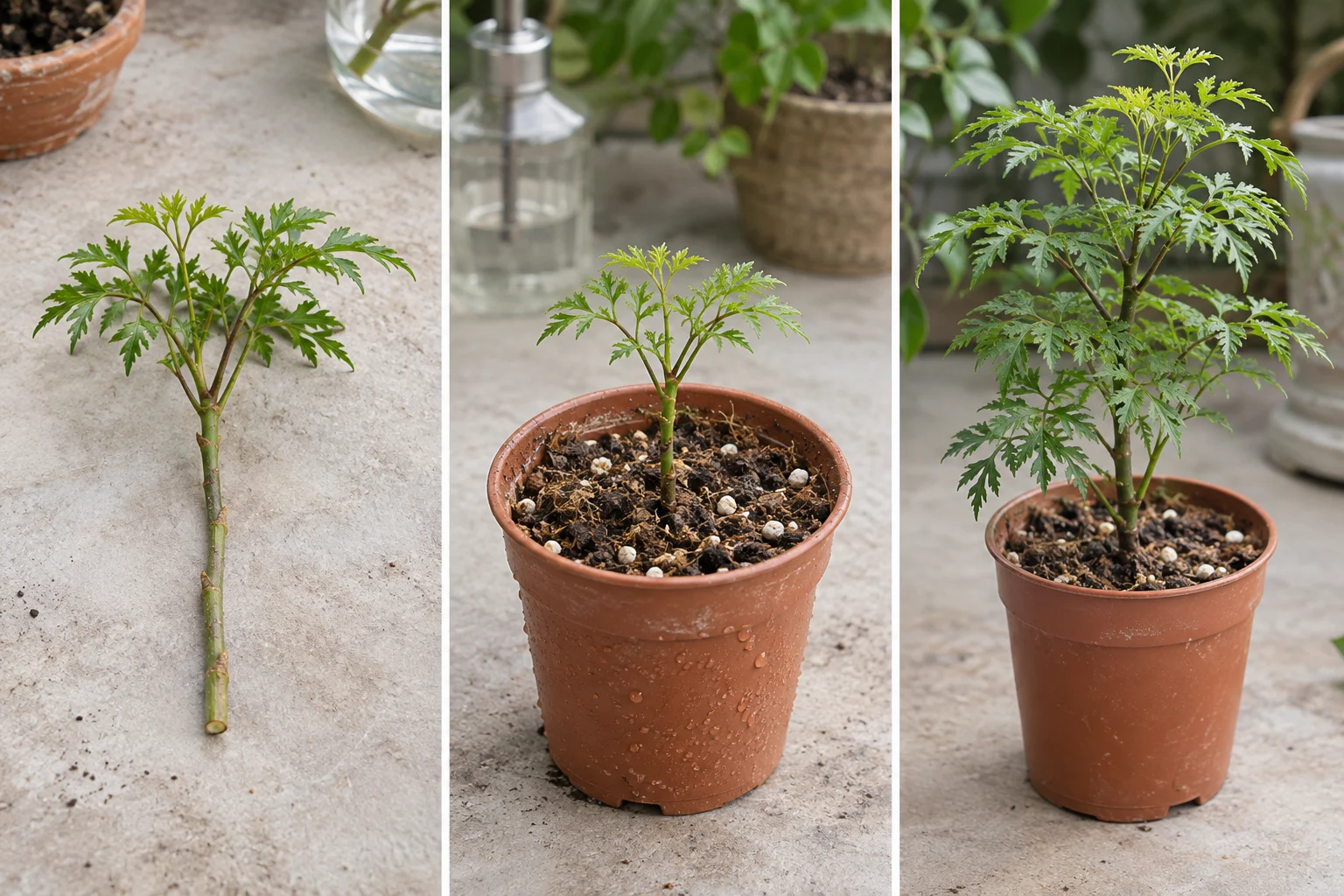
Panels, from left to right
- Take a healthy node-bearing stem tip and keep only manageable foliage above the rooting zone.
- Insert the stem into an airy, lightly moist medium and protect it from intense sun and drying air.
- Ventilate the cover and wait for established roots before acclimatizing the new treelet gradually.
Fine foliage can hide small sap feeders
Inspect leaflet junctions and branch tips for aphids, mealybugs and scale, and look for fine stippling that may accompany mites. A dense crown makes an infestation easy to overlook until several leaves have declined. Whiteflies may be noticed when the foliage is disturbed. Examine a new purchase before placing it among other finely branched plants.
Choose a response only after identifying the pest. Follow the relevant indoor-ornamental product label and test delicate foliage before broad treatment. Avoid improvised mixtures that can burn the many small leaf surfaces. Wet-soil decline is not cured by spraying the crown: root rot remains a separate possibility when the container stays saturated and growth weakens.
[1]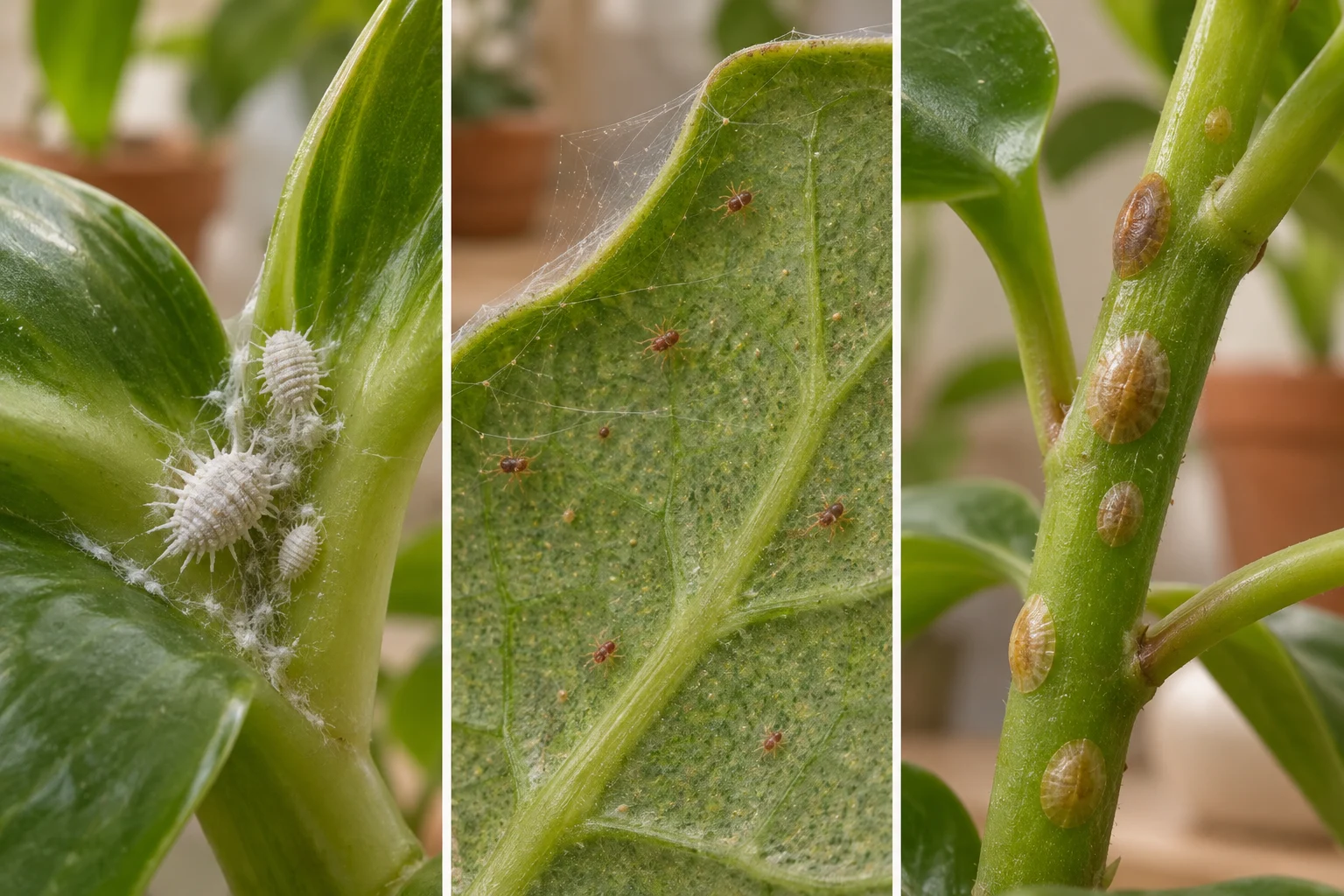
Panels, from left to right
- Mealybugs
- Spider mites
- Scale insects
Track which part of the compound leaf is falling
A shower of tiny green pieces may be leaflets, whole compound leaves or brittle dead fragments. That distinction helps describe the problem accurately. Record whether the change followed delivery, a cold night, a missed watering or a persistently wet pot. Inspect the woody base and growing tips rather than judging the entire plant from the amount of debris on the floor.
Leaf shedding can have several causes, including environmental stress, root problems and pests. Stabilize conditions and watch the surviving buds before repotting, pruning and feeding all at once. If roots are wet and the stem base is soft, investigate promptly. If stems remain firm and the root ball is dry, the immediate moisture assessment follows a different path.
[1][4]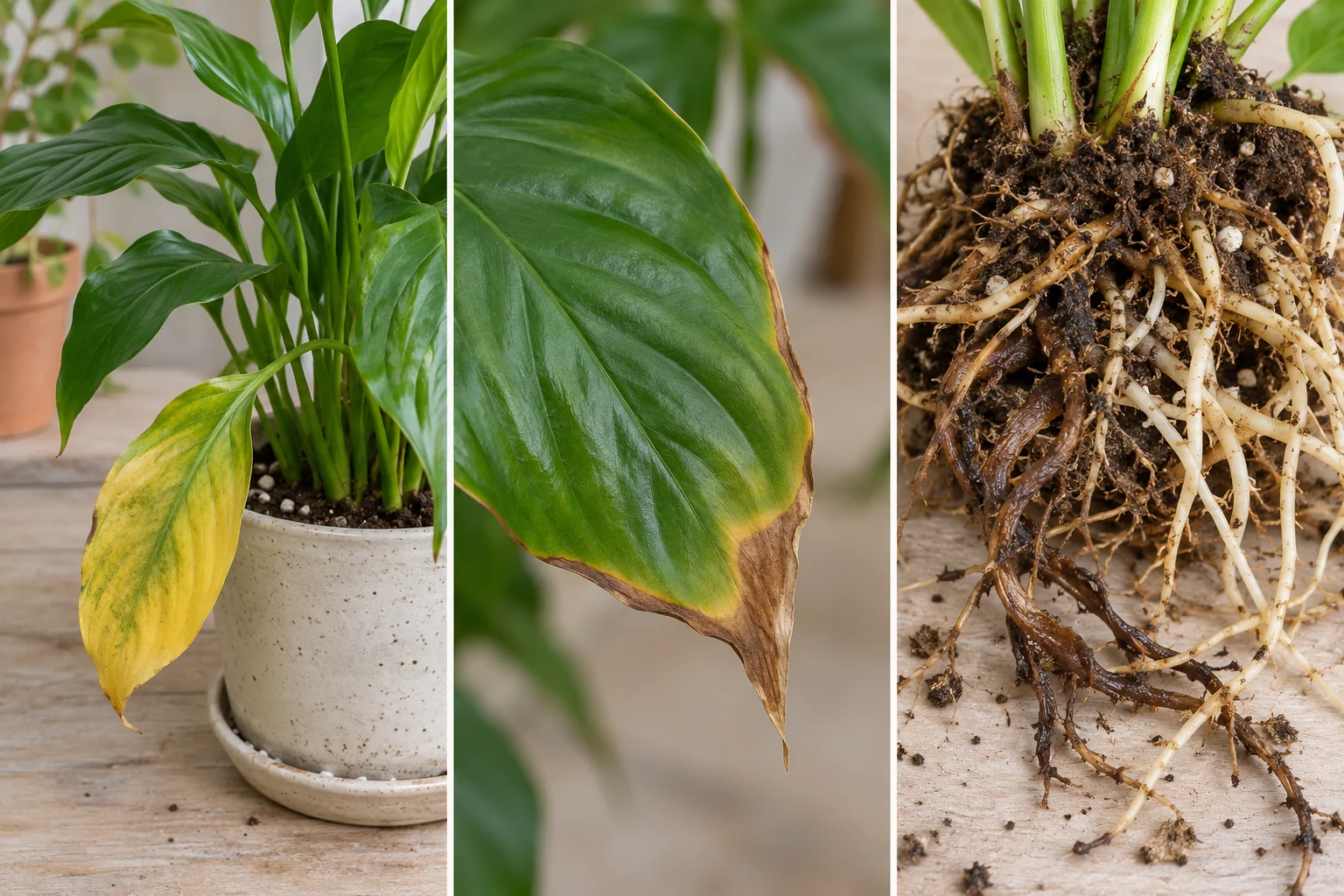
Panels, from left to right
- Yellowing foliage
- Brown leaf edges
- Damaged roots
Fine green debris beneath the crown
- Possible causes
- A compound leaf can break into many leaflets after a change in temperature, light or root moisture.
- What to check
- Identify whether whole leaves or individual leaflets are falling and compare the timing with recent changes.
- Next step
- Stabilize the environment and inspect surviving buds before making several corrective changes at once.
Drooping tips above a wet base
- Possible causes
- Saturated substrate may impair roots even though moisture remains available in the pot.
- What to check
- Check the cover pot for water and feel whether the woody base remains firm.
- Next step
- Correct drainage and investigate continuing root decline instead of repeatedly watering the wilted canopy.
Stippled foliage inside the branches
- Possible causes
- Mites or other small sap feeders may hide in the finely divided leaves.
- What to check
- Inspect undersides and leaflet junctions with magnification for webbing, moving pests or cottony deposits.
- Next step
- Isolate the plant and select a labelled treatment only after identifying the pest.
Adjust for heating and shorter days
As indoor heating starts, Ming aralia may experience drier air at the same time that window light decreases. Those changes can pull care decisions in opposite directions: foliage loses water to dry air, while the shaded root ball may dry more slowly. Check both conditions rather than assuming winter always means one universal watering schedule.
During a brighter growth period, renew the shaping plan and assess whether roots need more room. If taking the plant outdoors in warm weather, use a sheltered acclimatization period and bring it back before cold conditions arrive. Inspect for pests before the return. In climates without a pronounced winter, follow the actual pattern of light and growth rather than the names of the months.
[1][4]Foliage is the realistic indoor display
Small pale flowers can form in branched clusters of umbels on sufficiently mature plants. Fruit is possible in suitable conditions, but both flowers and fruit are rarely seen on a typical houseplant. A healthy leafy Ming aralia is not failing because it does not bloom in a room. The intricate canopy is its main ornamental contribution.
Do not switch to heavy bloom fertilizer to force a reproductive display. The flowering biology of a mature tropical plant does not translate into a dependable indoor calendar. If preserving a particular compact or finely divided form matters, vegetative propagation is more useful than expecting seed to produce an identical copy.
[1]Traditional uses do not establish pet safety
NC State flags Ming aralia as a problem for cats and dogs. Keep dropped foliage and pruning material away from animals, and avoid presenting the plant as pet-safe merely because it has a delicate appearance. A precise toxin, harmless dose or severity prediction is not established by that brief listing and should not be invented.
Some botanical sources record culinary or medicinal uses in particular traditions. Those records do not make a treated nursery plant appropriate for tasting or home remedies. Maintain clear identification and ask an appropriate medical or veterinary professional about an actual exposure. The plant-care page is for cultivation; safe use cannot be inferred from the common name Ming tree.
[1]A bonsai-like outline needs ordinary root care
A trained Ming aralia may resemble a miniature old tree, but a shallow display container changes the margin for watering error. Evaluate the root volume and drainage rather than assuming a bonsai label comes with a special fixed routine. Shape gradually and avoid removing large amounts of roots and canopy at the same time from a weak specimen.
Semi-hydro is an experiment in a different root environment, not a requirement for success. Start with a small rooted cutting if you want to learn that system, preserving an established parent in its familiar mix. A grow light can support the selected outline, but cannot replace balanced moisture or prevent all stress-related shedding. Document one change at a time.
[1][4]Check the species behind compact nursery forms
The fine division and density of foliage can vary. A compact sales specimen may also reflect pruning or its age, so do not promise a permanent final size without a reliable selection name.
Other aralias, including round-leaved Polyscias and false aralia, are not interchangeable with Ming aralia. Old labels may use Aralia or Panax names now treated as synonyms. Keep the accepted species name with your care records, and check any cultivar claim before transferring advice about growth rate or leaf shape from a different plant.
[3][2]Frequently asked questions
Is Ming aralia actually a fern?
No. Its fernlike outline comes from highly divided compound leaves on a woody flowering plant in Araliaceae. Trace a leaf back to the branch to see the structure.
[1]Why does one fallen Ming-aralia leaf look like a pile of tiny leaves?
A compound leaf contains many leaflets. When it breaks apart, the debris can look more extensive than the number of whole leaves lost.
[1]Does the name Ming tree mean this species comes from China?
The common name is not a reliable origin statement. Kew describes Polyscias fruticosa as a cultigen from Central Malesia to the Southwest Pacific.
[2]Why is my Ming aralia bare inside but leafy at branch tips?
Foliage naturally gathers toward branch ends, and shading can accentuate an open interior. Assess the intended treelet form before assuming the plant must be filled into a solid ball.
[1]Can I prune a Ming aralia immediately after it sheds many leaves?
First find the cause and determine which branches remain alive. Heavy pruning adds another stress and can remove buds that would otherwise rebuild the crown.
[4]Are white specks deep in Ming-aralia foliage always dust?
They may be dust, residue or pests such as mealybugs. Inspect the junctions closely and look for cottony clusters or insects before choosing a treatment.
[1]Is dwarf Ming aralia simply any small nursery plant?
Not necessarily. Compact forms exist, but pruning and age also affect size. A reliable selection label is needed before assuming the plant will stay permanently small.
[3]Should I move Ming aralia repeatedly to find the perfect spot?
Choose a bright sheltered position and evaluate new growth over time. Frequent changes can obscure whether light, temperature or watering caused the latest response.
[1][4]Why does a new Ming-aralia cutting make a bud before obvious roots?
Stored resources can support an early bud. Wait for established roots and sustained growth before treating that bud as proof that the cutting can tolerate normal dry room air.
[4]Compare related plants
- False aralia: False aralia has long fingerlike leaflets, while Ming aralia divides its leaves repeatedly into a much finer, fernlike canopy.
- Banyan fig: Banyan fig creates a broad-leaved tree silhouette; Ming aralia gives a lighter, more finely branched outline but needs equally thoughtful root-moisture checks.
Care reminders with PlantPal
Record Ming-aralia leaf shedding and new tip growth in PlantPal, with reminders to check the pot before changing its watering routine.
Add my Ming aralia