 Plant
Banyan fig.
Ficus benghalensis
A potted banyan fig brings broad, pale-veined leaves and a sturdy tree silhouette indoors. Ficus benghalensis is the same species capable of forming enormous, root-supported canopies outdoors; keeping it in a room is a matter of managing light, roots and branches, rather than expecting a permanently miniature tree.
How to help it thrive.
Checked:
Quick care reference
- Identity: Ficus benghalensis, not an automatic Audrey label.
- Form: a woody tree whose indoor size needs planning.
- Light: a bright crown with gradual exposure to stronger sun.
- Moisture: inspect the root ball, not only the surface colour.
- Container: stable, draining and only modestly larger at repotting.
- Pruning: deliberate node-level cuts with gloves for latex.
- Reproduction: stem buds are essential for a complete cutting.
- Safety: prevent chewing of leaves and contact with fresh sap.
A container tree with a much larger life history
Ficus benghalensis belongs to the mulberry family, Moraceae. Its native range is the Indian Subcontinent. In tropical landscapes, branches can send roots toward the ground and eventually develop additional supporting trunks. The young nursery plant in a living room is an earlier stage of that woody tree, not a separate dwarf species. Its potential size makes available window space, container stability and future pruning worth considering at purchase.
Indoor height depends strongly on light, root space and pruning. Do not apply the dimensions of a named cultivar to every seedling. A well-kept ornamental fig can remain a long-term companion, but a promised lifespan or annual growth rate would be misleading. Choose a plant with an intact growing tip, sound trunk and evenly supported root ball instead of judging quality only by the number of large leaves.
[2][1][5]Broad oval leaves and a pale vein network
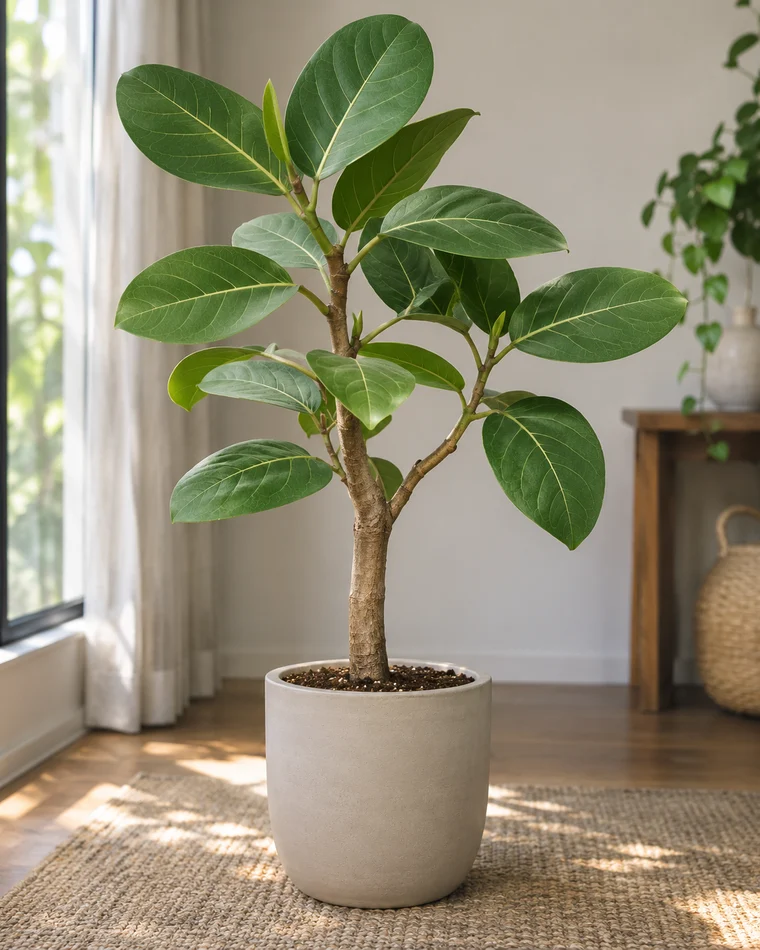
Look for firm oval to oblong leaves with entire margins, a conspicuous pale midrib and lighter branching veins. The undersides and young leaf stalks may feel finely hairy. Leaves arise alternately along woody shoots. New foliage is lighter before it matures, so one pale emerging leaf is not automatically a nutrient deficiency. Compare fully expanded leaves when checking identity.
The silhouette differs from the narrowed waist of a fiddle-leaf fig and the smaller pointed leaves of a weeping fig. Retail labels sometimes use Audrey loosely; a species name alone does not prove that cultivar. Keep the nursery label and distinguish a named selection from an unnamed banyan. A generated illustration can show the overall habit, but cannot certify the identity of your particular plant.
[1][4]Light must reach the whole leafy crown
Give this broad-leaved fig a bright position close enough to a window that the lower crown also receives daylight. It can grow in full or filtered light under protected cultivation, but leaves raised in a shaded nursery need gradual exposure before receiving stronger sun. A sudden bleached patch on the window-facing surface calls for protection, not more fertilizer.
A floor plant can appear well placed while its upper leaves shade everything below. Inspect the direction and spacing of new shoots. Long, weak extension toward the window suggests that the canopy is searching for light. If adding a grow light, arrange it for useful coverage rather than lighting only the topmost leaf. Judge the next growth flush; old stretched internodes do not shorten afterward.
[3][4]Read the root ball beneath those large leaves
Let the upper layer of compost begin to dry before watering again, while avoiding a prolonged hard-dry core. Large leaves lose water, but a large decorative pot can remain wet long after its surface changes colour. Check the actual nursery container inside the cover pot and compare its weight after drainage with its weight before the next watering.
Water through the root ball when needed, then remove collected drainage water. A tree with a small root system should not receive a larger volume just because its crown is tall. When leaves droop, distinguish a dry, light pot from a wet, heavy one before responding. The shared watering guide explains the technique; the important banyan-specific question is whether the whole woody specimen and its container are drying at a reasonable pace.
[3][4]Support the trunk without burying its base
A moisture-retentive but aerated potting mix suits a container banyan. RHS recommends a loam-based, peat-free medium with added bark for ornamental figs. The mineral component can help support a woody plant, while the bark maintains a more open structure. A drainage hole remains essential; a decorative stone layer does not compensate for a sealed pot.
Repot when root crowding or deteriorating mix makes it necessary, preferably while growth can resume promptly. Increase container size modestly and preserve the original planting depth. Burying the lower trunk to make a leaning plant stand upright creates a different problem. Correct the support and container balance instead. On a large specimen, renewing accessible surface compost can be more practical than repeatedly enlarging the pot.
[3][4]Keep the root zone warm as well as the room
Banyans are tropical trees, not cold-season deciduous figs. A stable warm interior suits them better than a doorway with repeated cold gusts. RHS gives 15°C as a protected-cultivation minimum for Audrey; this is a useful conservative reference for an untested indoor specimen, not proof that all plants share an exact damage threshold.
Cold glass and a chilly floor may expose the leaves and pot to lower temperatures than a room thermostat records. Check the immediate position on winter nights. Avoid placing a radiator directly below the crown: hot dry air can stress leaf margins even when the room average seems comfortable. Humidity support is helpful only when it does not leave the root ball constantly wet.
[4][3]Feed new leaf production, not a bare trunk
Use a suitable houseplant fertilizer during sustained leafy growth, following the product dilution and the condition of the potting mix. A plant recently moved into pre-fertilized compost may not need an immediate extra feed. Watch the youngest expanded foliage and shoot strength over time instead of trying to correct every older leaf with nutrients.
A bare section of trunk does not refill simply because fertilizer is stronger. Light, branching and the survival of dormant buds determine the eventual shape. Pause feeding when roots are stressed or growth is stalled in a dark season. Crusty deposits on the pot and damaged leaf margins justify reviewing fertilizer and irrigation inputs rather than adding another tonic.
[3]Plan branches before shortening the leader
A banyan naturally builds a woody framework. Keep the central leader if you want a taller tree, or shorten selected shoots above a node when a healthy plant has enough light to produce replacement growth. Pruning changes the architecture; it is not an immediate way to turn a sparse tree into a dense sphere. Make a few deliberate cuts and allow time to evaluate the response.
Wear gloves and protect nearby furniture from milky sap. Remove dead material and awkwardly crossing shoots, but avoid combining heavy canopy removal with major root disturbance on a stressed specimen. Support a top-heavy plant while it establishes. Clean dusty leaves gently, including the pale veins, without using products intended to create an artificial glossy coating on the naturally softer surface.
[3][1]A cutting needs a piece of living stem
Use a healthy semi-ripe shoot with nodes during a period of active growth. A detached leaf with its stalk may remain green or make roots, but lacks the stem bud needed for a complete new tree. Handle cut surfaces carefully because they release latex. An airy propagation medium, warmth and protected humidity help the cutting maintain itself while roots develop.
Air layering is another option for a suitable established branch and can preserve a larger section of canopy, but it requires a controlled wound and patience. It is not a rescue for a rotting trunk. Follow the shared propagation guide for hygiene and enclosure management; judge progress by rooted growth rather than repeatedly pulling the cutting out to inspect it.
[1][4][3]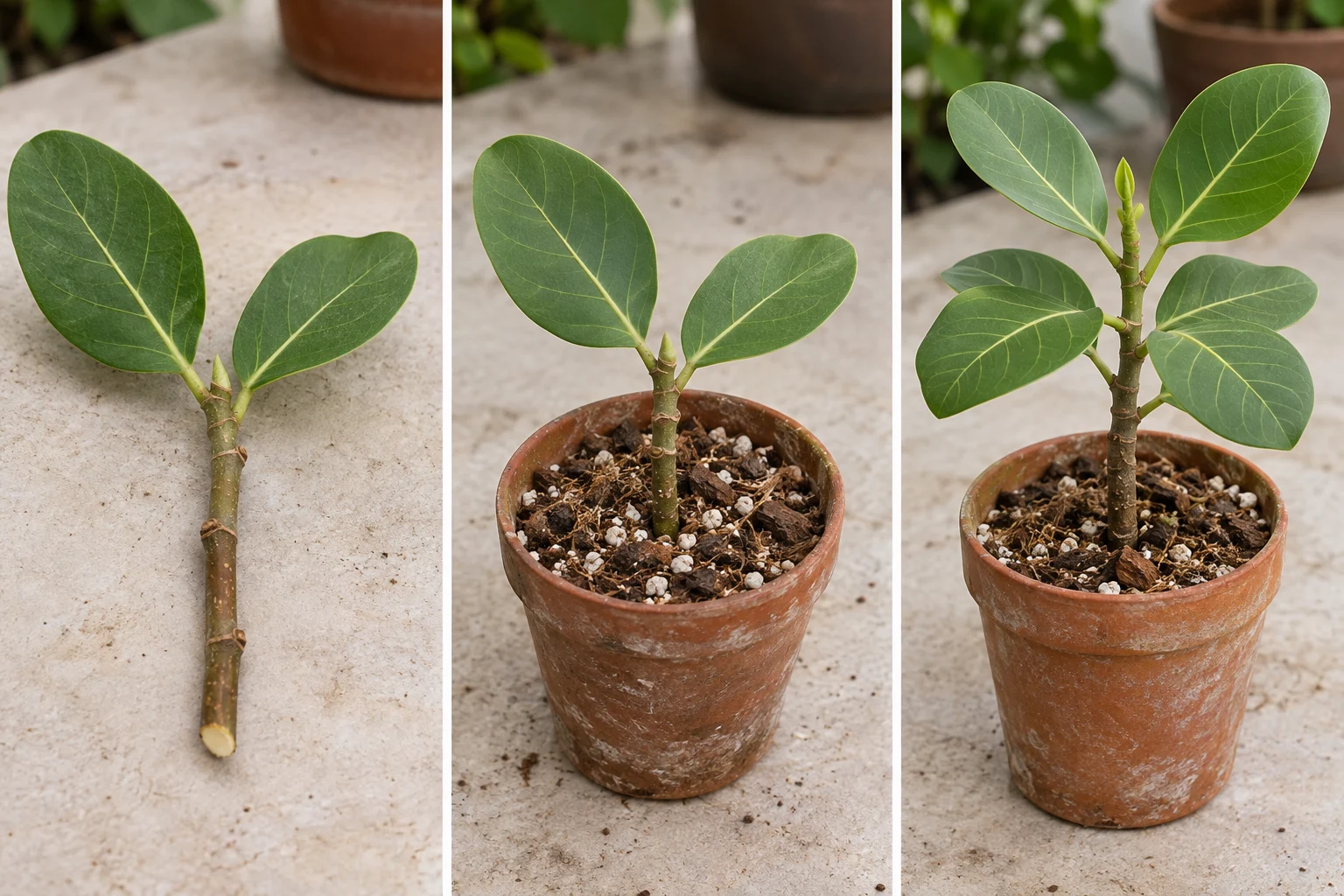
Panels, from left to right
- Choose a healthy node-bearing semi-ripe shoot and protect skin from the released latex.
- Place the prepared stem in an airy rooting medium with warm, sheltered conditions.
- Wait for established roots and new growth before gradually moving the young tree into normal room conditions.
Inspect broad undersides and branch junctions
Scale insects and mealybugs can hide where leaf stalks meet the stem; mites may first show as fine stippling across a broad leaf. Sticky deposits deserve an insect inspection before they are blamed on sap leakage. Look beneath leaves and along veins, using magnification when necessary. Isolate a suspicious specimen while identifying the cause.
A product must be labelled for the pest and indoor ornamental use where you live. Test sensitive foliage before treating the whole canopy and keep chemicals away from people and animals. Do not assume every spot is fungal: sun injury, rubbing during transport and root stress can also mark leaves. Record whether damage spreads onto new foliage after conditions are corrected.
[3][4]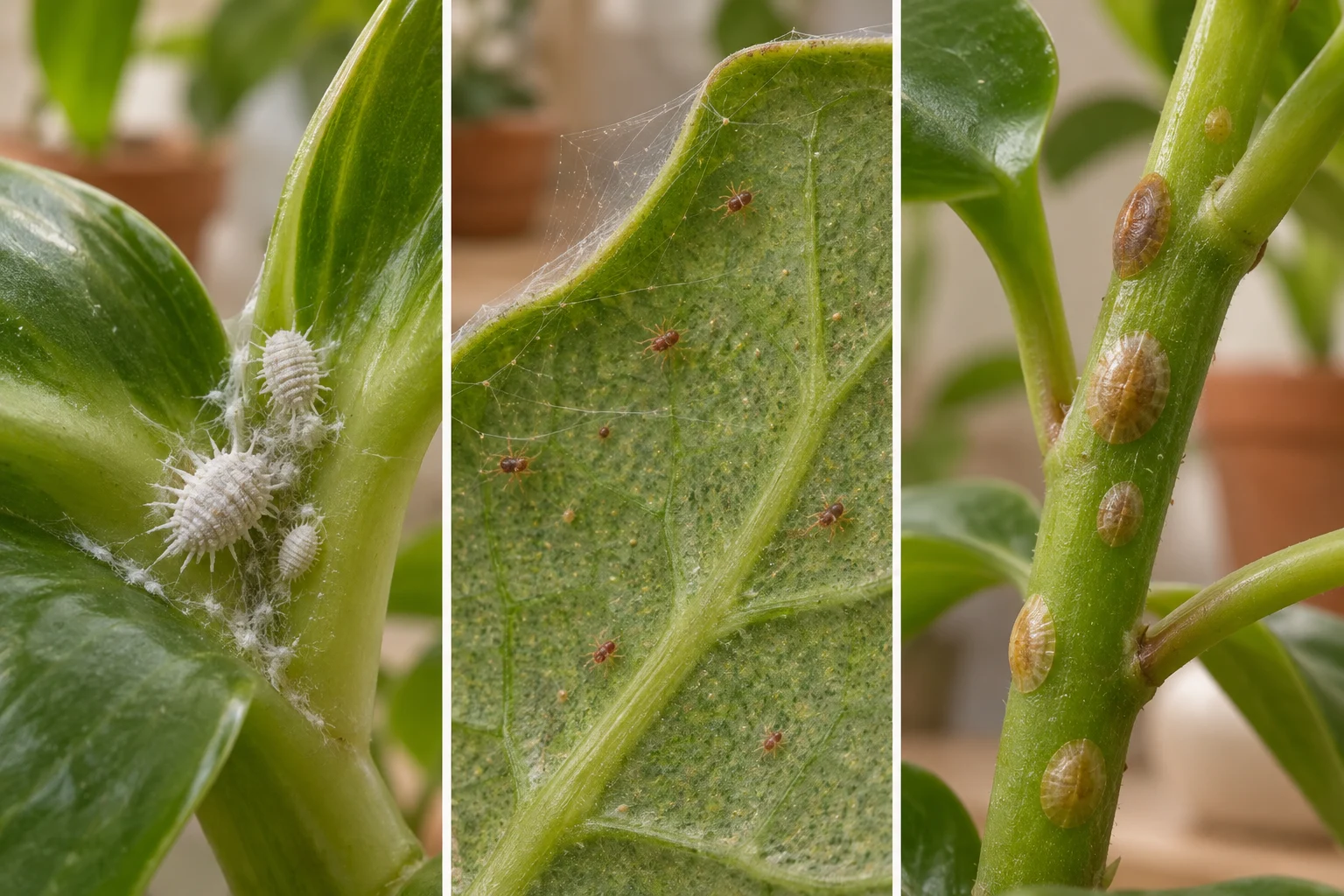
Panels, from left to right
- Mealybugs
- Spider mites
- Scale insects
Separate leaf ageing from a failing root system
The occasional loss of an older lower leaf can accompany a growing crown. Several leaves dropping together after delivery, a cold night or a sudden change in watering need a timeline rather than a single diagnosis. Note which leaves are affected, whether the trunk remains firm and whether the compost is wet or dry.
A wet pot together with yellowing leaves and declining new growth raises concern about root function. A dry pot with curled, brittle margins suggests a different path. Brown patches do not identify the cause by colour alone. Compare the plant with photographs taken before the change, and inspect roots only when the moisture history or continuing decline gives a reason.
[3]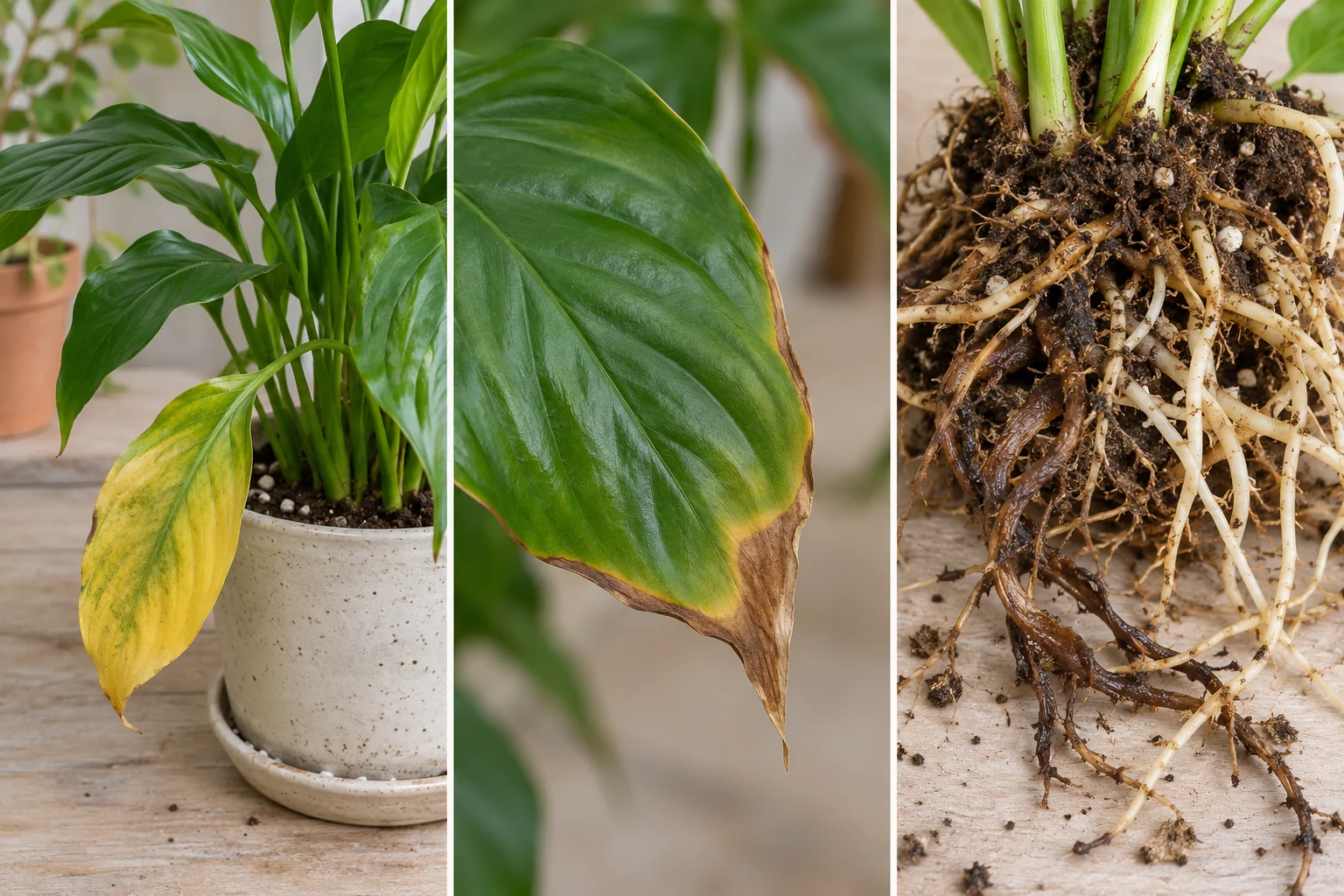
Panels, from left to right
- Yellowing foliage
- Brown leaf edges
- Damaged roots
Large leaves falling after delivery
- Possible causes
- Transport, a new light level or a cold doorway can unsettle a newly placed banyan.
- What to check
- Compare the timing of leaf loss with the move and check the actual moisture of the nursery pot.
- Next step
- Stabilize the position and watering assessment before attempting major pruning or feeding.
Pale patches on the exposed crown
- Possible causes
- A sudden increase in direct sun can injure banyan leaves that developed under nursery shade.
- What to check
- Look for a concentration of damage on the window-facing side rather than all new leaves.
- Next step
- Filter the strongest exposure and assess the next leaf flush instead of treating old scars.
Yellowing above a heavy wet pot
- Possible causes
- Slow-drying compost and impaired roots may limit water uptake despite abundant moisture.
- What to check
- Inspect drainage, the concealed cover pot and the length of time the core remains wet.
- Next step
- Correct trapped water and investigate continuing root decline using the shared root-rot guide.
Adapt the routine when the window changes
As daylight increases, a banyan may produce a flush of larger leaves and use water faster. Check for roots filling the container before deciding on spring repotting. If you move it to a sheltered outdoor position in warm weather, acclimatize its leaves gradually and keep its eventual return route manageable. A heavy tree is difficult to move in a hurry.
In shorter, darker days, retain useful window light and lengthen watering intervals when the root ball actually dries more slowly. Do not manufacture a dormant winter by withholding all water. Inspect the plant before bringing it back indoors, especially branch junctions and pot rims. Local weather and indoor lighting matter more than applying a fixed northern-hemisphere calendar everywhere.
[3]Its flowers are hidden inside figs
Banyan flowers develop inside the enclosed structure called a syconium, rather than as an obvious blossom above the leaves. In suitable outdoor conditions, specialized fig wasps participate in pollination. That relationship explains why a room-grown plant should be valued for its foliage and architecture instead of being expected to supply viable seed.
Small paired figs on a mature tree are not equivalent to the edible common fig, Ficus carica. Do not taste ornamental fruit to test identification or offer it to pets. The absence of fruit on a young indoor plant is normal and is not an indication that phosphorus fertilizer, a second plant or artificial pollination is urgently needed.
[1]Treat latex and fallen leaves as exposure risks
NC State identifies leaves and sap as potentially harmful when ingested and notes that sap can irritate skin. Keep this tree where pets cannot chew fallen leaves and children cannot reach fresh pruning cuts. Gloves are especially useful when shortening a large branch, because the amount of latex can be greater than expected from a small cut.
The traditional uses of banyans do not make a nursery-grown houseplant an appropriate food or home remedy. If exposure occurs, identify the plant and seek advice from the relevant medical or veterinary service; do not improvise treatment from a plant-care article. Store cuttings and pruned material securely while working.
[1]Aerial roots are optional indoors
Aerial roots form part of the mature banyan’s outdoor architecture. Their absence in a dry room is not a deficiency to correct by soaking the pot. An existing aerial root can be guided gently toward its own container if practical, but do not force it into a sharp bend or let it attach to a building surface.
Semi-hydro conversion is a separate growing-system change, not an upgrade every banyan needs. If experimenting, begin with a small rooted cutting rather than stripping the established roots of a valued tree. Likewise, additional light should support a balanced canopy, not provoke faster growth than the available space can accommodate. Keep one variable stable while evaluating another.
[1][5][3]Species identity comes before the Audrey label
Audrey is a named Ficus benghalensis selection described by RHS, but this profile covers the species record in the encyclopedia. The cultivar’s documented size and habit are helpful context only when the plant has reliable provenance. An unlabelled seed-grown tree can vary in leaf size, branching and vigour.
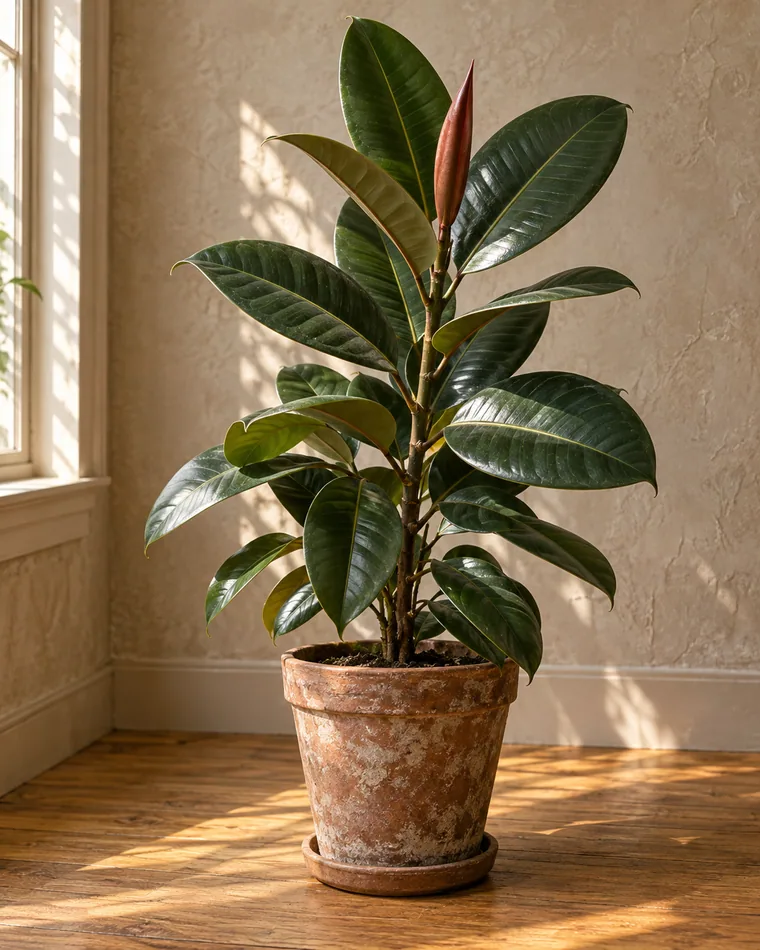
Do not confuse a banyan with Ficus religiosa, which usually has more heart-shaped leaves and an elongated tip, or with rubber plant, whose foliage is generally glossier. Variegated or unusually compact retail plants need their own verified label before cultivar-specific promises are made. Shared species care is a starting point; observe the actual plant’s response.
[4][1]Frequently asked questions
Is every potted Ficus benghalensis an Audrey cultivar?
No. Audrey is a named selection, while Ficus benghalensis is the species. Keep a trustworthy nursery label if cultivar identity matters; leaf colour alone cannot establish it.
[4]Will my indoor banyan develop a forest of supporting trunks?
That dramatic structure belongs to mature trees in suitable tropical conditions. A young container tree may produce no aerial roots indoors and can still be healthy.
[1][5]Why are the pale veins on a banyan leaf so prominent?
Lighter veins are part of the normal appearance, particularly on plants sold as Audrey. Compare the surrounding blade and new growth before interpreting that contrast as chlorosis.
[4]Should I bury the banyan trunk deeper if it leans?
Keep the original planting depth. Assess root anchorage, pot stability and temporary support instead of packing wet compost around the lower trunk.
[3]Does a missing lower branch mean the banyan needs stronger feed?
Fertilizer cannot choose where a new branch forms. Review light and the pruning plan; a bare stem section may remain visible even after the tree resumes healthy growth.
[3]Why does a newly opened banyan leaf look lighter than the others?
Young foliage can emerge bright green and deepen as it matures. Persistent pale growth across several fully expanded leaves deserves a broader review of light, roots and feeding.
[4]Are the little figs on a banyan the same fruit as supermarket figs?
No. Supermarket figs are generally Ficus carica. Do not use the fruit of an ornamental Ficus benghalensis as food or as an identification test.
[1]Can I cut the top off my banyan to make it branch?
A healthy tree may branch after a deliberate cut above a node, but the response depends on light and vigour. Avoid combining that major cut with root damage or a recent stressful move.
[3]Does the banyan need a male and female plant to flower?
Male and female flowers occur within its fig structures. Indoor fruit and viable seed depend on much more than keeping two pots, including maturity and specialized pollination.
[1]Why is the banyan’s upper crown full while the bottom is thinning?
The upper canopy may intercept much of the available window light. Assess light at the lower leaves and the direction of new shoots before changing fertilizer.
[3]Compare related plants
- Rubber plant: Rubber plant usually carries glossier, thicker-looking foliage; banyan fig is distinguished by its softer surface and conspicuous pale vein network.
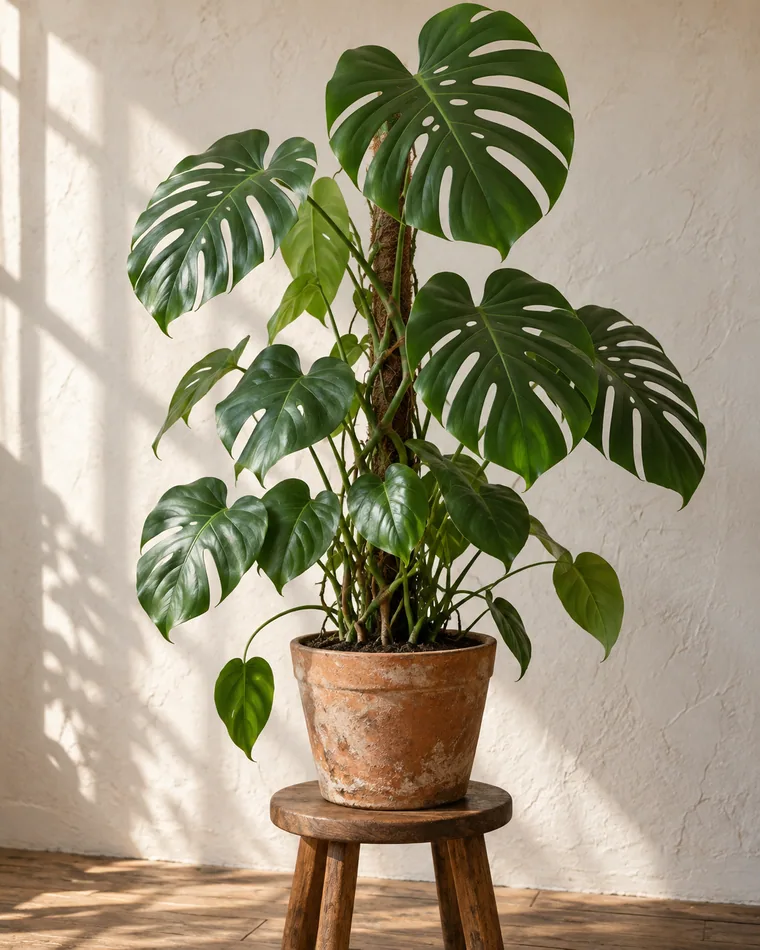
- Fiddle-leaf fig: Fiddle-leaf fig has a violin-like leaf outline, while banyan fig offers broader oval leaves and a different branching silhouette.
Care reminders with PlantPal
Keep notes on your banyan’s new leaf flushes and set care reminders in PlantPal before changing the routine for a larger pot.
Add my banyan fig