 Plant
Copperleaf.
Acalypha wilkesiana
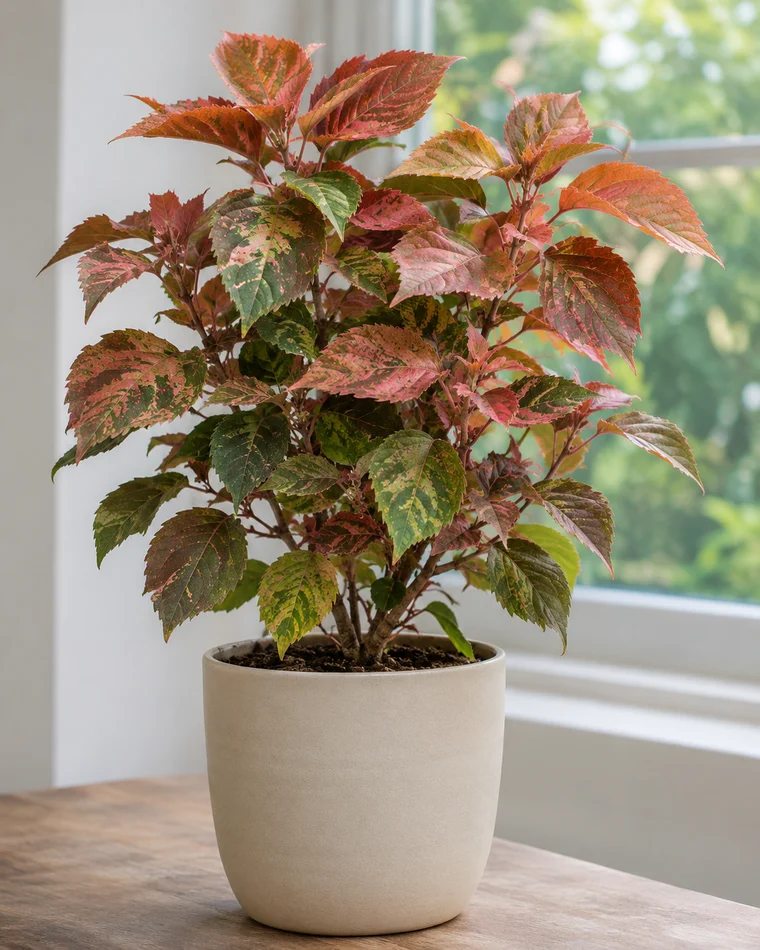
Copperleaf produces a changing mosaic of bronze, green, pink and cream on a branching tropical shrub. Acalypha wilkesiana needs useful light and consistent moisture to maintain its leafy display indoors. Its many selections differ in shape and colour, so preserve a reliable label and judge changes against your own plant’s healthy growth.
How to help it thrive.
Checked:
Quick care reference
- Species: Acalypha wilkesiana, a colourful evergreen shrub.
- Foliage: cultivar-dependent mottling, not one fixed copper shade.
- Light: strong useful exposure, introduced gradually.
- Water: avoid both prolonged dry spells and stagnant saturation.
- Pot: stable support for a broad branching canopy.
- Shape: selective pinching during healthy active growth.
- Continuity: labelled stem cuttings preserve a chosen selection.
- Safety: clear copperleaf sap can inflame skin; do not allow chewing.
A leafy colour display on a fast-growing shrub
Copperleaf, Acalypha wilkesiana, is an evergreen shrub in Euphorbiaceae. Kew places its native range from the Bismarck Archipelago into the southwest Pacific. In warm landscapes it can become a large branched shrub, while a container specimen is kept smaller through pruning and available space. Its main display is the foliage: different selections combine copper, red, pink, cream, yellow and green without waiting for a seasonal flower show.
Treat it as a bright-window or conservatory shrub rather than a low-light desk plant. Before choosing a large specimen, allow space around the canopy and access to the pot. Broad leaves can hide the medium and obstruct an adjacent window, so the position must work for both observation and growth. There is no fixed lifespan at which a healthy plant becomes disposable; older material can be shaped or renewed from sound cuttings when its form becomes inconvenient.
[1][2][3]Read the leaf texture as well as its colour
Leaves are generally broad, ovate to heart-shaped, with toothed edges and a soft-textured appearance. Their mottling can combine several colours on a single blade. Exact shape, curling and colour differ among cultivars, so the common name copperleaf does not promise that every plant will be uniformly copper. New leaves can also look different from mature ones on the same branch.
Do not confuse normal mottling with an infection merely because it is irregular. Inspect whether tissue is firm and growing normally, whether marks correspond to the cultivar's pattern, and whether actual lesions expand. Copperleaf is not the same plant as croton, despite both being colourful tropical foliage shrubs. Nor should its flowers be expected to resemble the very long plush red tassels of Acalypha hispida. Retain a reliable cultivar name when one is supplied.
[3][2][4]Colour depends on useful exposure, not the label alone
NC State notes the strongest leaf colour in good sun, while RHS permits full or filtered light indoors. A bright position is therefore important, with gradual adaptation if the plant was previously shaded. Watch new leaves rather than expecting old faded foliage to change instantly. A plant several metres from a window may survive for a time while losing the compact, strongly coloured growth that made it attractive.
Strong exposure also brings heat, especially behind glass. If only the window-facing side develops pale dry patches, assess scorching and leaf temperature before adding fertilizer. Rotate the pot gently for a more balanced canopy, leaving room for its broad blades. A grow light can help a suitable location, but its intensity and distance should follow the fixture and the growth response. Colour alone is not a precise light meter because the cultivar and leaf age also matter.
[3][2]Avoid the dry spells that strip the branches
Copperleaf prefers a consistently moist but freely draining root zone. NC State specifically connects unsuitable moisture with leaf drop. Inspect the pot before it becomes completely dry, particularly during strong growth in a warm bright window. Water evenly through the medium and remove drainage water from an outer container. A large leaf canopy can use water quickly, but its apparent size does not reveal how much root space is available.
Reduce the supply when indoor winter conditions slow growth; RHS describes keeping the mix barely moist then. Consistency does not mean holding a saturated root ball indefinitely. If leaves fall while compost remains heavy and wet, examine roots, drainage and recent environmental changes before another soak. Record whether the pot was actually dry at each episode. That history is more useful than treating all fallen copper-coloured leaves as evidence of one universal cause.
[3][2]Choose a container that supports both roots and branches
Use a potting medium that holds enough moisture for a leafy shrub while retaining air and releasing excess water. RHS recommends peat-free potting compost for indoor cultivation. A container should have working drainage and sufficient stability for a broad crown. A tall ornamental vessel can be used as an outer pot only if you can inspect and empty it without damaging the branches.
Move up in size when roots or degraded medium justify the change, rather than buying a very large wet volume to postpone future work. Spring growth offers a useful opportunity to assess the root ball. Keep the previous planting depth and support the woody framework while removing the old pot. If the plant is too large to handle comfortably, a healthy rooted cutting can become a more manageable successor; that is a deliberate renewal choice, not an automatic annual requirement.
[2][3]Keep colourful foliage away from abrupt chills
This is a tender tropical evergreen suited to warm protected conditions. A summer container can move into a sheltered outdoor position where the climate allows, but it needs a plan for return before cold weather. RHS places it in a tender category suitable for summer outdoor use rather than a frost-hardy shrub. Do not infer winter tolerance from a photograph of copperleaf growing as a hedge in a tropical country.
A draft from an exterior door or leaves pressed against a cold pane can cause a local problem even in a heated room. Conversely, a hot radiator can dry a nearby canopy rapidly. Seek reasonably stable conditions with enough light, not maximum heat at any cost. If humidity is very low, improve the room environment without keeping leaves constantly wet. Assess changes in moisture demand whenever temperature or airflow is altered.
[2][3]Maintain new foliage without chasing every colour change
A balanced liquid feed about monthly during active growth is the RHS approach. Follow the product instructions and account for nutrient-rich fresh compost. Copperleaf can grow quickly when its environment supports it, but fertilizer should not be used to compensate for a dim site. A leaf's bronze or pink pattern is not itself proof that a nutrient is missing.
During winter slowdown or after root problems, reduce or pause feeding. If pale weak growth is new, inspect light, roots and pests before choosing an extra dose. Salt accumulation or repeated strong applications can damage a plant whose original problem was unrelated. Note which product was used and when, particularly if several people tend the collection. Judge a change in nutrition through subsequent healthy growth rather than expecting damaged old edges to recover.
[2][3]Pinch strategically to keep the canopy full
Pinching growing tips encourages branching and can prevent a container copperleaf from becoming a single tall sparse stem. Choose healthy active growth and preserve enough leaves on the remaining framework. A newly purchased compact plant will need space for its next flush; constant removal of all new tips can leave it unable to build the display you want. Turn the pot to reduce one-sided growth before cutting heavily to correct it.
An older shrub can be reshaped, or a suitable tip cutting can be retained as a replacement. First distinguish a naturally woody base from dieback or soft damaged tissue. Remove dead material and keep pruning debris away from pets. Very curled leaves may belong to a named selection, so do not shear off every unusual blade as if it were diseased. Compare the plant with its own healthy history and verified cultivar description.
[3][2]Carry a selected leaf pattern into the next plant
Use softwood cuttings in summer or semi-hardwood material in late summer, as described by RHS. Select healthy shoots that show the desired foliage pattern. A cutting from a clearly different or reverted branch may not produce the appearance you hoped to preserve. Inspect the parent for pests, and prepare the stem with clean tools before inserting its lower portion into an airy rooting medium.
Keep cuttings in bright protected light with sufficient humidity to limit severe wilting, while allowing ventilation and avoiding saturation. Remove leaves that would be buried, but leave useful foliage above the medium. Pot on after a functioning root system develops, not just after a calendar deadline. Label the cutting with the parent's verified name; seed propagation should not be relied upon to reproduce a particular ornamental cultivar's leaf pattern.
[2][3]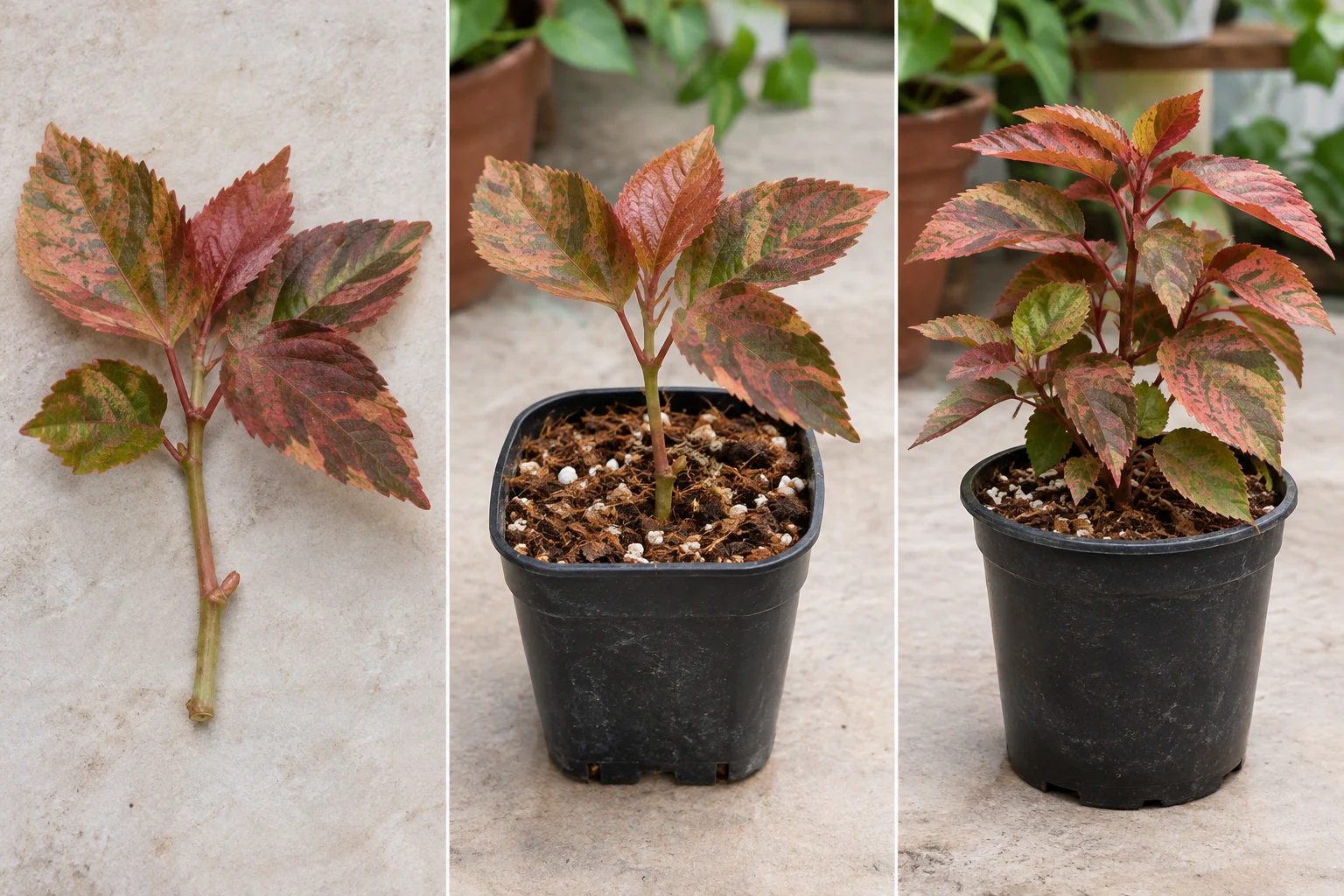
Panels, from left to right
- Select a pest-free shoot showing the copperleaf pattern you want to retain, and label its parent identity.
- Prepare softwood or semi-hardwood stem material in airy rooting compost with protected light and ventilated humidity.
- Move the cutting on once its roots support continuing growth, keeping its cultivar information with the new pot.
Mottled foliage can conceal early insect damage
Whitefly, mealybugs, spider mites and other pests can affect copperleaf. Its naturally patterned blades may hide the first stippling, so inspect undersides, shoot tips and stem junctions rather than relying on an overall photograph. Sticky residue, tiny moving organisms or webbing provide more useful evidence than colour variation alone. Plants moved indoors after summer need particular attention before joining a collection.
Separate a suspect specimen and identify the pest before choosing an indoor-appropriate treatment. Follow the product label and any test-area directions, because ornamental leaves can also be damaged by treatment. Do not assume that every pale area is a mite symptom or that every curled leaf is an infestation. Root stress and environmental shifts can cause decline independently, and adding repeated sprays may obscure the original cause.
[2][3]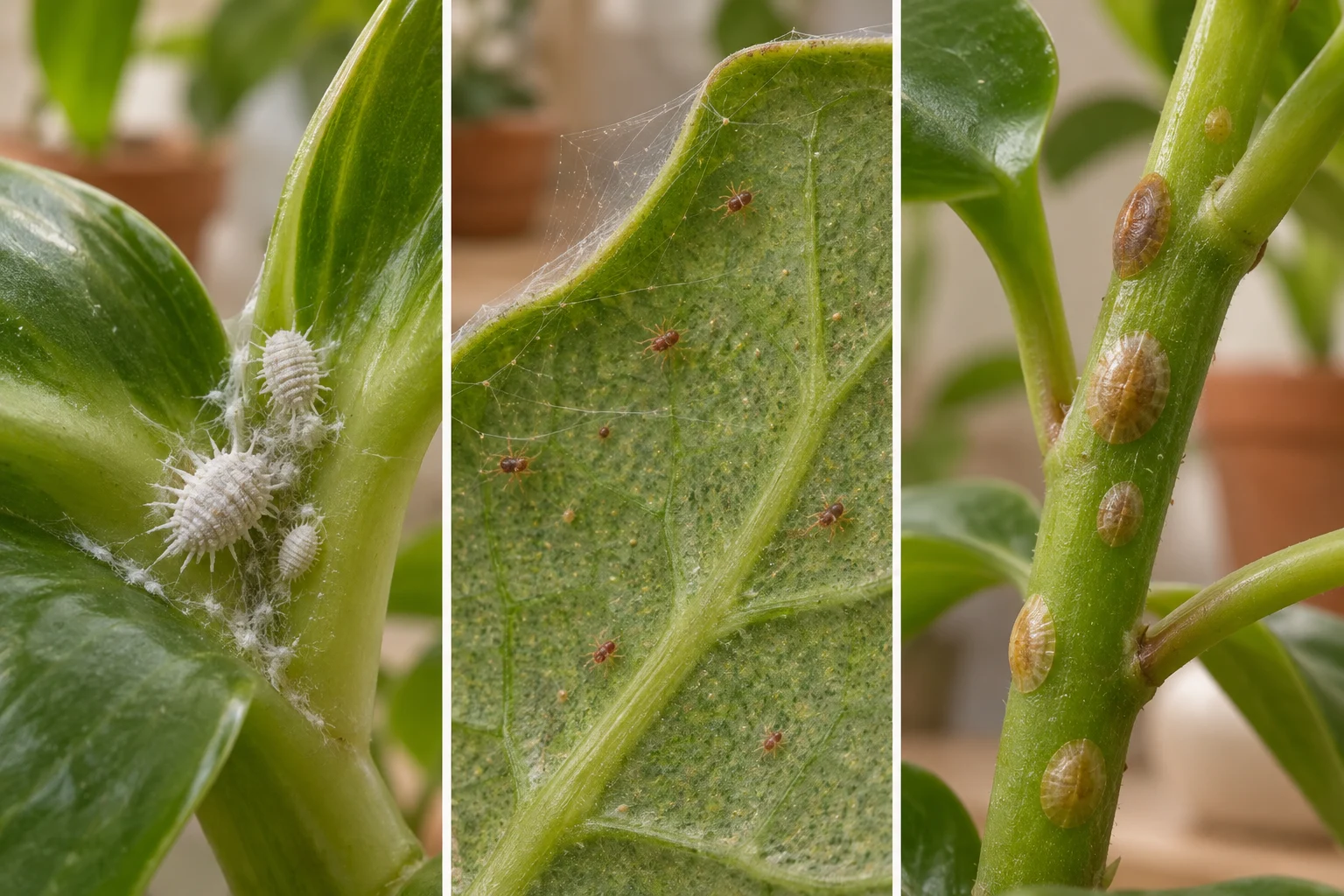
Panels, from left to right
- Mealybugs
- Spider mites
- Scale insects
Use the pattern of leaf loss to narrow the problem
A sudden shower of leaves following a dry spell points attention towards moisture history, but leaf loss from a wet pot needs a different investigation. Check whether the whole canopy is affected or only a shaded or chilled branch. Note the timing of moves, repotting and feeding. Copperleaf reacts to the combined environment, so one fallen leaf colour does not reliably identify a deficiency or a pathogen.
For fading colour, compare new leaves with mature ones from the same cultivar under the same lighting. A weak elongated shoot suggests insufficient useful light, while a firm, normally shaped leaf with an established pattern may simply be ordinary variation. If the stem base softens, lesions expand or branches die rapidly, isolate the plant and inspect beyond the foliage. Delay taking cuttings from unexplained declining material until its condition is understood.
[3][2]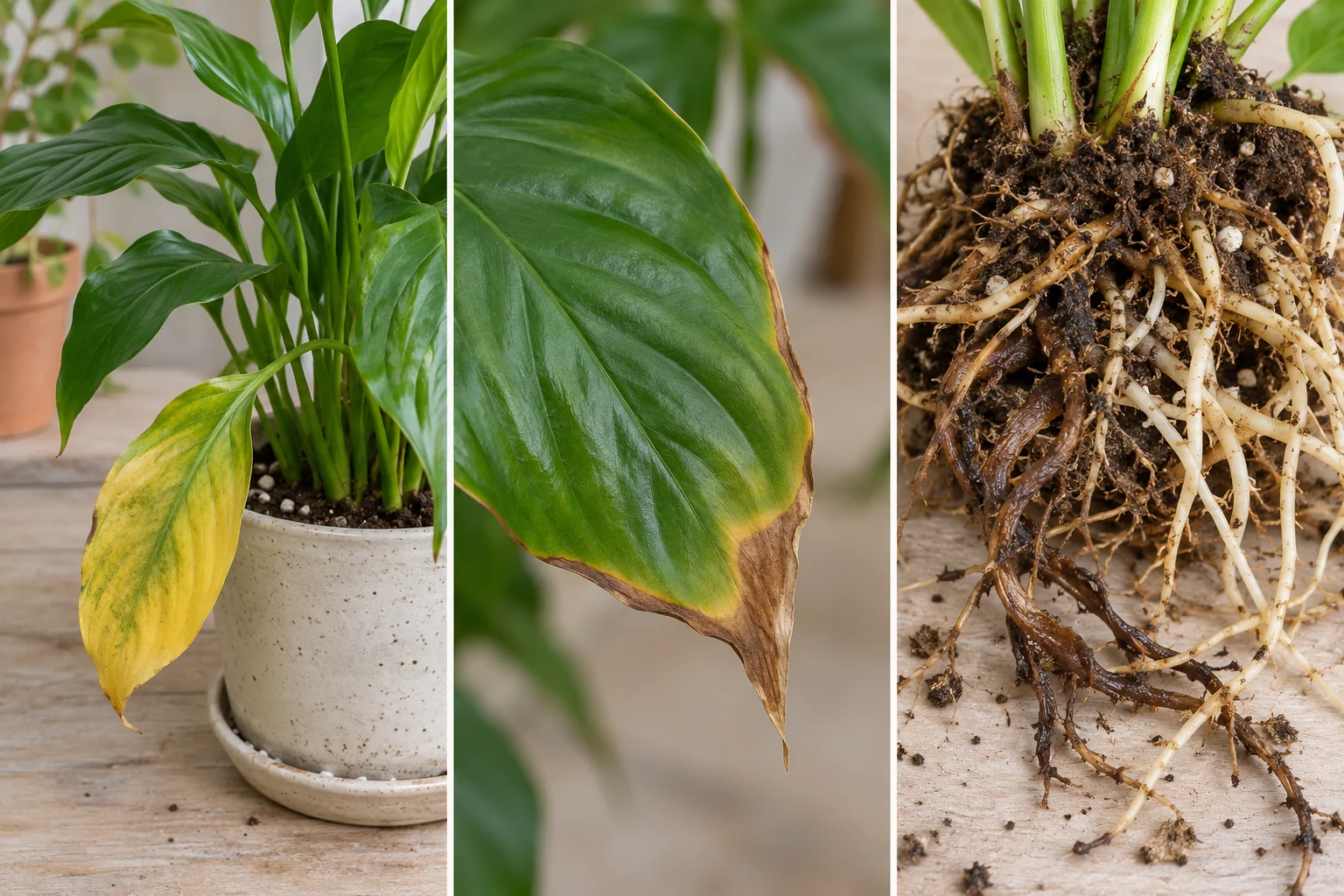
Panels, from left to right
- Yellowing foliage
- Brown leaf edges
- Damaged roots
Leaves falling after a dry spell
- Possible causes
- Interrupted moisture can stress the broad canopy, though cold moves and root problems can also cause shedding.
- What to check
- Review actual root-ball dryness and the timing of any relocation or temperature change.
- Next step
- Restore consistent, draining moisture and observe new growth without saturating the pot as compensation.
Fading colour with long new internodes
- Possible causes
- A dimmer position can reduce compact colourful growth; cultivar and leaf age also influence appearance.
- What to check
- Compare recent shoots with mature leaves and the light reaching the whole canopy.
- Next step
- Improve exposure gradually and assess the next flush instead of adding fertilizer solely to change colour.
Marks hidden among normal mottling
- Possible causes
- Natural patterning can resemble damage, while mites, other pests or expanding lesions may be concealed by colourful leaves.
- What to check
- Inspect undersides and tissue texture for organisms or progression rather than judging colour alone.
- Next step
- Isolate confirmed or suspected pests and select treatment only after identifying the actual problem.
Choose a workable route from patio to room
Copperleaf can spend warm months outdoors where conditions are suitable, often with stronger growth and colour than a dim room permits. Acclimate it gradually and keep the container accessible for water checks. Before cold weather, decide whether to bring the entire shrub indoors or keep healthy rooted cuttings. NC State identifies tip cuttings as an option for overwintering when a large plant is impractical.
Inside, provide a genuinely bright location and adjust water to the slower drying rate. Reduce feeding when growth becomes quiet, but do not treat an evergreen copperleaf as a leafless plant needing total drought. In spring, inspect root and branch condition before increasing care inputs. A seasonal move can alter several variables simultaneously; change what you can gradually and observe new foliage rather than interpreting every transitional leaf fall as permanent failure.
[3][2]Small catkins are secondary to the leaf display
Copperleaf can produce male and female flowers separately on the same plant. NC State describes the male spikes as longer and hanging, with shorter female spikes. The flowers are much less central to its ornamental appeal than its mottled foliage. Their appearance does not mean the plant has turned into chenille plant, and the absence of a conspicuous floral show does not make a healthy copperleaf incomplete.
If flower spikes appear, observe them without confusing them with pests or damaged shoots. Remove spent material where it becomes untidy, while preserving healthy leaves. Seed, if produced, should not be used as a guarantee of a particular cultivar's colour arrangement. When maintaining a named selection, vegetative propagation from a suitable branch offers a more direct connection to the parent than selecting seedlings by their first tiny leaves.
[3][2]Keep colourful foliage and sap out of reach
Queensland Poisons Information Centre identifies Acalypha wilkesiana as potentially toxic if swallowed and warns that its clear sap can cause severe dermatitis. The record concerns human exposure; it does not provide a species-specific assessment for cats or dogs. Keep cuttings and discarded foliage away from chewing animals, and avoid touching the face while pruning.
A colourful ornamental is not an edible herb merely because its common name mentions a leaf. Avoid homemade medicinal use and wear gloves for pruning if handling sap or plant debris. After suspected pet ingestion, seek veterinary advice with the accepted name and the older synonym available. Human exposures require appropriate medical advice; do not translate a list of animal signs into a home treatment or a supposedly safe dose.
[5][1]Compare growing conditions without losing the cultivar
Copperleaf offers a visible way to compare light treatments, but colour is affected by leaf age and cultivar as well as exposure. Use labelled cuttings from the same verified parent if you want a meaningful comparison. Keep water, container and feeding reasonably consistent while changing one major lighting variable. Photograph new leaves in similar neutral light so that camera settings do not masquerade as a horticultural result.
The cited sources describe conventional potting culture rather than a proven hydroponic protocol for every cultivar. A spare cutting is a more sensible experimental subject than a valued mature shrub. Avoid assuming that the demand for consistent moisture means roots should remain in unaerated water. Check root condition, stem firmness and successive leaf growth, and preserve a conventionally grown parent while learning how an alternative setup behaves.
[2][3]One species includes many different leaf displays
Cultivars can differ in leaf size, edge shape and mixtures of bronze, green, cream, pink or other colours. Some have curled or narrower foliage. Names such as 'Godseffiana' occur in horticultural use, while the botanical name Acalypha godseffiana also appears historically as a synonym; these naming levels should not be casually collapsed. Keep the exact label and its source instead of assigning a cultivar from colour alone.
Acalypha amentacea subsp. wilkesiana is another name encountered in references for this species. Those synonyms do not justify creating duplicate species pages, and an unidentified copperleaf remains useful without an invented cultivar name. When selecting a plant, match its mature outline and light needs to the available space. When sharing cuttings, include photographs and provenance so that a distinctive leaf pattern can be tracked accurately.
[1][2][3]Frequently asked questions
Why is copperleaf colourful even when it has no flowers?
Its ornamental display comes mainly from the leaves. Cultivars carry different mixtures of pigments and variegation, so a healthy plant does not need a flower spike to provide its characteristic colour.
[3][2]Is Acalypha godseffiana unrelated to Acalypha wilkesiana?
Kew and NC State list Acalypha godseffiana as an older name for A. wilkesiana. Retain the current species name and any cultivar label together when comparing plant records.
[1][3]Can normal copperleaf mottling be mistaken for disease?
Yes. Compare firm intact leaves with the known cultivar pattern and look for expanding lesions or actual pests. Irregular colours alone are expected in many selections and do not justify a pesticide.
[3][2]Will every copperleaf cultivar have the same broad bronze leaves?
No. Selections vary in leaf outline, size, curling and colour combinations. The species name does not identify a particular cultivar; reliable provenance is preferable to naming it from a single photograph.
[2][3][4]Does a copperleaf with curled leaves always have pests?
Some ornamental selections naturally have curled or unusual leaves. Compare new growth with the plant’s healthy pattern and inspect for organisms before assuming that leaf shape is damage.
[3][2]Can I overwinter copperleaf as cuttings rather than a large shrub?
Yes, NC State describes tip cuttings as an option. Root healthy material and provide a bright protected winter position; reduced size does not remove the need for suitable light and moisture.
[3]Are copperleaf catkins the same as chenille plant’s red tails?
Both plants are Acalypha, but copperleaf’s flowers are secondary to its foliage. A. hispida carries the much more conspicuous long plush red clusters associated with chenille plant.
[3][2]Does one copperleaf carry both male and female flowers?
NC State describes separate male and female flowers on the same plant. The male spikes are longer and hanging, while the female spikes are shorter.
[3]Will seed reproduce my favourite copperleaf leaf pattern?
Do not rely on seedlings to preserve a named ornamental selection. Choose a healthy vegetative cutting from a branch showing the intended pattern and retain its cultivar label.
[2][3]Why should I choose the branch carefully before taking a copperleaf cutting?
A shoot with a different or reverted appearance may not preserve the display you want. Select healthy growth matching the verified parent pattern and inspect it for hidden pests first.
[2][3]Does copperleaf’s older name establish safety for pets?
No. Acalypha godseffiana is a synonym, not a safety guarantee. The verified Queensland record warns about human ingestion and sap exposure; pet-specific effects are not established by that record. Keep clippings inaccessible and ask a veterinarian after suspected chewing.
[5][1]Can a healthy copperleaf remain indoors through winter without losing every leaf?
It is evergreen, so complete leaf loss is not a required dormant phase. Give it bright light, stable protection and moisture matched to slower growth; investigate major leaf drop rather than treating it as inevitable.
[2][3]Compare related plants
- Chenille plant: Chenille plant concentrates its colour in hanging red flowers; copperleaf carries its main ornamental pattern across the leaf blades.
- Croton: Croton and copperleaf both offer colourful tropical foliage, but they are different genera with distinct leaf textures and cultivar patterns.
Care reminders with PlantPal
Keep your copperleaf in PlantPal with reminders to compare new foliage, inspect moisture and record the timing of pruning or moves.
Record this foliage display