 Plant
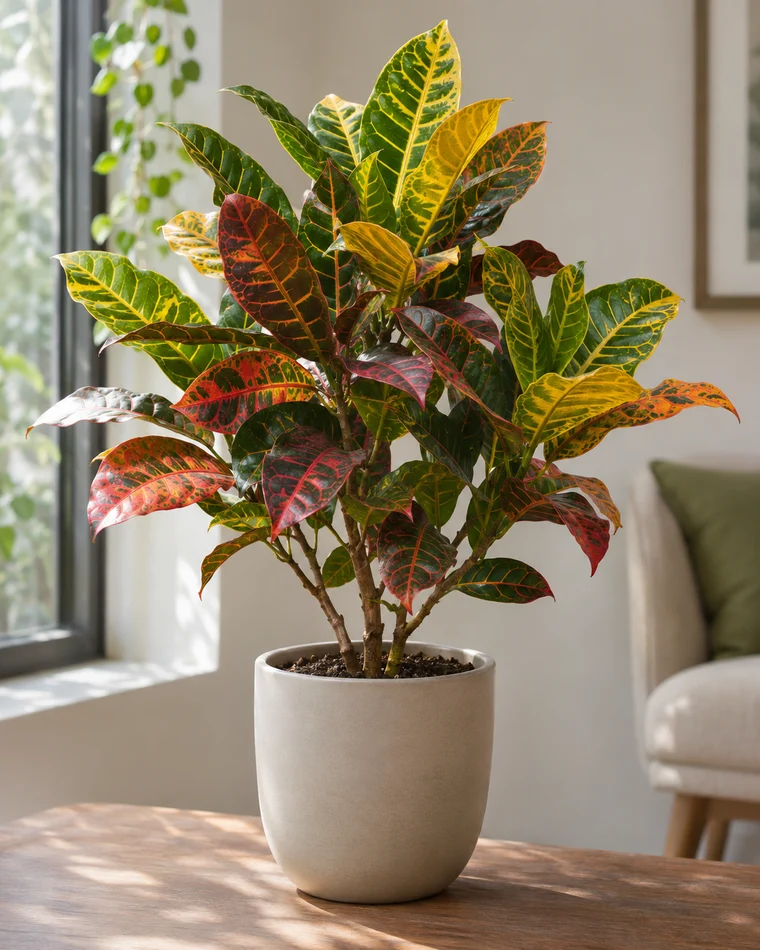
Croton.
Codiaeum variegatum
Croton turns a woody tropical shrub into a lasting display of coloured leaves. Its appeal comes with a preference for steady warmth and a bright position that does not scorch the foliage. This profile helps you distinguish normal changes in colour and leaf shape from stress, and rebuild a fuller plant without repeating the conditions that made it shed leaves.
How to help it thrive.
Checked:
Quick care reference
- Identity: Codiaeum variegatum, not the separate genus Croton.
- Colour: compare developing leaves before diagnosing fading.
- Exposure: bright filtered summer light protects the glossy canopy.
- Moisture: inspect the root ball because both wetness and drought can cause leaf fall.
- Warmth: avoid cold transport and keep the indoor position above 15°C.
- Shape: prune healthy leggy branches above leaf joints during active growth.
- Multiplication: stem cuttings or air layers retain a named selection.
- Handling: protect skin and eyes from sap and keep fallen material inaccessible.
Colourful foliage on a tropical woody shrub
Garden croton is Codiaeum variegatum, a member of Euphorbiaceae from tropical Asia and the western Pacific region. It is not a member of the botanical genus Croton, despite its everyday name. Cultivated selections turn a woody evergreen shrub into a display of yellow, red, orange, pink and green. The leaves carry the display throughout the year; flowering is not the main reason to grow it.
Indoor plants are often roughly 30–90cm tall, though age, cultivar and pruning change that substantially. Outdoor shrubs in suitable tropical climates can be much larger. Choose a position for future branching as well as today’s pot. A croton can live for years, but sudden changes of location often produce leaf loss. A stable bright room is a better starting point than repeatedly moving it to match a decorative scheme.
[3][4]Follow the pattern and shape of several leaves
Croton leaves are alternate, leathery and usually glossy. Depending on the selection, they may be broad, narrow, lobed, curled or twisted. Colours can follow veins, form speckles or occupy larger patches. New and older leaves on the same branch need not look identical. Compare several mature leaves before deciding that an unfamiliar colour is a disease or that the plant belongs to a particular cultivar.
A damaged leaf or stem releases irritating sap. Do not break a leaf simply to confirm identity. Use the label, growth habit and intact foliage first. The species record also covers plants previously labelled Codiaeum variegatum var. pictum. Keeping those names together avoids creating a second profile for the same cultivated croton complex.
[1][4]Enough light for colour, with protection from hot glass
Bright indoor light supports compact growth and the coloured foliage for which crotons are grown. Filter strong summer sunshine through glass, especially after purchase or a move from a shaded shop. Faded or greener new growth in a dim room calls for a gradual increase in useful light; a bleached, dull patch confined to the sun-facing surface suggests a different exposure problem.
Colour is also influenced by cultivar and leaf age, so brightness cannot turn every selection into the same red-and-yellow pattern. If using a grow light, illuminate the branching canopy rather than only the topmost leaf. Record changes in newly formed leaves instead of expecting old shaded leaves to transform immediately. Avoid moving a sensitive plant repeatedly between a dark shelf and intense sun.
[1][4]Keep the leaf display supplied without saturating roots
Water when the upper layer of the growing medium has dried, while avoiding a prolonged hard-dry root ball. Croton can shed leaves after either extended dryness or excessive wetness, making leaf fall alone an unreliable watering instruction. Check the substrate and the history of the pot before responding. Drain the inner container fully and empty any water trapped in its cover.
Low-mineral rainwater or suitably filtered water can be helpful where hard water repeatedly raises substrate alkalinity. Do not assume every household filter removes minerals, and avoid sodium-softened water. A warm room does not automatically mean a thirsty root ball when winter light is weak. Let the actual drying rate set the interval, particularly after a move or repotting.
[1][4][5]An airy, mildly acidic root environment
RHS recommends a light, well-drained acidic potting medium for codiaeums. Select a peat-free mix that retains useful moisture without becoming dense around the roots. The label houseplant compost does not guarantee that every blend behaves identically. If water runs straight around a shrunken core while the centre remains dry, address that root-ball condition rather than merely adding a larger decorative pot.
Repot when roots occupy the container and active growth can support recovery, generally in spring. Increase the pot size modestly. Excess unused compost can stay wet after the existing roots have enough water. Keep the original soil level against the woody stems and avoid combining a major root disturbance with a drastic change of light or temperature.
[1][4]Warmth must remain consistent through the night
Croton is a tropical shrub with little tolerance for cold shocks. A stable warm room around 18–27°C is a practical indoor setting; RHS advises keeping it above 15°C. Cold draughts and abrupt temperature changes can trigger leaf drop even before obvious tissue damage appears. Protect the plant during transport, including the short journey between a warm shop and a vehicle.
Humidity and airflow also affect the leaf margins. Keep the canopy away from radiator blasts and air-conditioning outlets. If measured room humidity is persistently low, improve the room conditions while maintaining ventilation. Wetting the leaves repeatedly does not correct a cold window or a continuously dry heating stream. A bathroom is useful only when it also offers adequate light and consistent warmth.
[1][4]Support new growth without chasing brighter pigments
A balanced houseplant fertilizer can support a croton that is actively producing shoots. Follow the container-plant directions and adjust to the product already present in the potting mix. Feeding should follow the growth cycle rather than a wish for redder leaves. Light, genetic selection and leaf development all influence colour, so a green leaf is not proof of a missing nutrient.
Avoid repeated extra doses after a move that caused leaf fall. Damaged or waterlogged roots are not repaired by fertilizer, and salts may add stress. Reduce or pause feeding when growth slows in poor light. If young leaves remain abnormally pale despite appropriate conditions, review water quality, substrate and root condition before adding single-element supplements.
[1][4]Prune above a leaf joint when growth can restart
Crotons can become leggy after shaded growth or earlier leaf loss. Pruning above a leaf joint during spring growth can encourage side shoots and rebuild a fuller outline. Decide which branches need shortening rather than removing every growing tip at once. Preserve useful foliage while the plant recovers, and improve the conditions that created the bare stems.
Wear gloves and protect eyes, nearby fabrics and surfaces from sap during cutting. Support a leaf from underneath when wiping away dust; its glossy surface does not need commercial shine to function. A mature leaf’s unusual twist may be normal for its selection, so do not flatten or trim it just because it differs from the broad-leaved plant pictured on a label.
[1][4]Use stem tissue to preserve a favourite selection
Softwood stem cuttings taken during warm active growth can reproduce a croton’s cultivated form. Air layering is another option for an established woody plant. Seedlings are variable and do not reliably reproduce a named selection. For a cutting, retain a viable stem node and healthy foliage; a detached decorative leaf is not the dependable way to recreate the whole shrub.
Prepare a small airy rooting setup before making the cut, since a leafy shoot loses water while unrooted. Handle sap with gloves, remove foliage that would sit in the medium and keep the cutting warm in filtered light. Humidity should support the leaves without leaving the base waterlogged. Root formation and fresh shoot development, rather than a fixed number of days, indicate progress.
[1][4]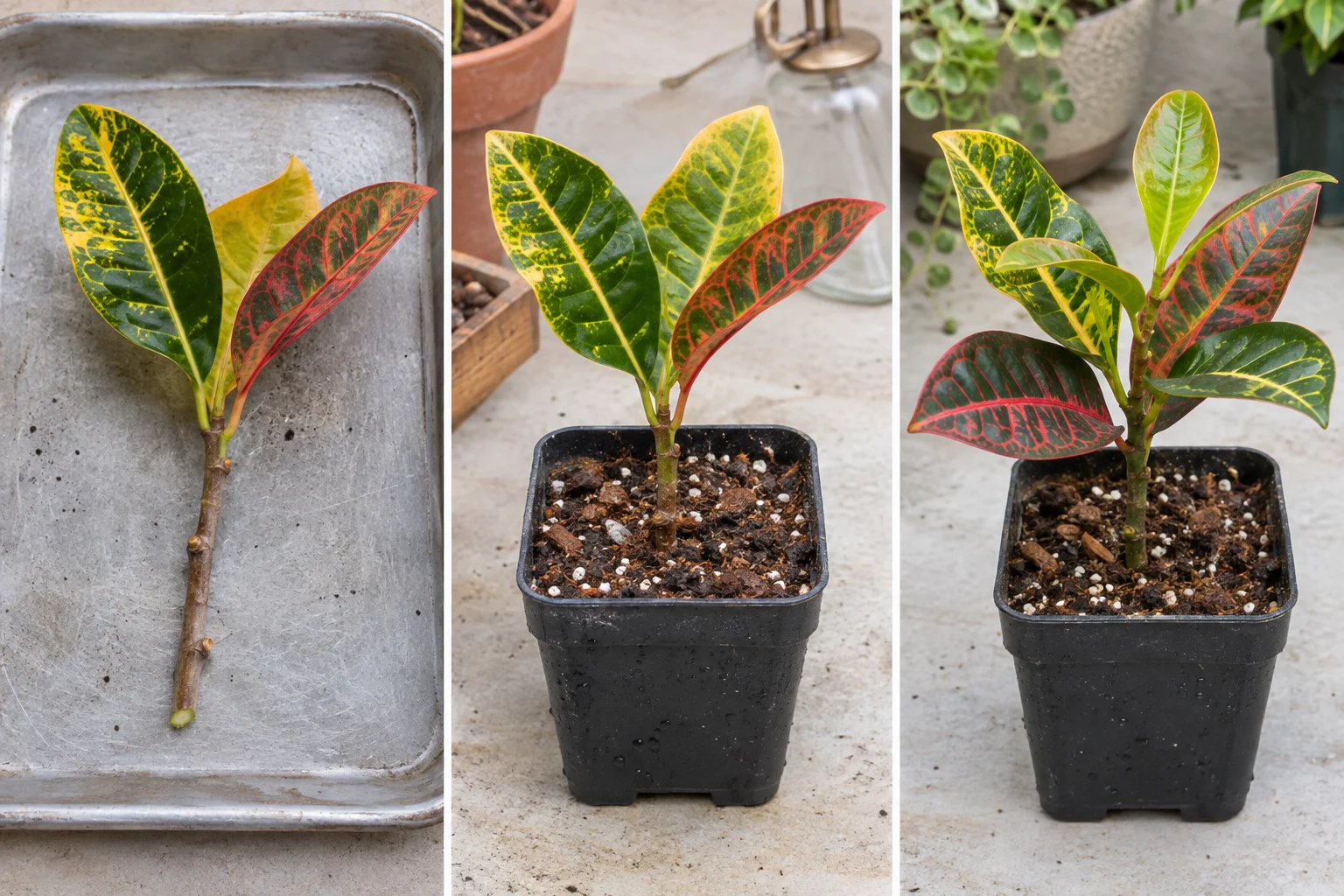
Panels, from left to right
- Choose a healthy leafy stem during warm growth and prepare an airy rooting pot before cutting.
- With gloves on, take a node-bearing cutting and remove foliage that would be buried, avoiding sap contact.
- Keep the cutting warm in filtered light with supportive humidity; watch for roots and new shoots before potting on.
Mites can hide beneath the brightly patterned leaves
The bold leaf colours can camouflage the fine pale stippling of spider-mite feeding. Examine the underside and the junction between leaf stalk and stem, using magnification if needed. Fine webbing and spreading loss of surface quality are more informative than one pale spot. Mealybugs and scale may also gather on protected stems, sometimes leaving sticky residue.
Isolate a suspect croton and identify the pest before applying a product. Its leaves and sap already require careful handling; aggressive repeated wiping or untested sprays can create additional injury. Use only treatments labelled for the situation, testing a small area first. Reinspect new leaves and sheltered joints after the first intervention instead of assuming the brightest leaves show the whole problem.
[1][4]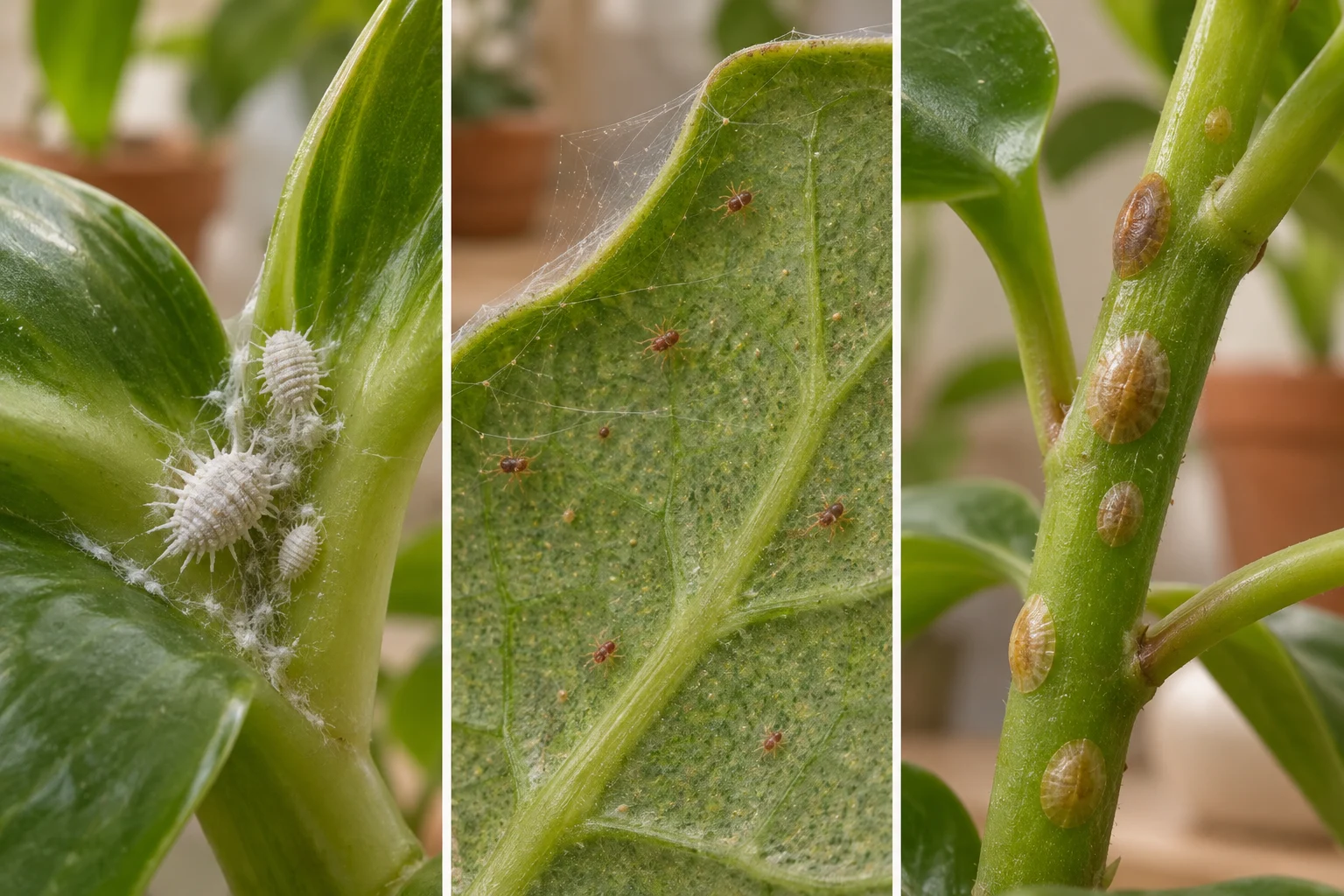
Panels, from left to right
- Mealybugs
- Spider mites
- Scale insects
Leaf loss needs a timeline, not one explanation
Record whether leaves began falling after transport, a cold night, a watering lapse or a move to a darker room. Crotons can respond to several environmental changes with the same visible result. Firm stems and viable buds after a recent move offer a different outlook from soft stems above a saturated root ball. Avoid changing light, feed, pot and watering simultaneously when the cause is unclear.
A leaf already dropped cannot be restored to its old node, but healthy buds may produce replacement growth once conditions stabilize. Brown crisp edges suggest reviewing dryness and airflow; soft dark areas call for checking moisture and tissue condition. Colourful older leaves naturally changing shade should be assessed separately from expanding lesions. Persistent decline despite stable care deserves root inspection or professional plant-health advice.
[1][4]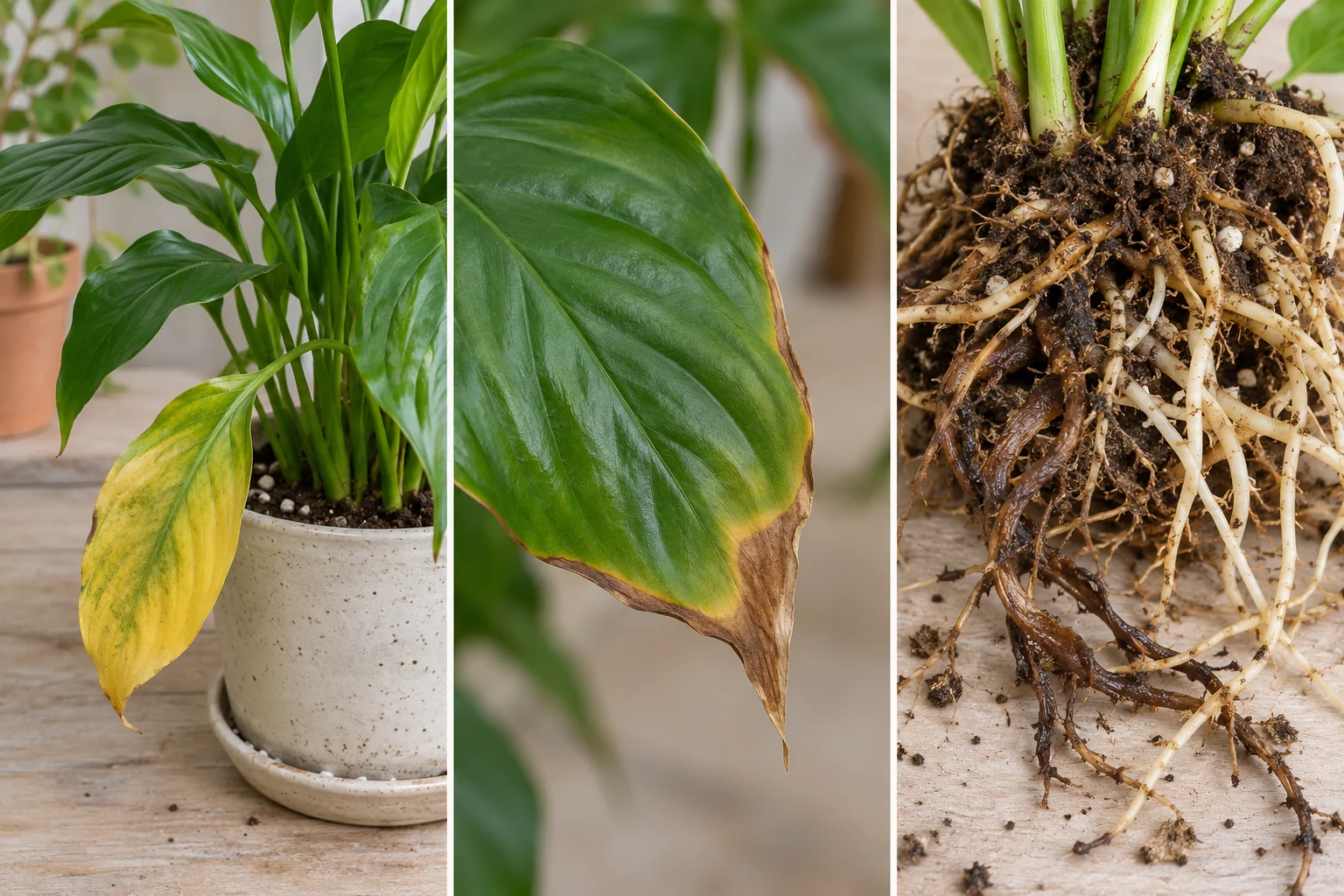
Panels, from left to right
- Yellowing foliage
- Brown leaf edges
- Damaged roots
Leaves fall after a change of room
- Possible causes
- A croton can react to sudden differences in temperature, light or moisture after transport or relocation.
- What to check
- Compare the timing of leaf loss with the move, cold exposure and the moisture of the original root ball.
- Next step
- Stabilize the growing position and avoid stacking repotting, heavy feeding and further moves.
New leaves become greener and spaced farther apart
- Possible causes
- Insufficient light can reduce the coloured display and produce a looser croton canopy.
- What to check
- Compare the newest branch growth with older growth and assess daylight at the leaf surface.
- Next step
- Increase useful light gradually while protecting the plant from abrupt hot sun; do not chase colour with extra feed.
Fine dull speckling beneath bold colours
- Possible causes
- Spider mites can damage croton leaves while normal variegation partly hides the early signs.
- What to check
- Inspect undersides and leaf joints for webbing and moving mites, using magnification if available.
- Next step
- Isolate the shrub and choose a confirmed-pest response suited to indoor ornamentals, testing treatments first.
A tropical shrub has no required winter dormancy
Croton remains evergreen and does not need a cold, dry dormancy to flower or survive. In a temperate home, shorter days usually slow growth, so watering and feeding should decline with use. Keep warmth and the brightest suitable position through that quieter period. Do not deliberately expose the plant to cold to encourage colour.
A summer stay outdoors can provide good light, but begin in shelter and introduce stronger exposure gradually. Bring the plant back before cold nights become a problem, with time to inspect for pests. Plan the return location in advance so it does not spend days in a dim hallway while space is cleared. Stability is especially valuable during this seasonal transition.
[1][4]Small flower clusters sit behind the foliage display
Crotons may produce slender inflorescences with separate male and female flowers. The male flowers can look like tiny pale starbursts; the female flowers are less conspicuous. Indoor flowering is possible, but a plant without flowers is not necessarily immature or poorly cared for. There is no need to force a bloom through high-phosphorus feeding.
Pollinated female flowers can develop into small capsules containing seeds. Those seeds do not preserve a cultivar’s exact leaf pattern. Keep any fallen reproductive material away from children and pets, just as with cut foliage. If flower stems are removed for tidiness, apply the same sap precautions used for pruning branches.
[1][4]Treat sap and fallen leaves as handling hazards
RHS describes croton as poisonous if eaten and its sap as a skin and eye irritant. Keep the plant and pruning waste inaccessible to children and pets. Gloves are particularly useful when taking cuttings, trimming branches or cleaning up broken leaves. Wash exposed skin after handling and avoid touching the face while working.
Do not use this ornamental shrub as a food plant or a source of home remedies. If ingestion or a significant exposure occurs, seek advice from an appropriate medical or veterinary service and provide the name Codiaeum variegatum. The common word croton alone can refer to other plants, so accurate identification matters. Follow professional advice rather than trying to diagnose exposure from the leaf colour.
[1][4]Use observations to stabilize the display
A useful croton care record follows new leaf development, room temperature and the interval in which the root ball dries. Comparing photographs of the same branch can reveal whether new leaves are becoming smaller, greener or more widely spaced. Change one care factor at a time when practical, so improvement can be linked to an actual adjustment.
An inert-medium or reservoir experiment changes moisture and nutrition together and is not a shortcut for a plant dropping leaves. First establish a healthy specimen in a predictable setup. If experimenting later, use a separately rooted cutting and a system with controlled nutrients and aeration. Protect the established coloured plant while learning how the alternative medium behaves.
[1][4]Cultivar differences are part of the attraction
Selections such as Petra, Gold Dust and Spirale differ in leaf markings and shape. Petra is associated with bold coloured veins, Gold Dust with yellow spotting, and Spirale with twisted leaves. Those descriptions are useful comparisons, not a reliable identification key for every unlabelled plant. Growing conditions and leaf age can alter how a selection appears.
Keep a supplied cultivar label with its source. A broad-leaved unnamed croton should remain unnamed rather than acquiring a fashionable identity from a similar photograph. The same basic need for warmth, suitable moisture and useful light applies across these selections, while a larger or denser canopy may change how quickly its particular pot dries.
[3]Frequently asked questions
Is garden croton actually in the genus Croton?
No. The familiar colourful houseplant is Codiaeum variegatum. Croton is a separate botanical genus. Use the scientific name when checking care, toxicity or a plant label so that advice for unrelated plants is not mixed in.
[1][3][4]Does a green new croton leaf mean the plant has lost its variety?
Not necessarily. Leaf age, cultivar and light affect the colour display. Compare several developing leaves and the recent light conditions before concluding that the plant has changed identity or needs extra fertilizer.
[1][3][4]Why did my croton shed leaves after the trip home?
Transport can combine cold exposure, moisture changes and a sudden difference in light. Place it in stable warm bright conditions and check the root ball. Repeated moves and immediate heavy feeding may prolong the stress.
[1][3][4]Can I restore the original colours by giving croton more fertilizer?
Extra feed is not a reliable colour treatment. Appropriate light and the plant’s genetics matter, and young leaves may develop their colours with age. Feed only to support active growth at a suitable container rate.
[1][3][4]Are twisted croton leaves always a sign of pests?
No. Some selections, including Spirale, naturally have twisted foliage. Look for new distortion inconsistent with the established pattern, webbing or visible insects before treating the normal leaf shape as damage.
[1][3][4]Can a croton’s bare lower stem produce a fuller plant again?
A healthy plant can branch after pruning above leaf joints during active growth. First improve the conditions that caused leaf loss, and preserve enough foliage for recovery. A soft or dying stem needs diagnosis rather than cosmetic pruning.
[1][3][4]Should croton spend winter in a cold room to rest?
It does not require a cold dormancy. Keep the shrub warm while reducing water and feed as growth slows in lower light. Cold draughts can cause additional leaf loss instead of providing a useful rest.
[1][3][4]Why can croton drop leaves when the soil is wet and also when it is dry?
Both prolonged drought and saturated roots can disrupt water supply to the canopy. Inspect the root ball and recent care history; the fallen leaves alone cannot tell you which condition occurred.
[1][3][4]Will croton seeds reproduce the exact pattern of Petra?
Seed-grown offspring vary. To retain a named selection, use vegetative propagation such as a suitable stem cutting or air layer from a correctly identified parent. Keep the parent label with the resulting plant.
[1][3][4]What do the tiny pale sprays on my croton represent?
They may be inflorescences, especially the small male flowers that look like pale starbursts. Inspect their organized structure before assuming they are insects. Flowering is optional for a successful indoor foliage plant.
[1][3][4]Why is leaf colour a poor way to diagnose croton mites?
Its normal yellow and red markings can hide feeding damage. Look beneath leaves for fine stippling, webbing and moving pests, and compare new changes with the cultivar’s established pattern.
[1][3][4]Compare related plants
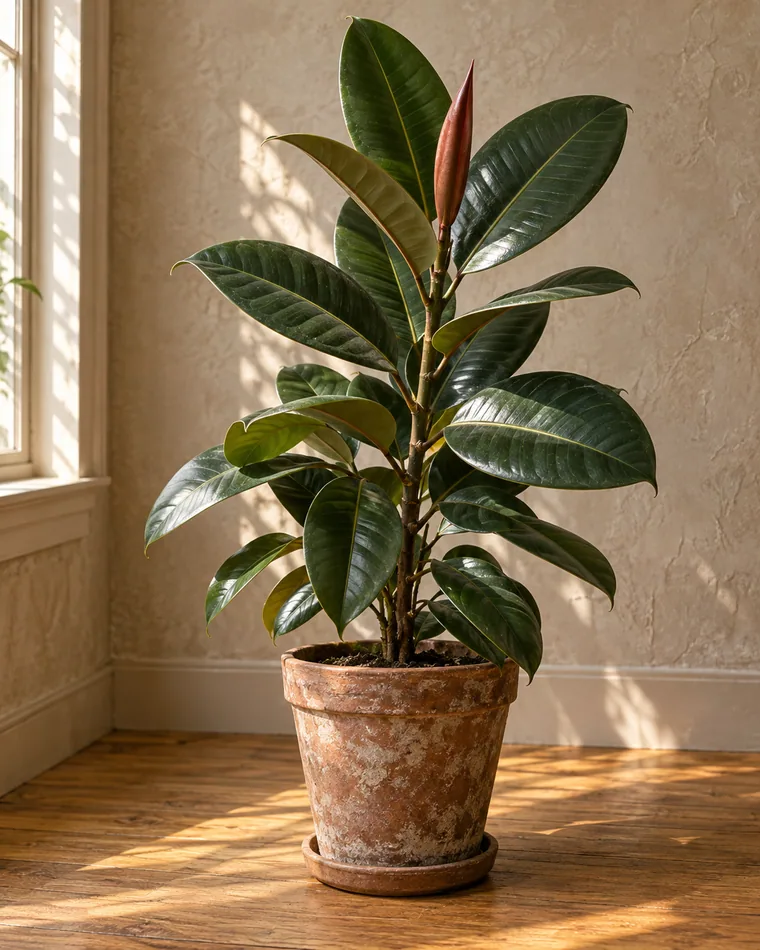
- Rubber plant: Rubber plant offers larger, simpler leaves and a more architectural outline. Croton’s smaller branching canopy carries many colour patterns but is especially sensitive to abrupt changes of conditions.
- Copperleaf: Copperleaf is another colourful tropical shrub in Euphorbiaceae. Croton usually has firmer glossy leaves; copperleaf’s broader, often softer foliage creates a different texture and growth habit.
Care reminders with PlantPal
Record your croton in PlantPal and use care reminders to review new leaf colour, room warmth and root-ball moisture together.
Keep my croton care record