 Plant
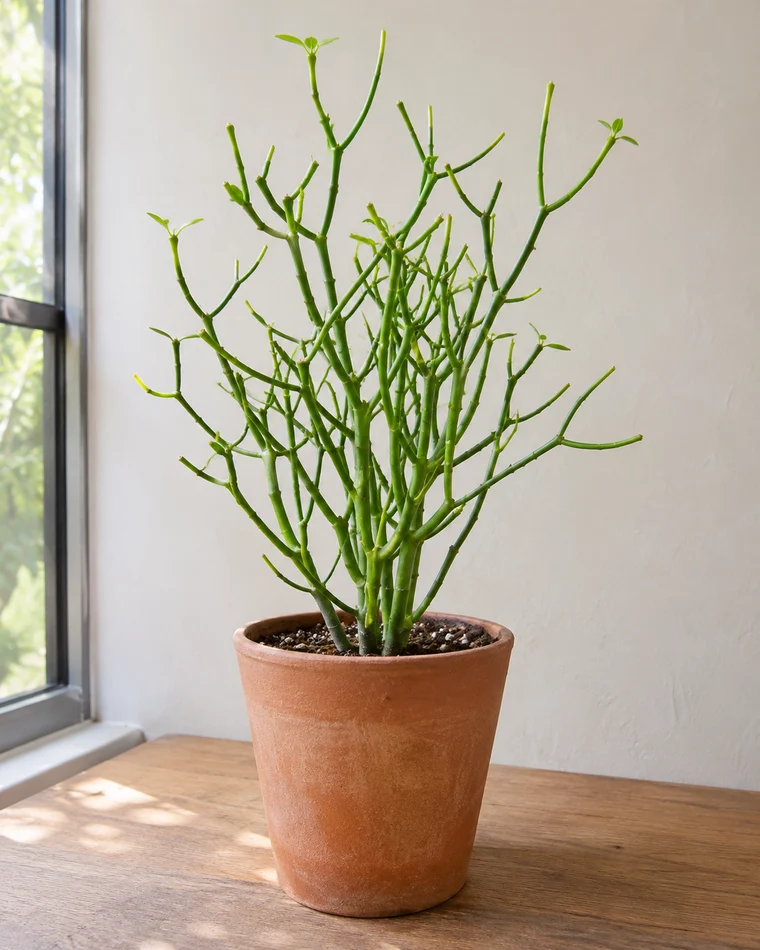
Pencil cactus.
Euphorbia tirucalli
Pencil cactus, Euphorbia tirucalli, is a succulent spurge whose slim green branches create an airy, sculptural outline. Tiny leaves appear near growing tips but soon fall, leaving the stems to define the plant. It needs substantially more light than many foliage houseplants. Its spineless appearance also hides an important limitation: broken stems release hazardous latex, so safe placement and handling belong at the center of its care.
How to help it thrive.
Checked:
Quick care reference
- Identity: Euphorbia tirucalli, a spurge rather than a true cactus.
- Give strong light and acclimate gradually to direct outdoor sun.
- Allow the medium to dry before watering again.
- Use a draining container and a structured succulent medium.
- Tiny leaves naturally drop; firm green stems can remain healthy.
- Warm indoor conditions suit it; protect from cold glass and frost.
- Fresh and dried latex can harm skin and eyes; protect against accidental breakage.
- Keep children and pets away; rooted nursery stock is the simpler beginner option.
A succulent spurge with pencil-thin branches
Pencil cactus is Euphorbia tirucalli, a succulent shrub or tree in Euphorbiaceae, not a member of the cactus family. Kew accepts the species and currently places its native range in Madagascar; its long history of cultivation explains a much wider present distribution. Green cylindrical branchlets create the characteristic outline above older woody supports. The plant is perennial and can become a substantial specimen, so its initial small pot should not define your long-term expectations.
NC State describes indoor plants around 0.6–1.8 m tall, with considerable variation in conditions and pruning. Choose a location that leaves the brittle branches clear of passing people, pets and window controls. This matters as much as finding adequate light: accidentally snapping a branch releases irritating latex. If the only sunny position is a busy narrow passage or an accessible pet perch, choose a different plant rather than relying on its lack of spines.
[1][2][3]Look for round stems and short-lived tiny leaves
Young growth consists of slim, smooth, green cylindrical stems. Very small leaves may appear near active tips and then fall early, leaving the familiar nearly leafless plant. Older supporting portions turn woody and brown. This combination explains why a healthy specimen can have few visible leaves. It does not mean that soft, dark or collapsing stems should be treated as normal seasonal change.
Other pencil-shaped succulents and cactus relatives can look similar in a shop photograph. Retain the scientific label and compare the complete branching pattern, not just one isolated stem. Do not snap a piece to check for white sap: latex is a hazard, not a home identification test. Green branches are normal for the species; red or orange coloration is not required to prove that you bought the correct plant.
[2][6]Strong light is essential for sturdy growth
Give pencil cactus the sunniest suitable indoor position, introducing stronger exposure gradually. Window orientation alone is insufficient: neighboring buildings, trees and seasonal sun angles can reduce actual exposure. Slender stretched growth in a dim room will not be corrected by a larger fertilizer dose.
An appropriate grow light can supplement a weak window, but its output, coverage and distance matter more than the word 'full spectrum' on packaging. Follow equipment guidance and evaluate new branch strength while retaining a dark period. Even an indoor plant accustomed to sun may scorch after an abrupt move outdoors. Increase exposure gradually and protect it from exceptionally harsh afternoon heat where local conditions demand it.
[2][6]Let the root zone dry between thorough waterings
Wait for the medium to dry before watering again, checking more than the top decorative layer. When watering is needed, wet the root zone evenly, let runoff escape and empty the outer container. A plant in strong light and active growth will use moisture differently from one in a cool, dim winter room. Neither a fixed weekly schedule nor the label 'succulent' can replace checking the pot.
The stems store water, but that does not mean indefinite drought is harmless. Shriveling in a thoroughly dry pot suggests a different situation from wrinkling or drooping above wet, damaged roots. Examine moisture history before adding water. In reduced light or slower growth, lengthen the interval as the medium dictates. A persistent wet reservoir beneath a small root system is particularly risky, even if the exposed branch tips look dry.
[2][6]Use a gritty medium and a manageable container
Choose a freely draining succulent medium with enough coarse structure to avoid prolonged saturation. Inspect a bagged cactus mix after watering instead of assuming the label guarantees rapid drying in your home. Dense organic material and an oversized container can retain water around a relatively small root system. A drainage hole is essential to make excess water removable; stones beneath wet medium do not replace it.
Repot only when root growth or deteriorated medium makes it worthwhile, and choose a modest increase in root space. The brittle canopy makes handling a tall plant difficult. Gloves, eye protection and protective clothing are appropriate even when no pruning is planned because accidental breakage can release sap. For a large tangled specimen, obtaining experienced assistance is more sensible than forcing it through a narrow doorway or gripping the branches to lift it.
[2][6][3]Warm rooms and ordinary dry air
Pencil cactus suits warm household conditions and does not need a humid enclosure. Keep it clear of cold glass, frost and strong air-conditioning drafts. A warm daytime room can conceal a cold nighttime windowsill, so check the actual plant position rather than relying only on a central thermostat.
Misting is unnecessary for this plant and does not solve stem shriveling caused by root trouble. Good air movement helps the pot dry, while constantly humid, still surroundings can keep an already retentive medium wet longer. If moving outdoors in warm weather, consider both overnight temperatures and rainfall. Bring it into protected conditions before cold develops, without exposing unacclimated stems to a sudden change from indoor shade to intense outdoor sun.
[2][6]A restrained nutrient routine
A modest, label-directed succulent fertilizer during active growth is more appropriate than frequent feeding intended for fast-growing leafy plants. Account for nutrients already included in a commercial medium. Pencil cactus needs strong light to produce sturdy branches; fertilizer cannot compensate for a dark position. Avoid feeding a dry, stressed or root-damaged plant as an attempted rescue.
Use branch development and overall condition to review the routine, rather than chasing red coloration with additional nutrients. If deposits accumulate on the pot or stem deterioration follows a heavy application, reconsider fertilizer concentration and drainage. Pause feeding during a slow, dim period. Healthy green growth is a reasonable target for the species; increasingly soft or stretched growth is a reason to examine the environment, not to increase every input.
[2][6]Plan space before the branches become crowded
The open framework can gradually become a dense tangle of brittle pencil-like stems. Keep the canopy clear of curtains, passing shoulders and objects that must be reached regularly. Move the pot by its container, never by the branchlets. A brown, firm, woody lower trunk can be normal maturation; brown tissue that is soft or spreading upward deserves closer investigation.
Pruning is possible, but every cut creates a sap exposure and should not be treated like pinching a harmless herb. For large plants, overhead growth or substantial reshaping, use a competent professional and explain the species' latex hazard. Do not make trial cuts merely to see whether the plant is alive. Where recurring pruning would be required to keep it safe indoors, a smaller specimen or another plant may be the more practical long-term choice.
[2][6][3]Understand stem propagation without casual sap exposure
Euphorbia tirucalli can be propagated by stem cuttings, but this is not a suitable casual cutting activity around children or pets. An already rooted nursery plant is the simplest option for an inexperienced grower. Experienced propagators protect eyes and skin, contain cut material and allow the prepared cutting's base to dry and form a firm callus before rooting. Dried sap remains a handling concern; a sealed cutting is not a toy or a safe bare-handed object.
The teaching sequence shows a professionally prepared cutting, its placement in a freely draining propagation medium and eventual establishment. It deliberately does not depict snapping a stem or handling dripping latex. Rooting time varies with warmth and conditions, so new growth alone is not a reason to flood the pot or transplant immediately. Keep the process inaccessible and obtain experienced help when unsure.
[2][6]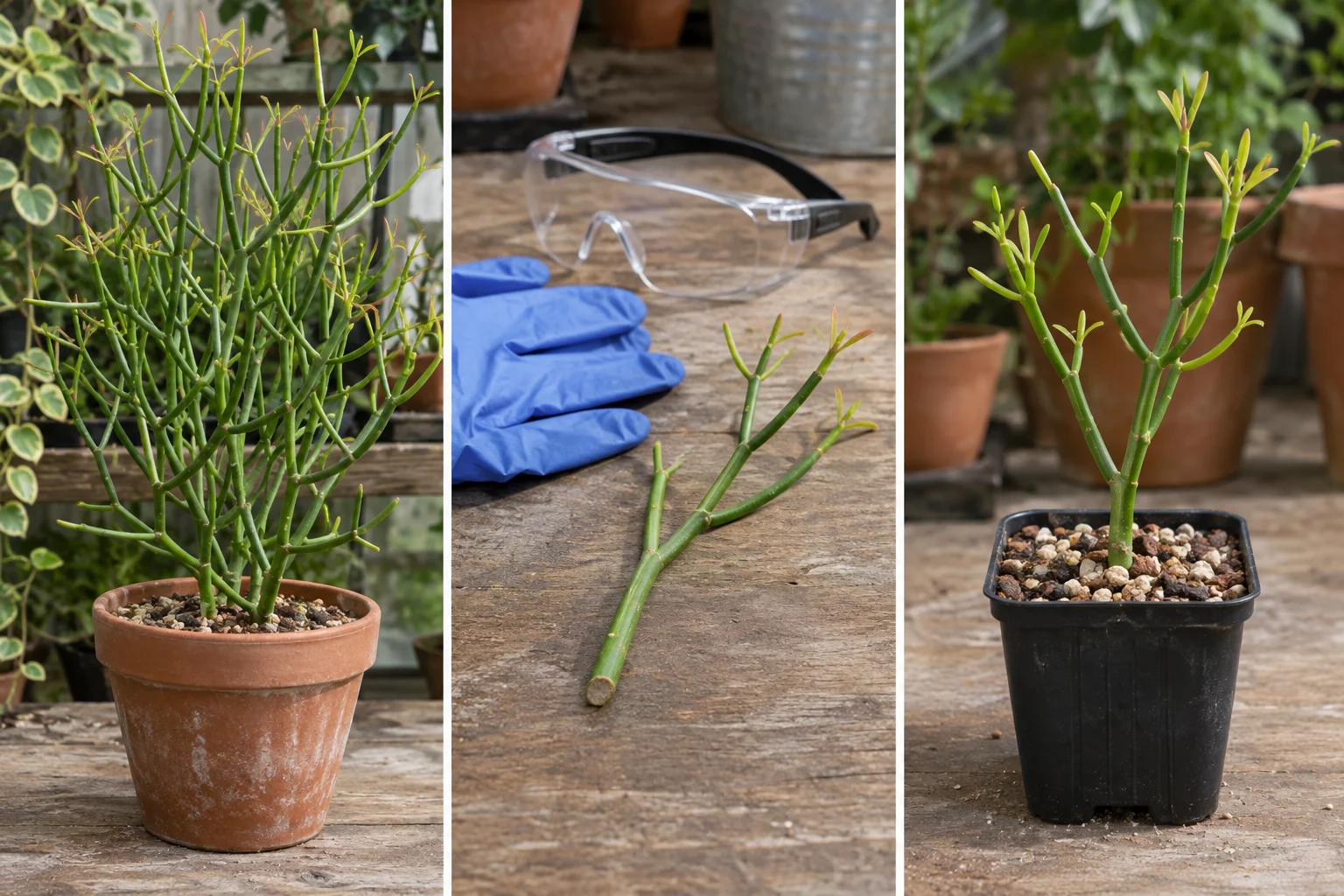
Panels, from left to right
- Start with an intact identified plant; beginners can choose rooted nursery stock instead of making a cutting.
- An experienced propagator uses protected handling and a prepared, dry-callused cutting in freely draining medium; no water rooting.
- Keep the young plant inaccessible while it establishes roots, then move it carefully into an appropriate growing pot.
Inspect without bending or breaking the stems
Mealybugs and spider mites are among the pests to watch for. Inspect branch junctions and newer growth using a magnifier, keeping fingers away from suspect dried sap. White cottony material may indicate mealybugs, while fine webbing and stippling can suggest mites. Deposits, injury and pest signs can be confused, so obtain a clear identification before treating a plant with such fragile growth.
Isolate an affected specimen where it will not be brushed accidentally. Use a product only when its label permits the pest, succulent ornamental and indoor application concerned. Avoid improvised corrosive mixtures or vigorous scrubbing that can damage stems and expose latex. Persistent softening may reflect root disease rather than insects. If treatment or inspection requires extensive handling of a crowded specimen, ask a qualified horticultural professional to help.
[2][6][3]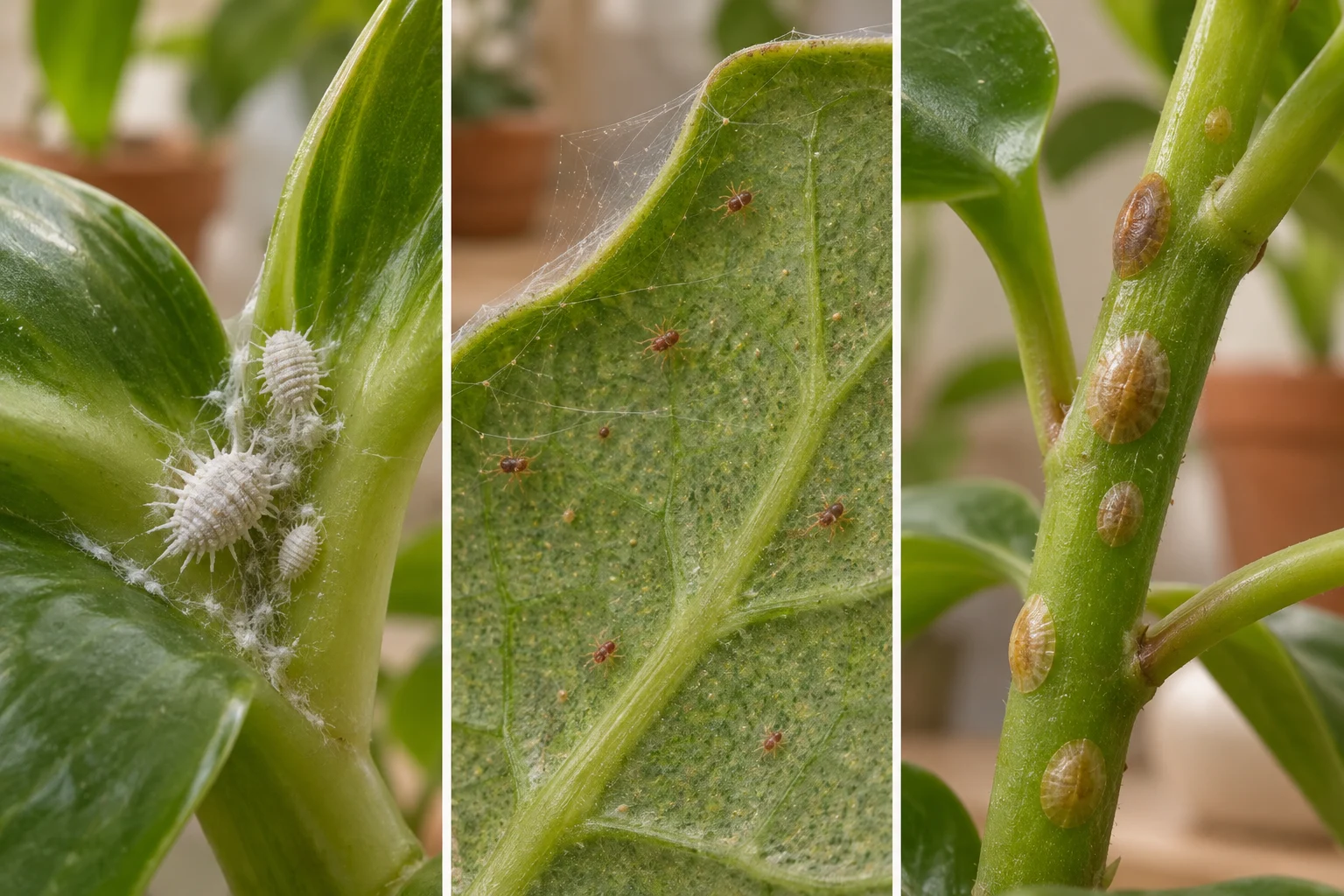
Panels, from left to right
- Mealybugs
- Spider mites
- Scale insects
Read the stem together with the pot
Tiny leaves dropping from firm green tips can be normal. Whole branchlets becoming soft, black or detached are a different observation. Prolonged wetness can damage roots and stem bases; cold or sudden intense sunlight can also injure exposed growth. Gradual firm bark formation at the base should be distinguished from a wet, spreading lesion. These possibilities overlap, and a color photograph alone cannot identify the cause.
Compare the timing of symptoms with watering, a move outdoors, cold nights or a new window position. Check drainage without breaking a branch for inspection. Severe softness spreading from the base may leave little healthy plant to recover, and repeated watering can worsen the situation. Arrange protected handling and specialist advice when deterioration is rapid. Do not turn a diseased plant into an improvised cutting project without accounting for the same sap hazard.
[2][6]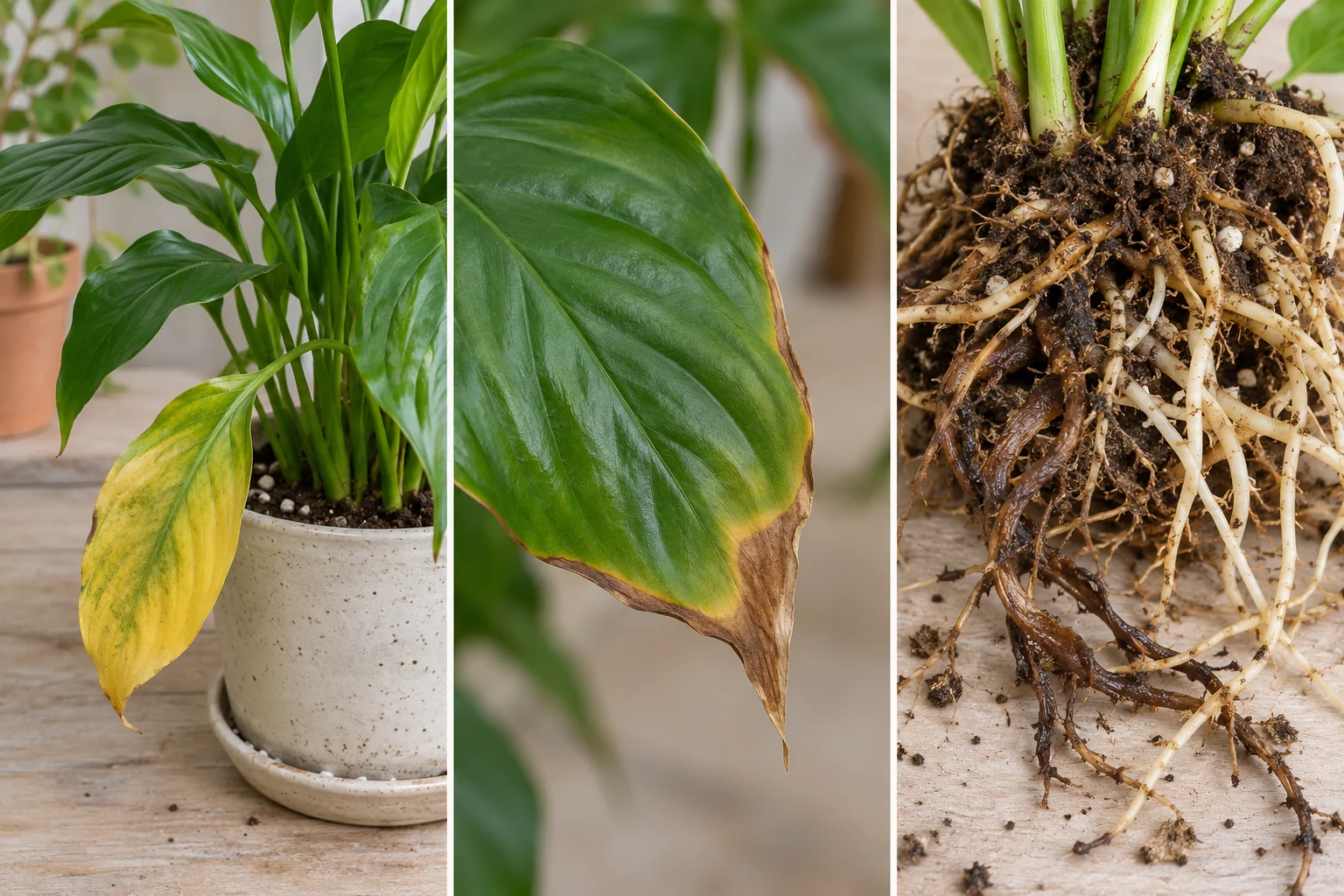
Panels, from left to right
- Yellowing foliage
- Brown leaf edges
- Damaged roots
Tiny leaves falling from green branch tips
- Possible causes
- Short-lived tip leaves may be shedding normally; stress is more concerning if stems also soften or decline.
- What to check
- Observe stem firmness, new tip growth and root-zone moisture without snapping a branch.
- Next step
- Do not increase watering solely to replace tiny leaves; investigate if whole branchlets deteriorate.
Soft dark tissue near the pencil-cactus base
- Possible causes
- Prolonged wetness and root or stem decay are possibilities, distinct from firm natural bark formation.
- What to check
- Review trapped runoff, drying time and whether discoloration is spreading into soft tissue.
- Next step
- Avoid more water into a wet pot and obtain protected expert help if deterioration is rapid.
Long weak shoots leaning toward light
- Possible causes
- Insufficient illumination may be producing stretched growth; unstable pot support can add to the lean.
- What to check
- Compare actual sun exposure and branch strength with the container’s balance and safe clearance.
- Next step
- Improve light gradually and stabilize the container without gripping stems or making casual corrective cuts.
A brighter growing period and a drier slow period
In a bright active season, check whether the enlarging framework still has safe clearance and balanced light. Water may be needed more often when the medium actually dries faster. If moving outdoors, acclimate the stems and shelter the container from repeated rain that outpaces drying. Strong sunshine does not make a pot immune to waterlogging.
As light decreases, growth and water use often slow. Extend watering intervals according to moisture and stem condition, and pause fertilizer rather than maintaining a summer routine. Indoors, inspect the nighttime window environment and avoid cold drafts. Before bringing an outdoor plant back, check pests and plan a route wide enough for its brittle crown. A safe transition matters more than moving it on a predetermined calendar date.
[2][6]Small flowers, not showy cactus blooms
Pencil cactus can produce tiny yellowish flowering structures near branch tips. It is usually grown for its sculptural stems, and indoor flowering is not a dependable performance measure. Its spurge flowers are botanically different from the large flowers people may expect from the common word 'cactus'. Do not interpret a flowerless but steadily growing plant as automatically deficient.
If flowering or fruits appear, maintain the same restricted access used for stems. These structures are not edible, and seed production is not necessary for ordinary houseplant care. The existence of seed propagation does not make it the simplest route for keeping a particular nursery form. Avoid withholding water excessively or adding strong fertilizer merely to trigger reproductive growth in a plant whose light supply is already limited.
[2][6]Treat the latex as a serious contact hazard
The white latex can irritate skin and cause serious eye injury. UC ANR warns that dried sap can also be hazardous and that the spineless appearance may mislead people. Use gloves, eye protection and protective clothing for necessary handling, and prevent accidental contact by children or animals. Even moving the plant can break a brittle branch, so caution is not limited to scheduled pruning.
If sap enters an eye, begin rinsing with clean water immediately and seek urgent medical or poison-center guidance; do not wait to see whether pain settles. Wash skin exposure promptly and seek advice for significant or persistent symptoms. Suspected ingestion also warrants prompt professional advice, or veterinary help for pets. Do not use the sap as a home remedy, test it on skin or leave cut stems accessible. Give advisers the name Euphorbia tirucalli.
[3][2][4]A safe location is part of advanced care
For a mature plant, improving light without creating a collision hazard is a practical design problem. A narrow shelf in a sunny passage may be less suitable than a protected position with supplemental lighting. Map the full branch spread, including likely new growth, before selecting a permanent spot. Access to the pot for watering should not require reaching through the crown or pulling stems aside.
Water-culture experiments and frequent reshaping add handling without providing a demonstrated advantage for a healthy specimen in draining medium. Keep changes simple enough to evaluate: adjust illumination, observe drying and document new branch strength. Consider the effort of safe repotting before letting the plant become very large indoors. If circumstances change and an inaccessible position is no longer available, responsible rehoming is preferable to repeatedly cutting it back in a busy living area.
[2][6][3]Green species plants and ‘Sticks on Fire’
The ordinary species is commonly green. A named form, 'Sticks on Fire', is documented in botanical collections and is associated with conspicuous yellow, orange and red stems. Keep the nursery label rather than assigning the cultivar name to every temporarily colored branch. Color can also vary with growing conditions, and it does not provide a reliable diagnosis of health by itself.
No color form removes the latex hazard or the need for strong light and drainage. Do not deliberately expose a green plant to frost or severe drought to imitate a photograph of brightly colored growth. Select a plant for its documented identity, achievable size and safe placement. Similar common names such as pencil tree, milkbush and fire sticks can overlap in trade, making the scientific name especially useful when seeking care or exposure advice.
[5][2][6][3]Frequently asked questions
Why does my pencil cactus lose its tiny leaves but keep green stems?
Those small tip leaves are short-lived and can drop naturally while stems remain healthy. Softening, blackening or loss of entire branchlets is a different sign. Check the stem condition and root-zone moisture rather than watering simply to replace the tiny leaves.
[2][6]Is Euphorbia tirucalli a true cactus?
No. It belongs to Euphorbiaceae, the spurge family. Its succulent shape and common name do not place it in Cactaceae, and the absence of spines does not mean that its irritating latex is harmless.
[2][6]Can I break a pencil stem to confirm the white sap?
Do not use breakage as an identification test. The latex can injure skin and eyes, and brittle stems may release it unexpectedly. Use the scientific label, complete growth pattern and expert identification instead.
[3]Is a brown pencil-cactus trunk always rotting?
A firm woody lower trunk can be normal as the plant matures. Soft, wet, spreading discoloration is more concerning. Compare tissue condition, drying time and recent cold exposure without cutting into the plant as a casual test.
[2][6]Why is my pencil cactus stretching in a bright-looking room?
Human perception of room brightness can overestimate usable plant light. Assess the actual window and consider appropriate supplemental light.
[2][6]Should every pencil cactus turn orange or red?
No. Green growth is normal for the species. Named forms and exposure influence color, but redness is not a required sign of good care. Do not use cold or extreme drought to force a color change.
[2][6]Does dried pencil-cactus sap become safe to touch?
No. UC ANR specifically warns about dried sap as well as fresh latex. Protect skin and eyes during necessary handling and keep broken pieces inaccessible. A dry-looking cutting should not be handed to a child or handled casually.
[3]Can I root a pencil-cactus branch in a glass of water?
Experienced propagators use prepared, callused stem material in a suitable draining medium. For a beginner, an already rooted nursery plant avoids the initial cutting and sap-management task.
[6][2]Why can a wrinkled pencil cactus still be overwatered?
Damaged roots in wet medium may fail to supply stems effectively. Wrinkling alone therefore does not prove drought. Check moisture throughout the root zone and recent watering before adding more water to a pot that is already wet.
[2][6]Is misting useful for pencil-cactus branches?
It does not meet this species’ root-water needs, and ordinary dry indoor air is generally suitable. Persistent stem decline calls for reviewing light, root moisture and temperature. A humid enclosure may slow drying without correcting the cause.
[2][6]Can I safely keep pencil cactus beside a busy doorway?
That is a poor placement when people or pets can brush brittle stems. An accidental break can expose latex. Choose a protected, inaccessible position with enough light and clearance, or select a plant better suited to the available space.
[3]What if pencil-cactus latex splashes into an eye?
Start rinsing with clean water immediately and seek urgent medical or poison-center guidance. This exposure can cause serious injury; do not wait for symptoms to become severe. Provide the name Euphorbia tirucalli and explain the contact.
[2]Is pencil cactus safe for a dog that ignores most plants?
It is not pet-safe. Exposure can irritate the mouth, digestive tract, skin or eyes, and accidental branch breakage can occur without chewing. Prevent access and contact a veterinarian promptly after suspected exposure.
[4][3]Why did branches brown after moving my pencil cactus outdoors?
Cold exposure or a sudden increase in intense sun are possible explanations, alongside root problems. Compare the timing and whether damage is mainly on exposed stems. Return to suitable protected conditions and seek help if softness spreads.
[2][6]Should I prune a large pencil cactus over my head?
Avoid this situation: falling sap and cut material increase exposure risk. Arrange competent professional help for substantial or overhead work and identify the plant clearly. Planning adequate space earlier is safer than repeated difficult pruning.
[3]Does flowering mean the pencil cactus needs a wetter routine?
No. Small flowering structures do not override the need to let the medium dry between waterings. Keep judging moisture, light and active growth. Indoor flowering is optional, and the plant does not need forced wetness or heavy feeding to be healthy.
[2][6]Compare related plants
- Aloe vera: Aloe vera stores water in broad leaves rather than pencil-like branches; its own safety limits still need checking rather than assuming all succulents are interchangeable.
- White frangipani: White frangipani also has sap-bearing stems and high light needs, but its broad seasonal foliage and fragrant flowers create a different watering and space-management problem.
Care reminders with PlantPal
Add pencil cactus to PlantPal for reminders to inspect pot moisture and safe branch clearance before routine care.
Add pencil cactus