 Plant
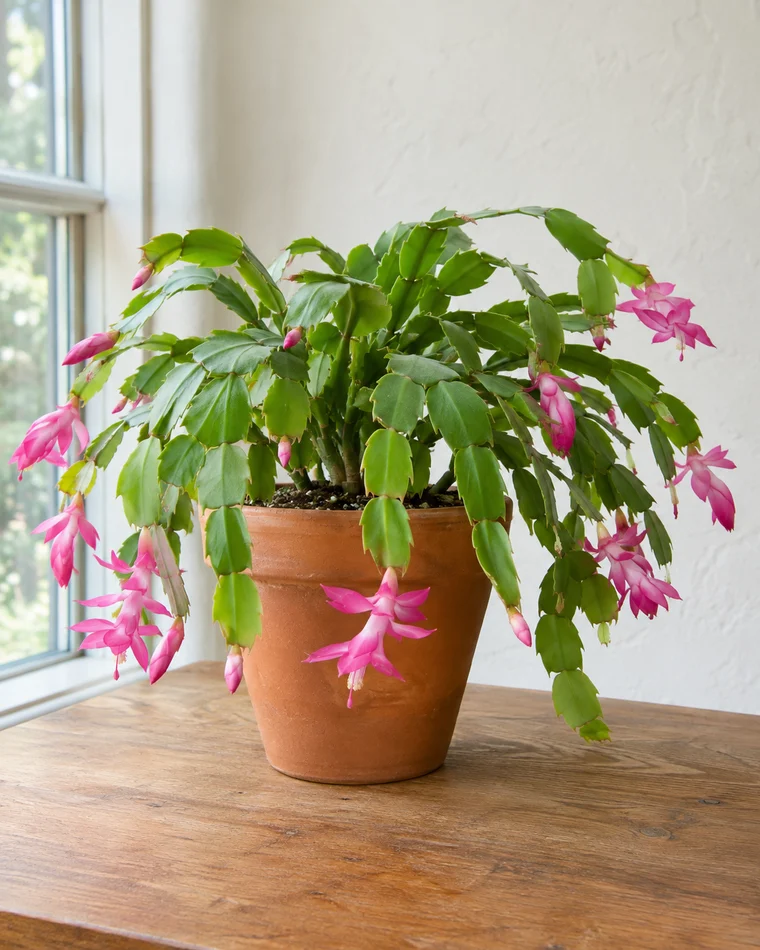
Christmas cactus.
Schlumbergera × buckleyi
True Christmas cactus forms a soft cascade of rounded green stem segments, followed by pendant flowers when seasonal conditions suit it. Schlumbergera × buckleyi is a forest-cactus hybrid with its own identity: give it airy roots, filtered daylight and a quieter, darker night as buds are prepared.
How to help it thrive.
Checked:
Quick care reference
- Identity: rounded segment margins distinguish the true Christmas-cactus type from pointed Thanksgiving-cactus forms.
- Daylight: filter strong window sun while keeping the trailing canopy well lit.
- Moisture: allow slight surface drying during growth; keep the root ball out of prolonged drought and saturation.
- Roots: use a draining pot and a moisture-retentive but well-aerated substrate.
- Flower preparation: combine uninterrupted long nights with moderately cooler conditions.
- Shaping: remove selected terminal segments after flowering, not during bud preparation.
- Continuity: root a healthy stem cutting before renovating a sentimental old specimen.
- Safety: verified Christmas cactus is classed non-toxic, but plant parts and potting products are not food.
A long-lived forest-cactus hybrid
Schlumbergera × buckleyi belongs to Cactaceae and combines the parentage of S. russelliana and S. truncata. The cross was developed in cultivation, so it is more accurate to describe Brazilian forest ancestry than to give the hybrid its own wild native range. A young plant grows upward before its jointed branches arch over the rim. That changing silhouette is normal development, not evidence that a climbing support is missing. It suits a raised pot or hanging container where stems can hang without being brushed or trapped.
Indoor specimens commonly occupy a few tens of centimetres in height and width, while an established, well-supported collection plant can spread considerably farther. The container and branch length matter more than a single promised mature measurement. Some holiday cacti survive for decades, but no age is guaranteed. An inherited specimen deserves attention to the condition of its old growing medium, even when its thick basal stems look sound. Keep a rooted backup cutting if preserving that particular plant has sentimental value.
[3][2][4]Rounded segments, not crab-claw teeth
Look closely at the edge of a mature green segment. True Christmas cactus has rounded scallops; Thanksgiving cactus, S. truncata, has noticeably pointed projections. Both consist of flattened photosynthetic stems rather than conventional leaves. The true Christmas type usually develops a more pendant outline and downward-facing tubular pink to red flowers. A plant sold in December is not identified by its sales date, and a mixed-parentage cultivar can show intermediate features. Record uncertain plants as Schlumbergera hybrids until the evidence is clearer.
A woody or corky surface at the oldest base can accompany ageing. It differs from a newly dark, wet, soft patch that spreads through a joint. Inspect texture and progression before treating a brown base as disease. Likewise, new fine roots appearing at an aerial joint are possible on an epiphyte, but many new roots together with shrinking segments and persistently wet compost justify checking the main root system. One photograph of a single segment rarely settles every identification or health question.
[3][4][5]Bright days and genuinely dark nights
Place the arching stems where they receive useful daylight without sustained hot midday exposure. A filtered bright window is a practical starting point; protect the plant if glass concentrates strong sun on one side. A pale, scorched patch on the exposed face suggests excess exposure, whereas sparse new segments and poor flower preparation can follow an overly dim position. Change light gradually and judge new growth, because a damaged old segment will not regain its original surface.
Artificial lighting has two separate roles here. A grow light can improve daytime growth, but a room lamp running late into the evening can interrupt the long night needed during bud initiation. A timer should preserve a continuous dark interval rather than compensate with an extra-long illuminated day. Start by checking the actual room routine: hallway lights, a television corner and frequently opened doors may make a supposedly dark room unsuitable. Do not keep the cactus shut in darkness throughout the day.
[3][1][5]Match moisture to stems and growth stage
Although its segments store water, this cactus is not managed like a sun-loving desert barrel cactus. During active growth, let the surface begin to dry while retaining some moisture deeper in an airy mix. Water the root zone and let the pot drain fully. A small hanging pot in warm moving air may need checking sooner than a large decorative container in a cool room. Neither a weekly calendar nor the firmness of one segment replaces an inspection of the growing medium.
Reduce the frequency when growth slows, including the cooler preparation period before flowering and the quieter period after it. Reduced watering means longer intervals and closer checking, not forcing the whole root ball into a prolonged hard drought. Once buds are developing, avoid alternating severe dryness with saturation. If limp segments sit above wet, slow-drying compost, inspect drainage and roots before adding more water. When salts accumulate from fertilizer or hard water, review the inputs and the substrate rather than repeatedly soaking an already wet pot.
[1][4][5]Air around the roots without desert drought
Choose a container mix that holds modest moisture while draining and admitting air. Fine soil from the garden and compacted old peat can keep an epiphytic cactus wet around its roots for too long. Bark, perlite or other suitable coarse components can improve an appropriate potting base, but a fixed recipe is less useful than observing how the finished mix behaves in your room. A package marked cactus mix may suit desert plants and still need assessment for this forest-grown type.
Repot after flowering as fresh vegetative growth is beginning, unless failing roots require earlier action. Increase pot size only modestly when healthy roots have filled the available space. A much larger pot leaves a broad volume of unused wet substrate around a small root system. For an old specimen, support the branch canopy while handling the root ball; lifting it by the hanging stems can break joints. Replace degraded medium when necessary even if the plant does not need a larger container.
[1][4][5]A cooler flowering cue, never frost
Normal comfortable indoor warmth supports vegetative growth; roughly 18–24°C is a useful working range rather than a hard boundary. For flower preparation, nights around 13–18°C are commonly used together with long darkness. Recommendations differ with cultivation method, and temperature affects how strongly day length controls flowering. Keep the plant comfortably above cold-damage conditions: a chilly pane, open winter door or outdoor frost is not a safe flowering treatment. Measure near the stems, not at a distant room thermostat.
The segments and buds cope better with a stable position than with blasts from heating or cooling equipment. If the room is exceptionally dry, improve ambient humidity while retaining ventilation and keeping the pot out of standing water. Repeatedly wetting flowers is not a substitute for managing the room. Any humidifier belongs in a cleaning routine of its own. Move a budded specimen carefully and only when necessary, choosing a destination with similar light and temperature instead of making several successive moves.
[1][3][5]Feed growing segments, not a flowering deadline
Use a balanced houseplant fertilizer at the product’s appropriate diluted rate while the cactus is making healthy new segments. A modest monthly application during active growth is one established approach, but concentration and frequency must reflect the formulation and any fertilizer already in the mix. Small pots and damaged roots provide little margin for excess salts. Moisten an excessively dry root ball appropriately before feeding; fertilizer should not be the first response to a wilted, stressed specimen.
Pause or reduce feeding through the cool rest and after-flowering slowdown. Adding more fertilizer does not replace the correct night conditions or repair roots damaged by saturation. If a previously green plant becomes pale, compare its recent sunlight, root condition and feeding history before assuming a deficiency. Avoid treating household food scraps or coffee grounds as a measured nutrient program. For this cactus, consistent new segment growth followed by appropriate seasonal cues is more useful than trying to force instant buds with a stronger dose.
[3][5][1]Preserve the cascade and renew crowded stems
A true Christmas cactus naturally forms a hanging canopy. Position the pot so the longest branches can curve freely, and check that a shelf edge or hanging cord is not pinching them. Gently support a segment from below when removing dust with a damp soft cloth. Aerial joints and old branches can be more fragile than they appear. Heavy leaf-shine coatings are unnecessary on these green stems and can make inspection of pests and damaged tissue more difficult.
After flowering, shorten selected long stems by removing whole terminal segments at a joint. This can encourage a denser outline over time while providing suitable propagation material. Avoid a severe simultaneous overhaul of roots and canopy on a weak old specimen. Pruning during bud preparation removes the tips that may carry flowers, so plan shaping around the growth cycle. If an inherited plant is becoming difficult to move, a few established backup cuttings offer continuity without requiring destructive renovation of the entire parent.
[1][4][5]Root a short chain of healthy stem segments
Select a healthy, nonflowering tip with two or three connected segments during active growth. Detach it at a joint and leave the basal wound in a shaded, ventilated place until the surface is dry, commonly a day or a few days depending on conditions. Use a small draining container and airy propagation medium. Insert the basal end shallowly with the cutting upright; deeply burying several fleshy segments creates more wet tissue than the developing roots need.
Maintain bright indirect light and slight, steady rooting moisture without saturation. A cutting has a small demand for water, so a large wet pot or sealed, overheated enclosure is counterproductive. New growth and gentle resistance can suggest establishment; constant pulling to inspect roots may interrupt it. Rooting often occurs within several weeks but is not guaranteed by a date. Once established, allow the young plant to develop before shaping it, and keep its label with the parent’s identity and the propagation date.
[1][4][5]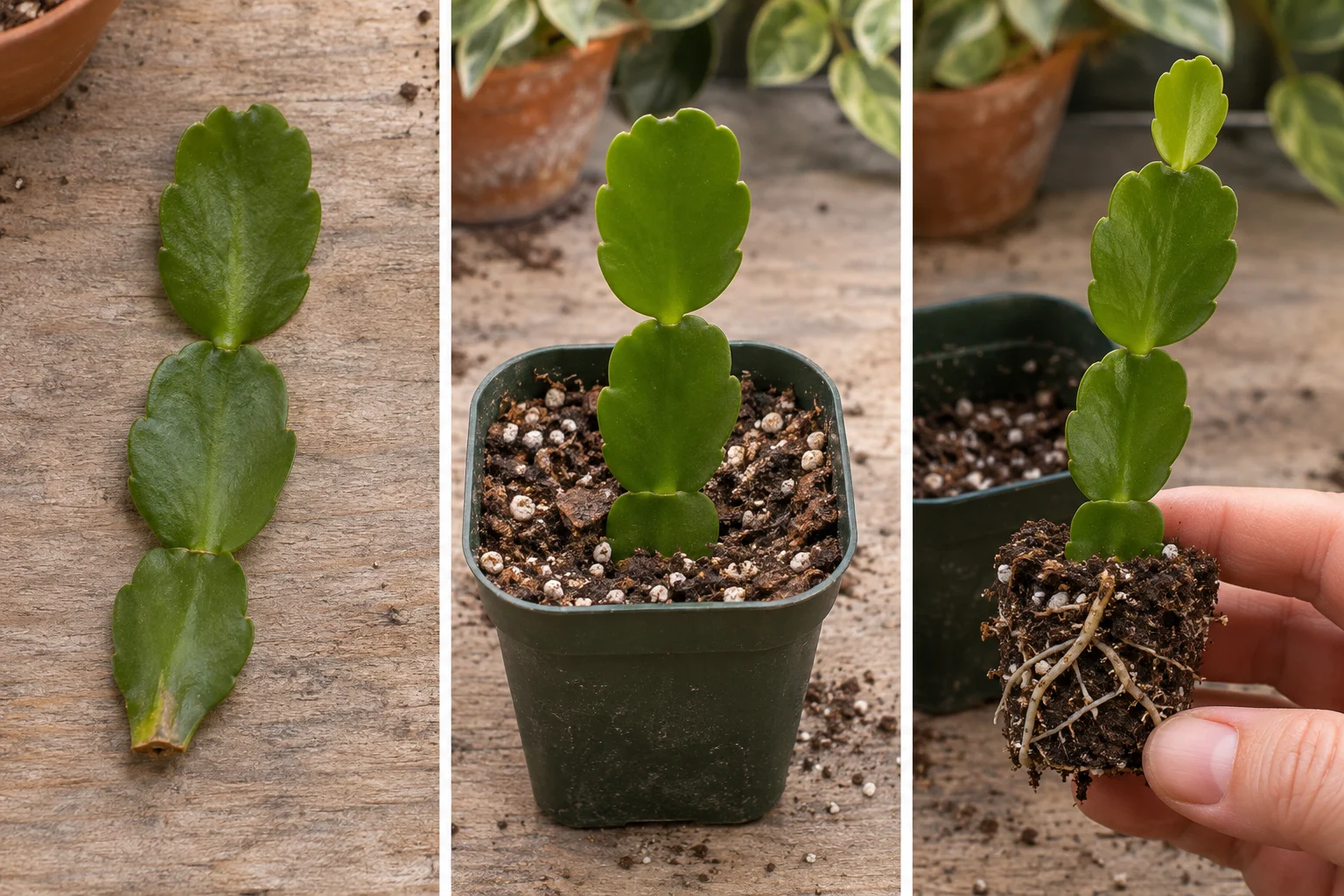
Panels, from left to right
- Take a healthy two- or three-segment tip at a joint and let the basal wound dry in shade.
- Insert only the basal end into a small pot of airy, lightly moist rooting medium, keeping the cutting upright.
- Wait for root establishment and new segment growth before moving the young Christmas cactus into its growing pot.
Inspect the joints and protected stem undersides
Mealybugs, scale and spider mites can occupy sheltered parts of a crowded holiday cactus. Examine the junctions between segments, the inner canopy and the rim of the nursery pot before bringing a new purchase beside an old specimen. White fluff, firmly attached bumps and fine webbing are clues to investigate, not interchangeable diagnoses. Cottony material around a joint deserves a close look before it is dismissed as dust, especially if nearby segments are weakening.
Separate a suspect plant and confirm the organism before choosing a response. The shared quarantine guide covers the broader inspection routine; any product must be labelled for the pest, the plant and indoor use where you live. Test suitability rather than assuming a succulent tolerates every spray. A spreading wet lesion beginning near the soil line raises a different concern from an insect on a firm stem. Seek local horticultural advice for extensive soft rot, and do not distribute cuttings from visibly affected tissue.
[3][4][5]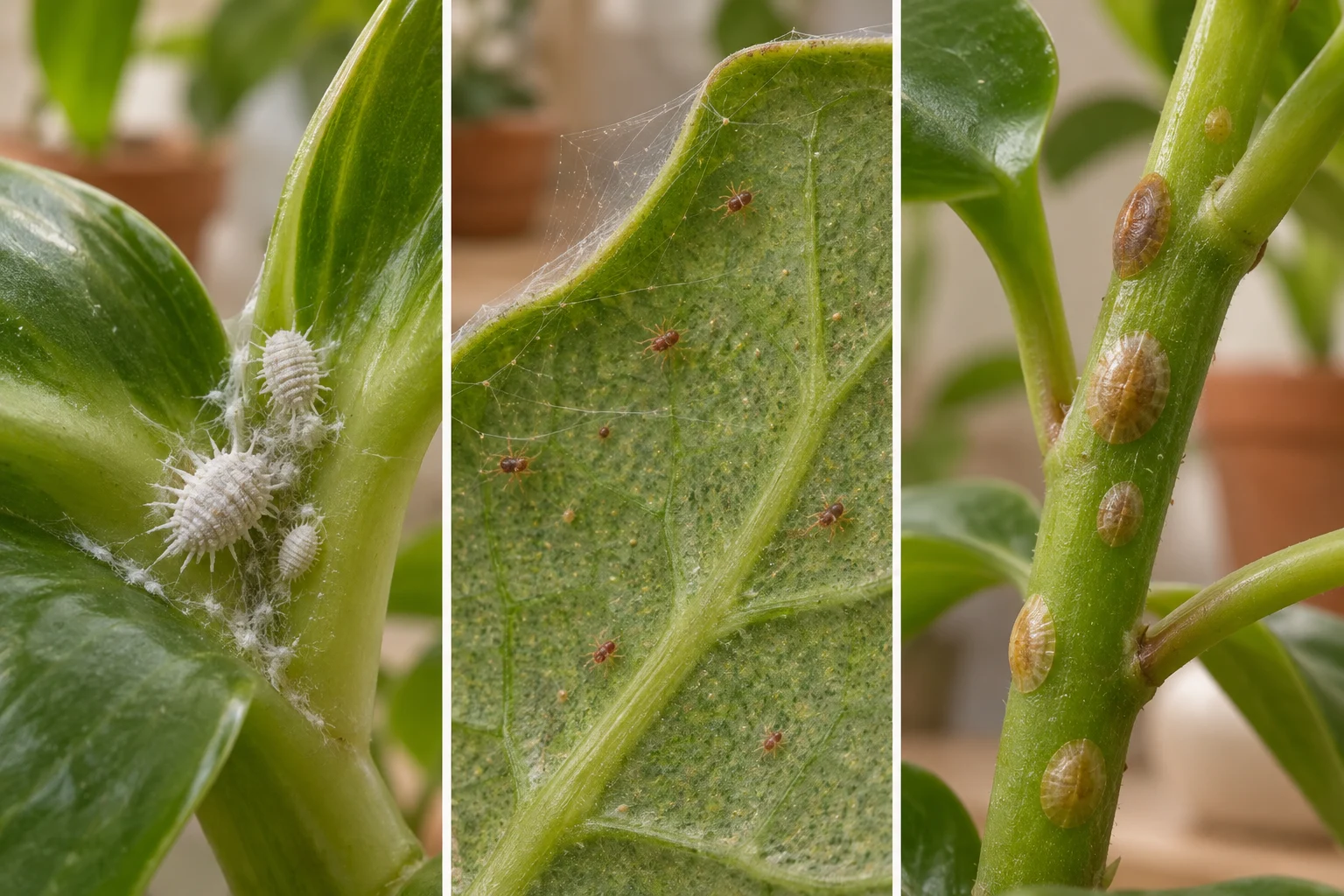
Panels, from left to right
- Mealybugs
- Spider mites
- Scale insects
Read buds, stems and roots together
Bud loss after a purchase often follows a change in temperature, light, moisture or air movement. Begin with the journey home and the new location, rather than treating every lost bud as a nutrient shortage. A few aborted buds do not prove the whole plant is dying. Retain stable care and assess the remaining stems. The next flowering cycle is a better opportunity to improve preparation than repeatedly relocating a stressed plant during the current display.
Wrinkled segments have more than one explanation. Dry compost and a light pot can point toward lack of water, while wrinkling over persistently wet compost can accompany impaired roots. Pale or reddish exposed growth may relate to light or temperature stress, but colour alone is not enough to diagnose the cause. Compare affected and sheltered branches and inspect the base. Record which problem changed first; that sequence is often more useful than applying several treatments and losing track of what helped.
[3][4][5]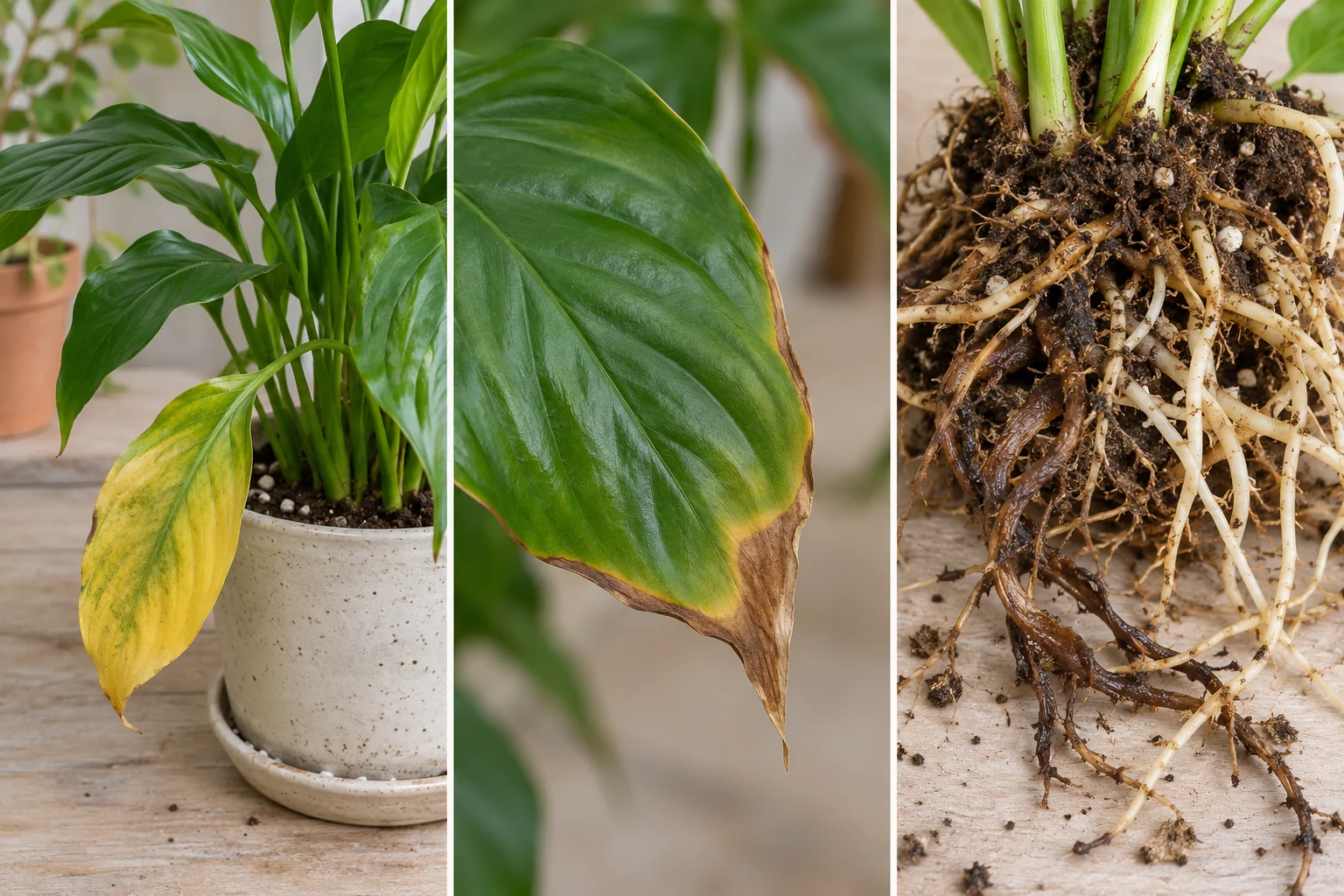
Panels, from left to right
- Yellowing foliage
- Brown leaf edges
- Damaged roots
Buds fall before opening
- Possible causes
- A Christmas cactus may shed buds after a change in room temperature, a draft, irregular moisture or a disruptive move.
- What to check
- Compare the journey home and the old position with the present window, heating vent and root-zone moisture.
- Next step
- Keep the budded plant in one suitable place, correct the identified stress and avoid forcing a response with extra fertilizer.
Shrivelled segments above wet compost
- Possible causes
- The forest-cactus roots may be impaired by a slow-draining mix, even though water is still present around them.
- What to check
- Inspect drainage and carefully assess whether roots are firm or dark and soft; note how long this pot remains wet.
- Next step
- Stop automatic watering, address damaged roots and degraded mix, and preserve healthy unaffected tips as backup cuttings if needed.
A brown patch at the stem base
- Possible causes
- Old Christmas-cactus tissue can become dry and corky; a new wet spreading patch may instead indicate rot.
- What to check
- Distinguish firm dry ageing from softness, collapse and a lesion advancing toward the next joint.
- Next step
- Leave stable firm corking alone. Isolate a plant with spreading soft damage and seek horticultural advice before taking or sharing cuttings.
Follow the plant’s cycle rather than a holiday date
After the flowers fade, allow a quieter period with less frequent watering and no attempt to maintain bloom through heavier feeding. When fresh segments appear, resume the active-growth routine and carry out necessary shaping or repotting. An outdoor summer position can be useful only where it is sheltered, shaded from strong sun and warm enough; inspect the hanging stems and pot before returning the plant indoors. Avoid relying on frost as the signal to bring a tropical cactus back inside.
As days shorten, plan a consistently darker night and a modestly cooler position before buds form. Northern Hemisphere calendar examples do not transfer unchanged to the Southern Hemisphere or to rooms lit late every evening. Once buds begin expanding, settle the cactus in its display position with reasonably steady moisture and temperature. Keep a brief record of the conditions that worked for this particular clone; it is more informative next year than expecting every Christmas cactus to flower on the same week.
[1][5][3]Flowers form at the ends of mature segments
The pendant pink-to-red flowers of this hybrid emerge from stem tips. A plant with many healthy branches has more potential flowering sites, but potential is not a promise of a fixed number of blooms. Shorter days and cooler nights help initiate buds after the growing season. NC State recommends at least thirteen hours of uninterrupted darkness during preparation; the temperature and the individual plant influence the response. Keep useful daylight during the rest of the daily cycle.
Do not confuse floral timing with identification. A plant flowering in November can have been grown under conditions that advanced its cycle, and retail names cover several related hybrids. Seed production is not a dependable way to preserve a named inherited plant, because hybrid offspring may differ and fertility can vary. Stem cuttings retain the parent’s identity more predictably. After the display, remove spent flowers gently without pulling off the attached terminal segment or disturbing newly emerging growth.
[3][4][5]A non-toxic classification still needs correct identification
NC State describes Schlumbergera × buckleyi as non-toxic and suitable for homes with pets or children. Confirm the identity using its rounded stem margins and hanging flowers; this classification cannot be transferred to an unidentified cactus. The stems have no rigid barrel-cactus spines, but detached joints and a hanging pot still deserve careful placement.
Non-toxic does not make the stems a snack or a teething toy. Keep fallen segments, potting mix, fertilizer and treatment products away from children and animals, and secure a hanging container against pulling or tipping. If chewing is followed by symptoms or the plant identity is uncertain, seek professional medical or veterinary advice with a photograph or label. There is no reason to use Christmas cactus as a home remedy, and its ornamental berries or flowers are not a recommendation for eating it.
[3]Use controlled light to understand flowering
A timed grow light and a nearby thermometer can help separate insufficient daytime light from nights that are too bright or too warm. Change one factor at a time and keep notes on new segments, bud appearance and water use. The useful result is a repeatable routine for your room, not an exact universal light distance: fixtures differ, and a hot lamp can stress a succulent even when the schedule looks correct. Let the plant retain an uninterrupted night during flower preparation.
Growing a soil-established holiday cactus in a permanent water reservoir or semi-hydro system is a separate experiment, not an essential improvement. Its roots still need oxygen, and conversion can disrupt a plant that was already functioning well. If you experiment, use an expendable rooted cutting instead of the only inherited specimen and learn the water and nutrient requirements of that system. Moss poles are not necessary for the natural cascade; a stable container with room for hanging branches suits its form.
[3][1][4]Keep the hybrid name with its history
This profile covers the rounded-segment Christmas-cactus hybrid Schlumbergera × buckleyi. It is separate from the pointed-segment Thanksgiving cactus profiled elsewhere in the collection. Commercial Schlumbergera breeding produces many colours and intermediate forms, so a flower colour alone does not establish membership of the Buckleyi group. If a seller provides a cultivar name and documented parentage, keep that record; if not, describe the visible characteristics without inventing a cultivar label.
A family cutting can be worth keeping even when its cultivar name is unknown. Label it with the source plant, its characteristic stem margins and the date acquired. Small differences in flowering time or branch posture may be a response to growing conditions rather than a new variety. When comparing plants, use several mature segments and a complete flower in addition to the nursery name. Shared care principles are useful, but an uncertain retail hybrid should not be presented as a second confirmed species.
[3][2][4]Frequently asked questions
Why are rounded stem edges important on a Christmas cactus?
Rounded scallops support identification as the Buckleyi type, whereas pointed teeth suggest Thanksgiving-cactus ancestry. Check several mature segments and the flower as well; a December sales label cannot resolve a mixed hybrid.
[3][4]Is Schlumbergera × buckleyi the same plant as S. truncata?
They are related but distinct. The Christmas-cactus hybrid has S. russelliana and S. truncata as parents; Thanksgiving cactus is S. truncata. Keeping separate names helps explain the rounded versus pointed segment margins.
[3]Why does my old Christmas cactus hang down instead of standing up?
The young shoots begin more upright and naturally become pendant as they lengthen. Give the canopy space below the pot. Sudden limpness accompanied by shrivelling or soft tissue is a different issue and warrants a moisture and root check.
[2][4]Can evening room lights stop a Christmas cactus from setting buds?
Yes, an interrupted night can interfere with the seasonal flowering response. Give the plant bright days and a consistent dark interval during preparation; NC State suggests at least thirteen uninterrupted hours. Cooler nights also influence the response.
[3][5]Should I keep a Christmas cactus in a cupboard all day to make it flower?
No. Its night needs to be dark during preparation, but it still needs useful light during the day. A cool bright room that is unused after dusk is usually simpler to manage than repeated daily moves between unsuitable places.
[3][5]Why did a newly purchased Christmas cactus drop unopened buds?
Transport and a new room can change temperature, moisture, light and air movement at once. Check those changes and stabilize the position. Repeated moves, extra fertilizer or automatic watering may add stress without solving the original problem.
[1][5]What does a woody brown base mean on an inherited Christmas cactus?
Firm, dry corking on the oldest base can be normal ageing. Wet softness, dark spreading lesions or a collapsing joint need a different response. Texture and progression are more useful than brown colour by itself.
[5][4]Why are my Christmas-cactus segments wrinkled although the compost is wet?
Water may be present without functioning roots being able to absorb it. Inspect how long the pot stays wet, whether the container drains and whether roots remain firm. More water is not a safe default for wet compost with shrivelled stems.
[4][5]Can I grow a new Christmas cactus from one fallen segment?
A healthy segment can sometimes root, although a short chain of two or three is convenient to handle. Let the basal wound dry before shallow insertion into airy lightly moist medium. Do not use a segment that fell because it was rotting.
[1][4]When should I shorten Christmas-cactus branches without losing flower tips?
Shape the plant after the display, as vegetative growth resumes. Removing terminal segments during the bud-forming period removes potential flower sites. Trim selected branches at their joints rather than cutting through every flat segment.
[1][5]Does a Christmas cactus need the same dry soil as a desert cactus?
Its forest-cactus roots need an aerated mix with some moisture during growth. A prolonged completely dry root ball can stress it, yet a saturated pot can damage roots. Evaluate the actual mix instead of relying solely on a cactus label.
[1][4]Are hairlike roots at Christmas-cactus joints always a bad sign?
They can occur on this epiphytic plant. A marked increase together with shrivelled growth and persistently wet compost is a reason to inspect the main roots. The aerial roots alone do not establish a diagnosis.
[4]Will seed from my family’s Christmas cactus produce an identical plant?
Hybrid seedlings can differ from their parent and seed production itself may be unreliable. If preserving that exact inherited plant matters, use healthy stem cuttings and retain a label connecting them to the parent.
[3][4]Does the name Schlumbergera × buckleyi help me check its household safety?
Yes. NC State assesses S. × buckleyi as non-toxic, so use that identity rather than an unspecified holiday-cactus label. This is an ornamental plant: prevent chewing, collect fallen joints and keep fertilizers separate.
[3]Why does my Christmas cactus flower on a different date each year?
Night length, temperature, indoor lighting and the condition of the previous season’s growth influence the cycle. The holiday name is not a flowering guarantee. Compare your growing conditions rather than changing the plant’s identity based on its calendar.
[3][5]Should I convert an heirloom Christmas cactus to semi-hydro to improve flowering?
Conversion is optional and can disturb an established root system. First assess daytime light, night conditions and ordinary root health. If you want to explore a reservoir system, trial a spare rooted cutting while keeping the heirloom in its successful substrate.
[3][4]Compare related plants
- Thanksgiving cactus: Thanksgiving cactus has sharper teeth on its stem segments; rounded edges and a more hanging outline help distinguish the true Christmas-cactus hybrid.
- Golden barrel cactus: Golden barrel is a sun-demanding desert cactus with rigid spines, so its adult light and drying routine should not be transferred to this forest cactus.
Care reminders with PlantPal
Add your Christmas cactus to PlantPal and set reminders to check moisture, review its evening light before bud season and record when your own plant flowers.
Add my Christmas cactus