 Plant
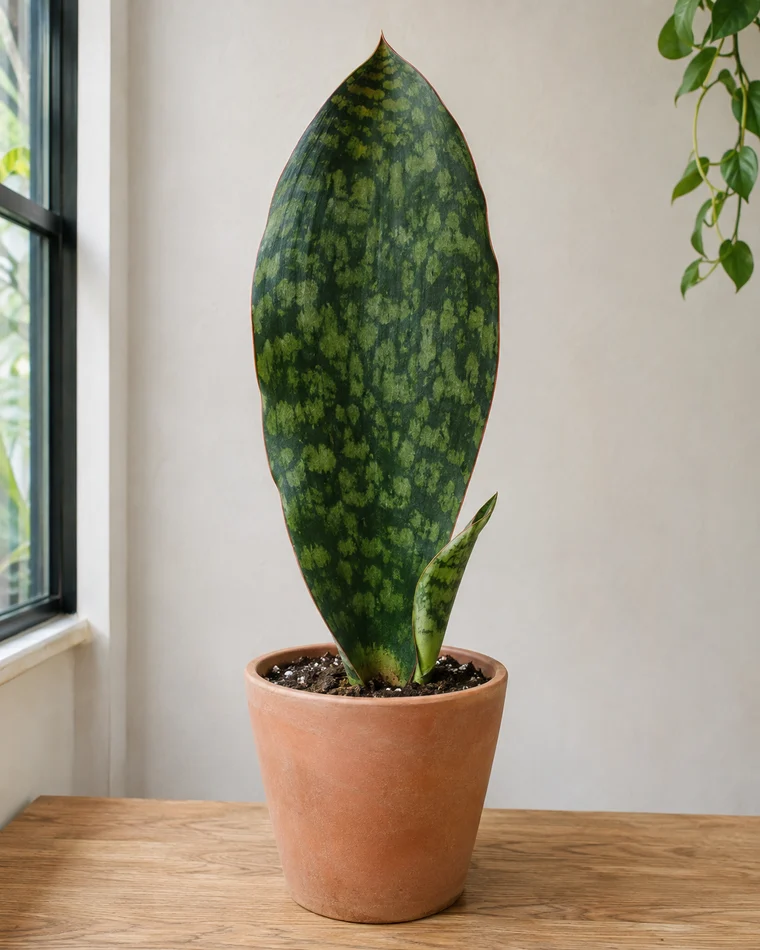
Whale-fin snake plant.
Dracaena masoniana
Whale-fin snake plant turns a single broad, mottled leaf into a striking display, but there is more to it than that first paddle. Dracaena masoniana, still widely sold as Sansevieria masoniana, expands through underground rhizomes and may eventually form a clump. Learn how to protect its long-lived foliage, match watering to the roots actually present, recognize normal sheath color and choose a sensible moment to divide it.
How to help it thrive.
Checked:
Quick care reference
- Accepted name: Dracaena masoniana; older name: Sansevieria masoniana.
- Native range recorded by Kew: Democratic Republic of the Congo.
- Broad green mottled paddles arise from a rhizomatous plant, not a permanent single-leaf form.
- Bright indirect light supports growth; sudden intense sun can scar the exposed face.
- Let the growing medium dry between waterings and empty the outer pot.
- NC State cultivation guidance: about 18–29°C; avoid conditions below about 13°C.
- Separate an established rooted side growth when propagating by division.
- Toxic if eaten by people, cats or dogs; sap may irritate skin.
A paddle-leaved plant with a hidden expanding stem
A whale-fin plant is often sold as one impressive leaf rising from an almost empty pot. That display is a retail stage, not a promise that the plant will remain a single paddle. Dracaena masoniana produces underground rhizomes from which further growth can emerge. The familiar label Sansevieria masoniana remains useful when checking older care references or nursery records; Kew accepts the Dracaena name and places its native range in the Democratic Republic of the Congo.
The broad blade makes slow changes unusually visible: a transport crease, a new pale shoot beside the original leaf, or a slight lean toward a window can dominate the whole plant. Judge those changes against the condition of the leaf base and root zone. This species suits someone willing to preserve a few long-lived leaves while waiting for new ones, rather than someone expecting frequent replacement foliage.
[1][2][3]Recognizing the fin, mottling and purple sheath
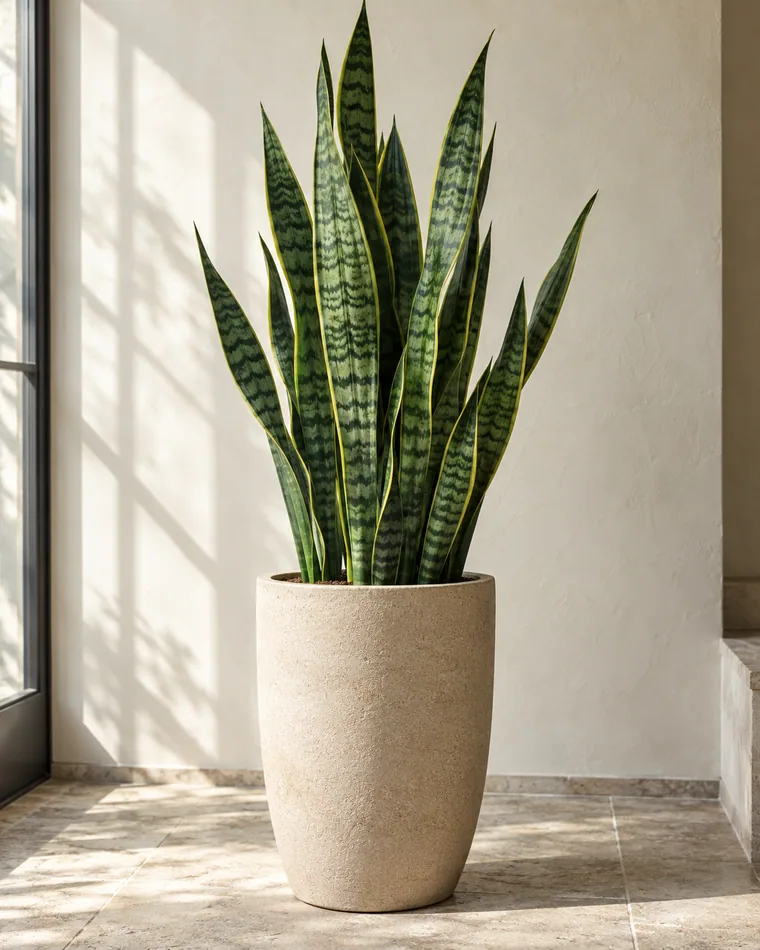
Look for a thick, upright, flattened blade with irregular lighter green markings over a darker surface. Its outline is much broader than the familiar sword leaves of Dracaena trifasciata and entirely different from the rounded spears of Dracaena angolensis. A narrow reddish edge can occur. Young stock, divided plants and leaves grown under different light may differ in size, so a small paddle is not automatically a different species.
NC State describes a purple-banded sheath below the soil surface. During a necessary repot, firm purple tissue at that location should not be classified as rot solely because of its color. Decay is more concerning when tissue becomes soft or collapses, especially with persistent wetness. Do not excavate a healthy plant merely to find the sheath: a label, whole-leaf shape and growth pattern together give a better identification record.
[2][3][1]Lighting the whole broad blade
Give the paddle a bright position with filtered or indirect light. The ability to persist in a dimmer room does not mean that a new broad leaf will appear quickly there. Its wide surface can receive strong light on one face while the other remains shaded by a curtain or neighboring plant. Make space around the blade instead of squeezing it into a slot where only its upper edge is illuminated.
A sudden move from shop lighting to intense sun can leave a conspicuous patch on a leaf that may remain for years. Increase exposure gradually and watch the illuminated face rather than using leaf thickness as proof of sun tolerance. Modest changes in pot orientation can improve balanced exposure. Rotate the container by supporting it, not by twisting the blade; its attachment below the mix must bear the leverage.
[2][3]Matching water to a single leaf and its roots
The visual size of one whale-fin leaf can encourage overwatering: a large green paddle looks like a large thirsty plant. Its succulent tissues store water, however, and the root system of a recently established cutting may occupy only a small part of the container. Allow the growing medium to dry between waterings. Assess the root zone rather than repeatedly dampening the visible top layer beside the leaf.
After watering, confirm that the nursery pot has drained and that water is not concealed in the decorative outer container. A small root ball surrounded by deep wet mix deserves a container assessment, not a stricter calendar. Wrinkling alone does not settle whether water is needed: a dry root zone and firm base suggest a different situation from wrinkling above damaged roots in wet mix. Resolve that distinction before adding more.
[2][3]A secure pot without an oversized wet reservoir
Use an airy, freely draining mix suitable for succulent roots. The broad leaf is top-heavy, but solving that problem by giving a small root system a very large volume of moisture-retaining substrate creates another risk. Prefer a stable container footprint and appropriate support around an intact root ball. A heavy outer pot can improve stability if the inner draining pot can still be removed and emptied.
Repot when roots and rhizomes have genuinely filled the available space or the container is being distorted, rather than whenever the blade looks taller than its pot. Set the division at its previous depth; burying more of the leaf to make it stand straight conceals tissue that needs inspection. During the move, protect the broad edges from the rim and do not lift the entire root ball by the single leaf.
[2][3]Warm roots and ordinary room air
NC State gives a preferred temperature range of about 18–29°C and advises avoiding conditions below about 13°C. Treat these as cultivation guidance, not a guarantee that a cold windowsill is safe whenever the room thermostat reads higher. A blade close to winter glass and a pot standing on a cold floor can experience a different microclimate from the center of the room.
Humidity advice differs between references: the species page mentions relatively humid conditions, while the RHS guide describes sansevierias as comfortable in drier household air. Those statements do not establish a mandatory humidity threshold for every whale-fin plant. Start with a stable room position and air movement, and investigate watering, roots and heat exposure before buying a humidifier for a damaged edge. Repeated misting is not a substitute for correcting root-zone conditions.
[2][3]Feeding a slow-growing paddle
A solitary leaf can remain unchanged above ground while a healthy plant establishes roots or develops a rhizome. Fertilizer should support demonstrated growth, not be used to force a second leaf on demand. During active growth, a suitable liquid houseplant or cactus fertilizer at the product's labeled rate is adequate; RHS general guidance uses monthly feeding in the growing season. Adjust the season to actual light and growth in your home.
Hold off on feeding an unrooted leaf cutting or a plant whose base is soft and whose mix remains wet. Extra nutrients cannot replace functioning roots. Record the date of feeding separately from watering so a rare watering event does not receive repeated fertilizer by mistake. If the plant has recently entered a mix containing fertilizer, account for that existing supply before adding another product.
[3][2]New fins emerge from below, not from the old blade
The visible leaf does not branch into a bouquet after its tip is cut. Future leaves are associated with new growth from the rhizome and base. A narrow emerging shoot may therefore look unlike the mature paddle beside it before expanding. Leave space where it appears and resist digging around the point to measure its progress. Comparison photographs taken from the same angle are more useful than daily manipulation.
NC State describes mature plants reaching roughly 0.9–1.5 m, with large leaves possible under suitable conditions. These are potential dimensions, not a timetable for a purchased single-leaf pot. Keep a sound leaf even if it carries a stable scar: removing the only blade for a cosmetic defect sacrifices most of the visible foliage. Cut away a leaf only when the benefit justifies that loss, and protect yourself from sap.
[2][3]Dividing a rooted side growth
For a plant with an established side growth, division preserves an already formed growing point and can retain a selected variegated form more reliably than leaf sections. Unpot carefully and identify the rhizome connection between the original plant and the side growth. Separate a section that has its own roots and a healthy bud or leaf. Do not confuse slicing the broad paddle in half with dividing the plant.
Leaf cuttings are also possible, but the donor blade will show the permanent cost of removal, and roots do not mean that a replacement paddle has already formed. Keep the original top-to-bottom orientation of any cutting and avoid maintaining its cut end in saturated mix. Leaf-derived offspring may fail to preserve a variegated pattern. For a valuable one-leaf specimen, waiting for a rooted side growth is often the less disruptive choice; success has no fixed deadline.
[2][3]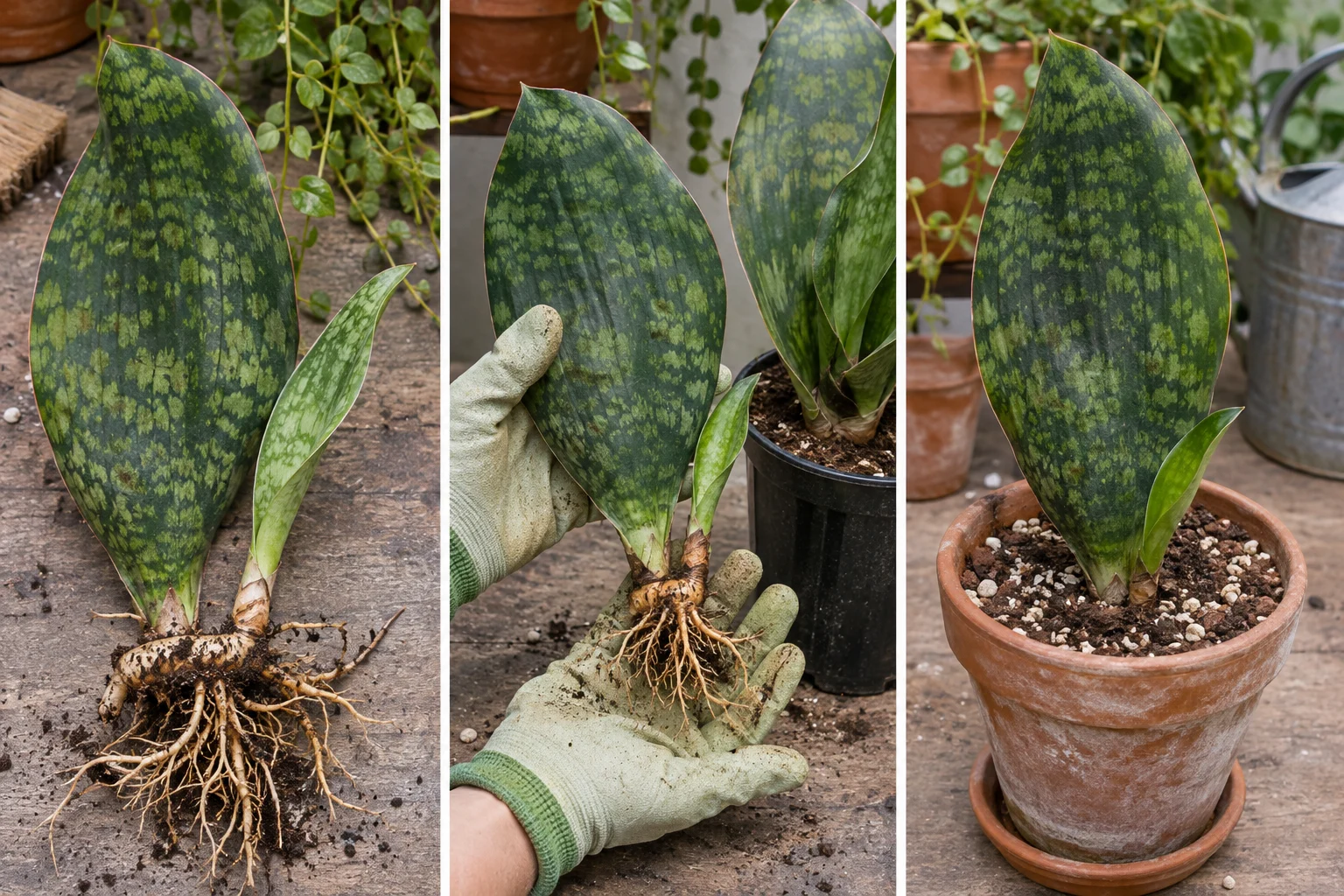
Panels, from left to right
- Unpot a plant with a developed side growth and locate the healthy rhizome connecting it to the original paddle.
- Separate a side section with its own roots and growing point, keeping the broad leaf and its attachment intact.
- Set the rooted division at its previous depth in a small draining pot and monitor establishment without keeping the mix saturated.
Inspecting the broad surface and sheltered base
A whale-fin leaf offers a large surface to examine, but pests can still hide along its edge, underneath it, or where the blade meets the mix. Inspect both faces under good light, especially after bringing a new plant home. Scale insects and mealybugs require closer inspection than the natural pale mottling, while fine speckling and webbing may warrant checking for mites. A photograph alone may not distinguish pest damage from an old abrasion.
Keep a suspect plant apart while checking live evidence and the neighboring collection. Any treatment should match the identified pest and be labeled for the plant's setting; try a small area before coating the main blade, whose surface is visually important and slow to replace. Recheck the protected base as well as the exposed center. Increasing watering to compensate for pest-marked leaves can add a separate root problem.
[2][3]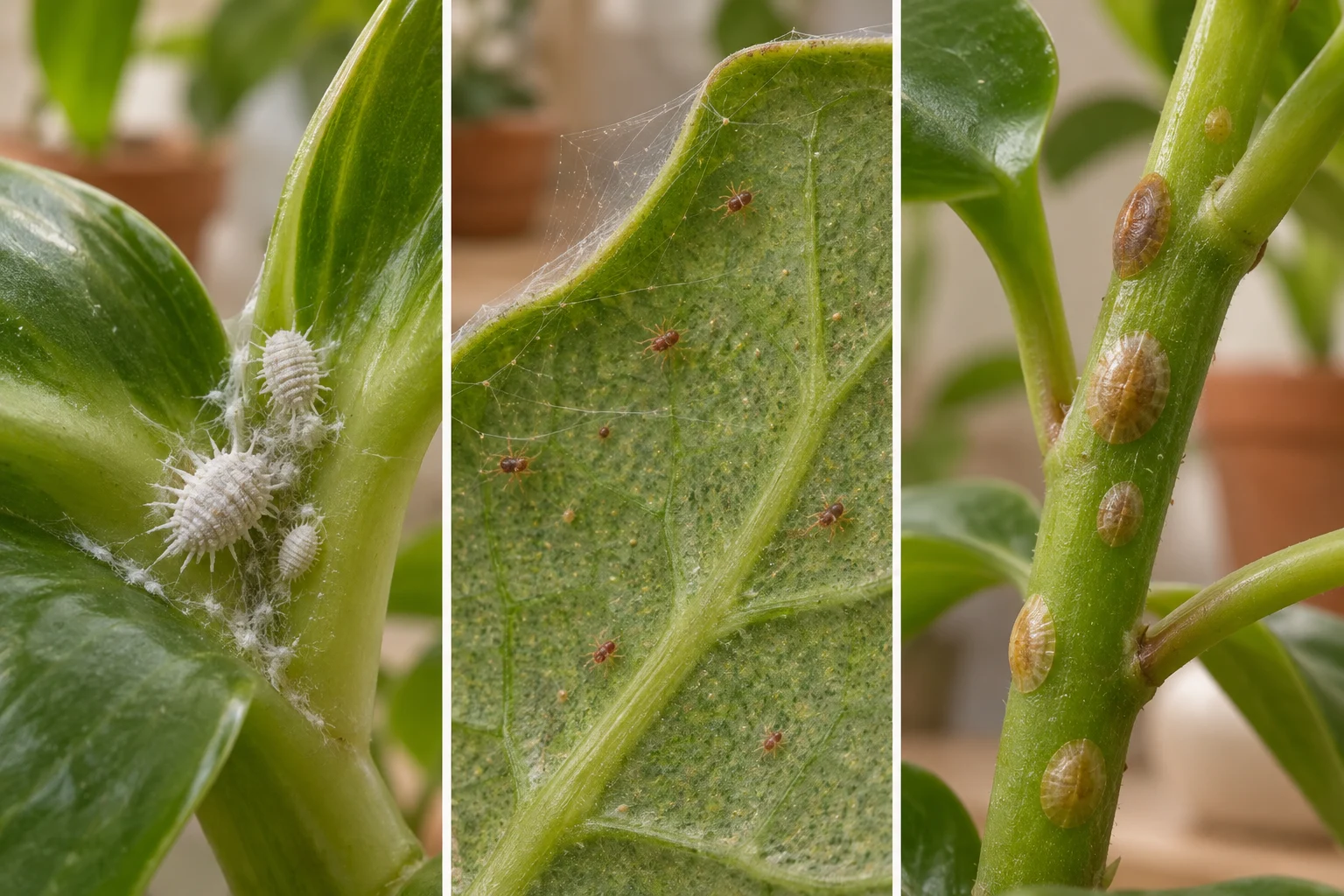
Panels, from left to right
- Mealybugs
- Spider mites
- Scale insects
Reading a large leaf without turning every mark into disease
Whale-fin foliage preserves its history. A crease from packaging, a rubbed edge or a sun-exposed pale patch can remain even after the original cause has ended. Mark the extent in a photograph and watch whether it changes. New softening, expanding damage or loss of attachment at the base needs a different response from a dry, stable scar on an otherwise firm blade.
Lean also needs context. An intact heavy paddle can pull a lightweight pot off balance, whereas a leaf that has suddenly become loose at a wet base suggests a root or rhizome problem. Support the container while checking rather than tugging the blade. Compare moisture, firmness and recent movement together. The symptom examples below are possibilities to investigate, not diagnoses made from a particular color or leaf angle.
[2][3]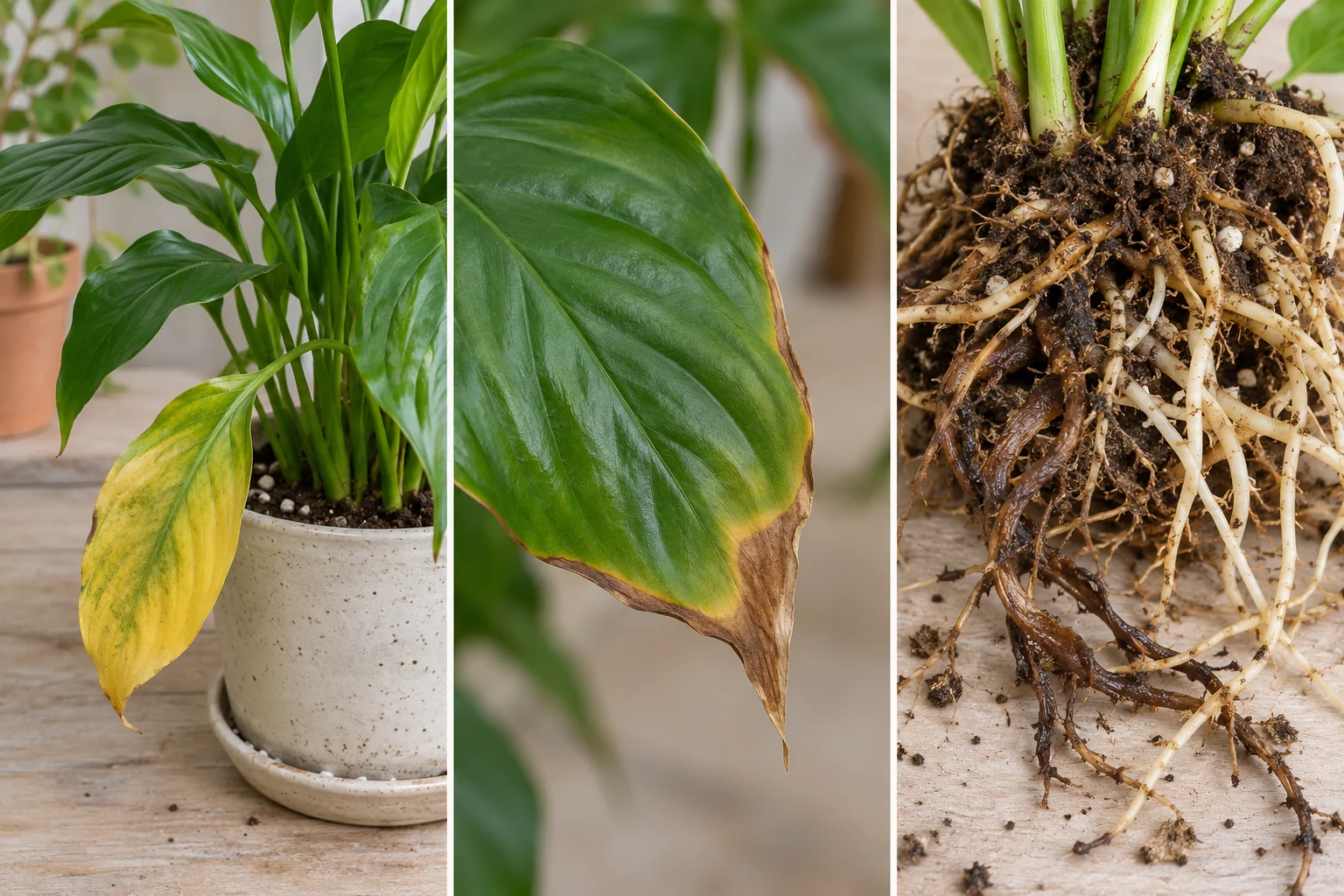
Panels, from left to right
- Yellowing foliage
- Brown leaf edges
- Damaged roots
Purple color revealed beneath the paddle
- Possible causes
- A normal purple-banded sheath may be visible during repotting; color accompanied by soft collapse raises a different concern.
- What to check
- Compare the firmness of the sheath and leaf attachment with moisture around the rhizome, rather than judging the purple shade alone.
- Next step
- Leave firm intact sheath tissue in place; if the base is soft in wet mix, investigate root health and correct the moisture problem.
A wide blade leans after the pot is moved
- Possible causes
- The heavy paddle may have shifted a light container or changed orientation toward light; failing roots are another possibility if the attachment has loosened.
- What to check
- Support the pot and assess balance, base firmness and recent wetness without pulling on the leaf as a handle.
- Next step
- Stabilize a sound root ball in an appropriately sized container; a loose, soft base requires investigation before another watering.
A pale damaged area on the window-facing side
- Possible causes
- Abrupt sun exposure or rubbing against glass can mark the broad face; pests or an expanding lesion remain alternatives if the pattern changes.
- What to check
- Review recent positioning and compare photographs while examining the opposite face and any live pest evidence.
- Next step
- Moderate exposure gradually and protect the blade from contact; retain stable firm foliage, but isolate and investigate spreading damage.
A year paced by new growth rather than a calendar
When light and warmth increase and a new shoot is extending, reassess water use and whether feeding is appropriate. An established plant with several leaves may dry its pot differently from the original single-leaf purchase. Keep notes about that transition instead of preserving the original watering interval indefinitely. A longer dry-down after moving the plant into winter light is a useful signal to check less often for watering need.
If the plant spends warm weather outside, move it gradually into brighter exposure and shelter the pot from repeated rain. Bring it back to protection before cold conditions develop. Indoors, seasonal curtains, a heater or a shaded balcony can alter conditions without the pot moving. Check both the face of the blade and the drainage arrangement when those changes occur; the leaf's durable appearance can conceal a changing root environment.
[2][3]A flower spike is separate from the next paddle
Whale-fin plants can produce fragrant white flowers on an upright flowering structure. An emerging flower spike carries buds and later flowers, unlike a new leaf that expands into a broad blade. Flowering is occasional in indoor cultivation and should not be used as the sole score for successful care. A sound plant with steady roots and intact leaves is valuable even if it never flowers in your room.
Do not keep the pot wet or intensify fertilizer merely to provoke a bloom. Continue assessing the root zone while the spike develops, and keep fallen floral material away from children and pets. Once the flowering stalk has finished and dried, it can be removed carefully without cutting into the neighboring leaf or rhizome. A photograph of the spike can also help document the identity of a plant sold under an incomplete trade label.
[2][3]A broad ornamental leaf is not a pet chew
The species-specific NC State record identifies Dracaena masoniana as toxic if ingested by people, cats or dogs, with saponins listed as the toxic principle. Sap may irritate skin. The stiff blade and calm appearance do not make it an edible or pet-safe plant, and changing the label from Sansevieria to Dracaena does not change that warning. Keep discarded cuttings as inaccessible as the standing plant.
Choose a position that also prevents a pet from tipping over the heavy container or reaching an overhanging paddle. Wear gloves for cutting and clean sap from tools and work surfaces. If a person or animal chews plant material, seek advice from an appropriate poison service or veterinarian and provide the botanical name, the part involved and what happened. Do not prepare a home remedy from the leaf or induce vomiting on your own.
[2][3]Managing a one-leaf display as it becomes a clump
A seller's photograph may show the clean outline of one fin, while healthy growth eventually adds a side leaf that changes the composition. Decide whether you value a developing clump or the original single-leaf silhouette before dividing anything. Removing every new shoot to preserve the sales image repeatedly disturbs the part of the plant responsible for expansion. A rooted side division can instead become a separate display when it is ready.
For long-term records, photograph the base as well as the dramatic upper blade. Note which pot is the actual growing container, when a side shoot appeared, and whether any leaf was sold as a rooted cutting. This makes a lack of visible change easier to interpret. Avoid repeatedly repotting a firm, well-drained plant simply to check for progress; the hidden rhizome does not need to be exposed to prove that it exists.
[2][3]Trade names, variegation and comparisons
Sansevieria masoniana is the earlier botanical name; 'Mason's Congo' appears in horticultural history and nursery references. Whale fin and shark fin are common names, not separate guarantees of identity. Keep the botanical label with the plant, particularly when comparing listings that use similar ocean-themed names for different leaf shapes. Kew's accepted name is Dracaena masoniana, in the asparagus family, Asparagaceae.
Variegated examples can have large yellow or pale sectors in addition to the species' normal green mottling. These patterns are not interchangeable: ordinary mottling is part of the typical leaf, whereas a selected variegated plant may require division to retain its character. Compare whole-plant habit and the seller's verified cultivar label before paying for a name. This profile does not treat every photograph of a differently colored paddle as a formally named cultivar.
[1][2][3]Frequently asked questions
Will a whale-fin plant sold with one leaf always stay a one-leaf plant?
No. The single paddle is a presentation stage. A healthy rhizome can produce further growth beside it, although this may take time. Leave room for that change instead of treating each new shoot as a weed or proof that the plant was mislabeled.
[2][1]Can cutting the top of the whale-fin blade make it branch?
The paddle is a leaf, not a branching woody stem. Cutting its top leaves a permanent wound and does not create branches along that blade. Additional fins arise through growth associated with the base and rhizome; preserve the intact leaf when possible.
[2][3]Why does my whale-fin label say Mason's Congo?
That horticultural name was used before the species received its formal name. Sansevieria masoniana is the older botanical combination, and Kew now accepts Dracaena masoniana. Keep those names together in your records so older references remain recognizable.
[2][1]Is the purple sheath under my whale-fin leaf a sign of rot?
Purple-banded sheath tissue is described for this species. Color alone therefore cannot diagnose decay. Check whether the tissue is firm, whether the blade is anchored and whether the surrounding mix stays wet; softness or collapse is more concerning than an intact purple surface.
[2]Are the pale green islands on a whale-fin leaf pest damage?
Irregular green mottling is normal. New fine stippling, attached insects or changing patches deserve closer examination, but the existing camouflage-like pattern should not be scrubbed or treated automatically. Compare both faces and use an earlier photograph to distinguish stable markings from new damage.
[2]Why is my purchased whale-fin paddle narrower than mature photographs?
Pictures may show established leaves grown in favorable conditions, whereas a retail plant may be younger or propagated from smaller material. The published large leaf dimensions are potential, not a minimum purchase size. Identify the plant through several features rather than width alone.
[2][3]Does the broad face of a whale-fin leaf need room beside a window?
Yes. A narrow gap can shade most of the blade even when its tip appears close to daylight. Give the full surface bright indirect exposure and adjust the container gently if growth becomes one-sided. Do not abruptly turn a previously shaded face into intense sun.
[2][3]Is splitting one whale-fin leaf lengthwise the same as dividing the plant?
No. Division separates a piece of the underground rhizome with a growing point and preferably established roots. Cutting the blade creates leaf material for propagation and damages the original display. Unpot only when a real side growth is ready to separate.
[2][3]Will a leaf cutting preserve a yellow sector on my variegated whale fin?
Not reliably. Leaf propagation can lose a selected variegated pattern. A division retaining an existing variegated growing point is the more appropriate choice when preserving that appearance matters, although the future pattern of an individual leaf still cannot be guaranteed.
[3][2]My whale-fin cutting has roots but no small paddle; has it failed?
Roots and a new shoot are different stages. A firm cutting with sound roots may still need time to develop new growth. Maintain suitable light and a draining root environment rather than repeatedly lifting it to search for a bud or feeding it heavily.
[2][3]Why does my heavy whale-fin blade lean while its base stays firm?
Its broad shape can act as a lever, especially in a light container or after transport. Check balance and light direction before assuming rot. Sudden looseness, soft tissue and persistent wetness would change the assessment and justify checking below the surface.
[2][3]Is a tall decorative cylinder suitable for a single whale-fin leaf?
It can serve as an outer holder if a correctly sized inner pot drains freely and can be removed. Filling the entire deep cylinder with wet mix around a small root ball is a different arrangement and may prolong moisture far beyond the roots' needs.
[3][2]Must I keep whale fin above 50 percent humidity?
The sources do not support treating that figure as a universal household requirement: the species page mentions higher humidity, while RHS sansevieria guidance allows dry indoor air. Evaluate your plant's actual condition and its root zone before changing humidity or adding misting.
[2][3]Will a torn whale-fin edge become smooth again?
The damaged edge will not reconstruct the missing blade. If the tear is dry and stable and the rest of the leaf is sound, keeping it avoids sacrificing the plant's main foliage. Protect future growth from packaging pressure, doorways and sharp pot rims.
[3][2]Is the narrow budded stalk beside my whale-fin paddle another leaf?
A stalk bearing multiple buds is likely a flowering structure, which can carry fragrant white flowers. A new leaf instead expands into a blade. Observe it without pulling it out; neither structure requires automatically increasing watering.
[2][3]Can a cat safely nibble a whale-fin leaf because it is so stiff?
No. The species is listed as toxic to cats and dogs if eaten; hardness is not protection against ingestion. Move both the plant and cut pieces out of reach. If chewing occurs, contact a veterinarian and identify it as Dracaena masoniana, also called Sansevieria masoniana.
[2]Compare related plants
- African spear: African spear has cylindrical, grooved leaves arranged in fans; whale fin carries flattened paddles. Both expand below ground, but the visible shapes and balance of their containers differ.
- Snake plant: The familiar snake plant has narrower sword-shaped leaves and many established cultivars. Whale fin's unusually broad blade makes even a small scar conspicuous and a single-leaf purchase visually dominant.
Care reminders with PlantPal
Use PlantPal to record new side growth and set reminders to inspect the whale-fin root zone before deciding whether to water.
Track my whale fin