 Plant
African spear.
Dracaena angolensis
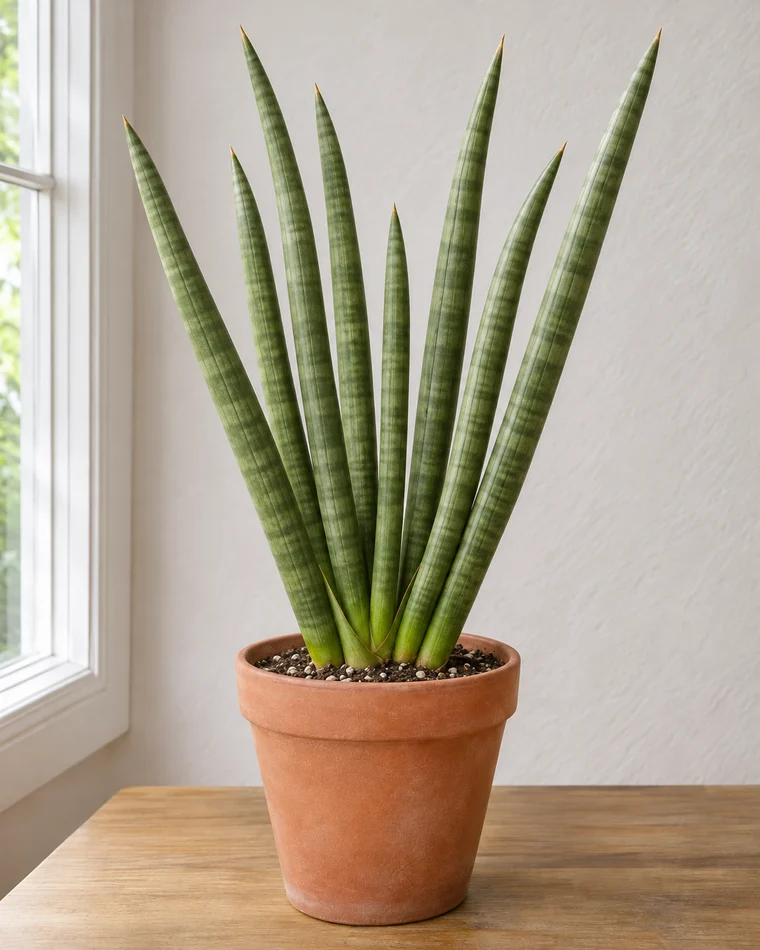
African spear is recognizable by rounded, banded leaves that spread into a natural fan. A shop display may instead contain several rooted leaves braided together, so understanding what is in the pot changes expectations about its future shape. The accepted name is Dracaena angolensis, although Sansevieria cylindrica remains familiar. This profile follows the growing fan and its underground connections, with particular attention to decorated leaves, slow new shoots and safe placement.
How to help it thrive.
Checked:
Quick care reference
- Accepted name: Dracaena angolensis; the familiar label Sansevieria cylindrica is a synonym.
- Natural form: rounded grooved leaves in basal fans, not a self-forming braid.
- Light: bright filtered exposure; adapt indoor leaves before stronger outdoor sun.
- Water: judge moisture around the actual roots under decorative gravel.
- Potting: stabilize tall spears without excessive unused damp substrate.
- Growth: new fans can emerge separately from an old arrangement of rooted leaves.
- Propagation: rooted fan division or properly oriented leaf cuttings; expect variable timing.
- Safety: ingestion and sap cautions plus a distinct hazard from stiff pointed tips.
A fan-forming plant with a familiar older name
Dracaena angolensis belongs to Asparagaceae and originates in southern tropical Africa, including Angola, Zambia and Zimbabwe. Kew treats Sansevieria cylindrica as a synonym. This is a perennial with succulent leaves and creeping underground rhizomes, adapted to seasonally dry conditions. The visible spears are leaves, not bamboo canes or woody trunks. They connect to living growth structures near and below the substrate rather than branching along their length.
RHS gives a general mature height of about 1–1.5 m, while botanical descriptions include taller plants and nursery selections can be much smaller. Treat the size of a purchased arrangement as a starting point, not its permanent adult silhouette. An established fan can widen as rhizomes produce additional groups. A small tabletop pot with three arranged spears therefore needs a different long-term space plan from a compact labeled cultivar. Growth is slow, and a firm unchanged leaf can remain ornamental while the plant develops below the surface.
[1][3][2]Read the fan rather than the braid
Natural leaves are nearly cylindrical, tapering to pointed ends, with shallow lengthwise grooves and gray-green transverse bands. They arise from a basal rosette that develops a fan-like arrangement. A regular groove running along the spear is not automatically collapse from drought. Examine whether the surrounding tissue remains solid and whether the marking is repeated on several sound leaves before interpreting texture as a symptom.
NC State notes that retail plants are often rooted leaf cuttings, sometimes braided or paint-tipped. Such a display is a horticultural arrangement, not a naturally braided species. New plants can arise from the cutting bases and need not follow the old braid. Paint is not a newly discovered flower color or cultivar pattern. Keep the botanical label and inspect the pot without assuming every upright piece belongs to one mature fan. Do not confuse this round-leaved species with the broad whale-fin or flat sword leaves of Dracaena trifasciata.
[2][3]Illuminate the whole cylindrical fan
Bright filtered light is a sensible indoor position. Although established outdoor plants can tolerate more sun, RHS specifically cautions against full strong summer sun under glass, and NC State recommends morning exposure when taking an indoor specimen outside. A shop-grown braid should not be placed immediately in a hot afternoon window merely because the leaves look tough. Give the plant time to adjust and keep a record of which side faced the strongest light.
A fan partly hidden behind a screen can receive very uneven light. Compare emerging leaves with the original retail cuttings rather than assuming the old uniform arrangement proves current conditions are adequate. Suitable artificial lighting may help a dark location, but its coverage must reach the developing basal growth as well as the spear tops. A tall lamp illuminating only the tips can leave the active lower part shaded. Do not promise a fixed fixture distance or new-leaf rate independent of equipment and room conditions.
[3][2]Inspect beneath a display of separate spears
A group of rooted leaf cuttings may occupy much less of a pot than the tall display suggests. Water should be guided by the drying root zone, not by the visual height of the spears. Check below decorative gravel and confirm that the growing container has an outlet. Once the mix is dry enough to need irrigation, wet it and allow surplus to leave; water left inside a tall cover pot defeats the draining substrate.
Published species accounts offer differing calendar intervals, so no fixed two- or three-week rule is used here. The number of rooted fans, light, temperature and recent repotting alter demand. Compare a leaf's natural longitudinal groove with new loss of firmness before deciding it is thirsty. A soft connection at soil level in a wet pot calls for investigation, not another automatic drink. If several separate cuttings share the container, one failing base does not prove all the others have the same condition; examine them individually when justified.
[2][4]Balance tall leaves over a modest root volume
Tall cylindrical leaves can make a narrow container top-heavy. Stability matters, but adding a deep reservoir of unused wet mix is not the solution. Choose a draining growing pot proportionate to the roots, with a stable outer support if needed. A cactus or succulent potting mixture is supported by the species references. Keep the structure airy below the surface rather than trusting a decorative stone layer to perform drainage.
Repot when the rooted fan genuinely fills or distorts its container, not solely because the tallest spear exceeds the pot height. Preserve the original level of the bases and avoid burying them as anchors. While the plant is out, observe whether the display consists of several rooted leaf pieces or connected fans with rhizomes; that information helps plan future division. Do not pull every cutting apart to satisfy curiosity if roots are still establishing. A broad stable footprint and a limited volume of free-draining medium can coexist.
[3][2][4]Protect the growing base, not just the visible spears
NC State advises returning outdoor plants when temperatures drop below about 55°F, approximately 13°C. RHS treats this species as a protected, frost-free plant. Use that guidance to plan a conservative move indoors rather than testing a theoretical lethal limit. The pot at floor level beside cold glass may be considerably cooler than the upper spear or the room thermostat. A wet, inactive base is particularly worth protecting.
Routine humidification is not needed to make the cylinders plump. Their stored water and underground system are more relevant than occasional mist on the surface. A closed humid display can also make it harder to inspect crowded bases. Keep enough air movement to avoid lingering wetness without placing the plant in a direct drying heater jet. If a leaf develops a new crease near a window or radiator, assess that local exposure as well as the pot moisture instead of automatically increasing humidity.
[2][3][4]Feed the living fan, not the retail styling
This species has modest nutrient demands and a slow growth pattern. A braided arrangement remaining visually unchanged is not proof that fertilizer is missing. First look for healthy basal shoots, usable light and an intact rooted system. When an established fan is actively growing, a suitable liquid houseplant or succulent fertilizer used according to its label can support it; fresh medium may already contain nutrients.
A painted tip or a cut leaf end will not improve color or reconstruct itself after an extra feeding. Neither will fertilizer force a new shoot to copy a braid. Track the date and product so repeated small doses do not accumulate unnoticed in a low-use pot. Pause unnecessary feeding during cool, dim inactivity. A broad general feeding guide can explain product labels; the species-specific decision is whether this particular pot contains an actively growing fan or mainly long-lived rooted leaf cuttings.
[2][3][4]Allow new fans to escape the original arrangement
New growth comes through the basal system and rhizomes. It does not emerge as woody side branches along a cylindrical leaf. Consequently, cutting the top off a spear does not make a branching column or restore a natural tip. A nursery braid may remain decorative for a long time, but new leaves are a biological continuation rather than extensions woven by the plant itself. Let a healthy new fan develop in its own orientation.
Check ties around braided displays for pressure as the plant develops, and avoid forcing a rigid older leaf into a new bend. If a tie is constricting or makes inspection impossible, release it carefully without tearing the leaf surface. Painted tips should not be scrubbed with solvents in an attempt to repair the plant; avoid further decoration and assess the live tissue below. Remove a seriously damaged leaf only when necessary, using protective handling. Move the container by its pot, never by grabbing a spear as a handle.
[2][3]Divide a rooted fan for a clear starting point
A healthy offset with its own roots and a firm rhizome connection offers a practical division. During a suitable growing period, unpot the group, identify the connection and separate it with a clean tool if necessary. Retain the offset's basal growing tissue and useful roots rather than leaving only a pointed leaf. Place the fan at its former depth in a small draining container and keep it steady while it establishes.
Leaf cuttings are also documented, which explains many retail pots of individual spears. Preserve the original basal direction if cutting sections: rooting tissue and later new plants must develop, so the cutting's continued green color does not show that a full fan already exists. Timing varies; repeated tugging to check roots can delay the project.
[3][2][4]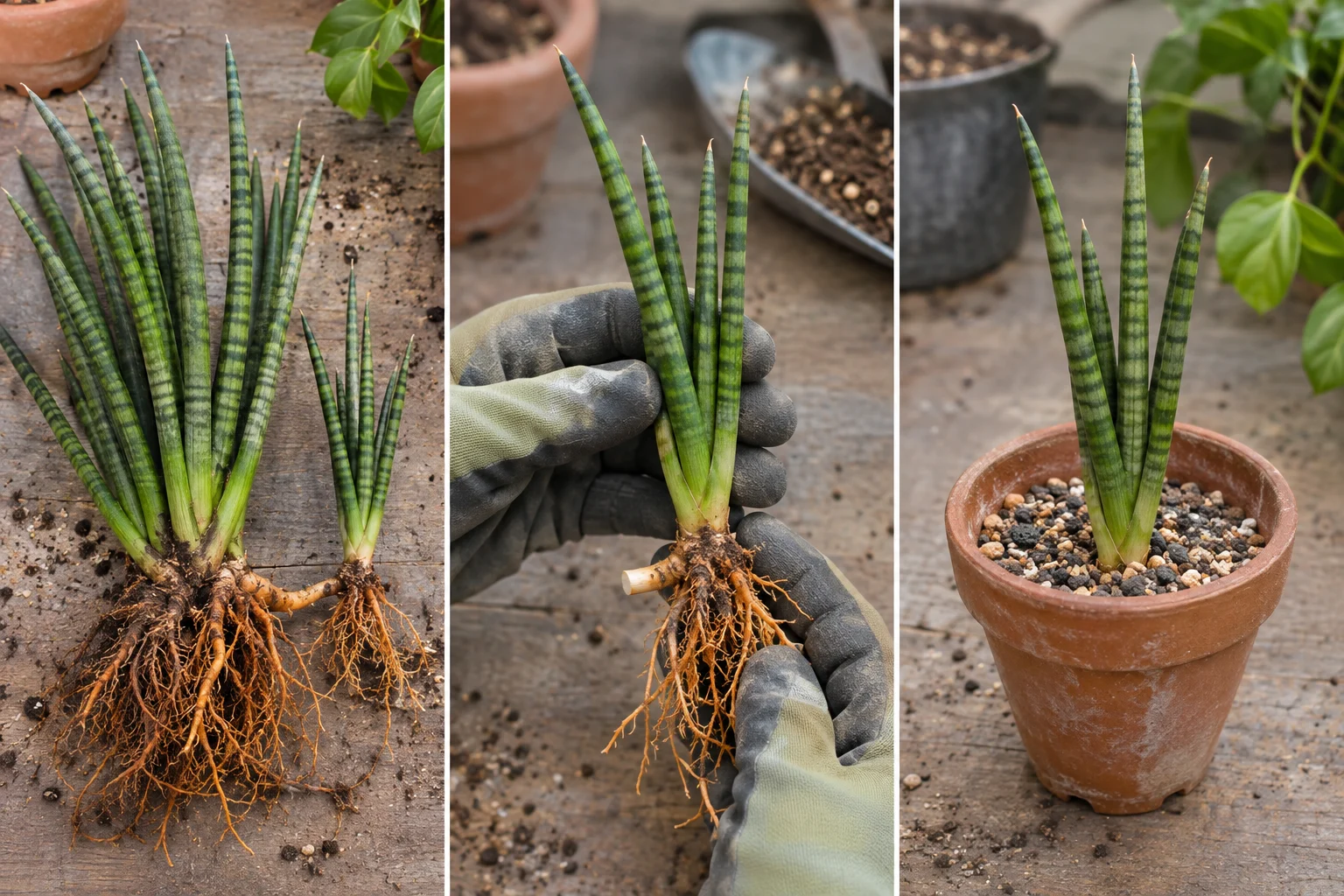
Panels, from left to right
- Unpot a healthy natural fan and identify a rooted offset joined by firm rhizome tissue, protecting hands from the pointed leaves.
- Separate the connecting tissue with a clean tool where needed, retaining the offset's roots and basal growing structures.
- Set the young fan at its former depth in a stable small draining pot and allow its leaves to grow naturally without braiding.
Use the grooves as inspection routes
Mealybugs and scale insects can occupy sheltered leaf grooves and the crowded area around a braid's base. The gray-green cross-bands are normal pigmentation, while an attached raised insect or cottony cluster needs closer examination. Compare a suspect feature along several leaves: a regular pattern is different from a changing localized colony. RHS also lists vine weevil as a possible problem, especially relevant to plants moved between outdoor and protected settings.
Separate an affected pot while identifying the organism and check hidden leaf-to-leaf contacts without forcing the fan apart. Any chemical treatment should be locally authorized for the identified pest and indoor ornamental use, with its label followed. A soft buried base can also result from prolonged moisture and is not automatically an insect problem. Avoid treating painted ends or old braid abrasions as fungal disease simply because they look unlike the natural surface. Escalate progressive deterioration when the cause remains unresolved.
[3][2][4]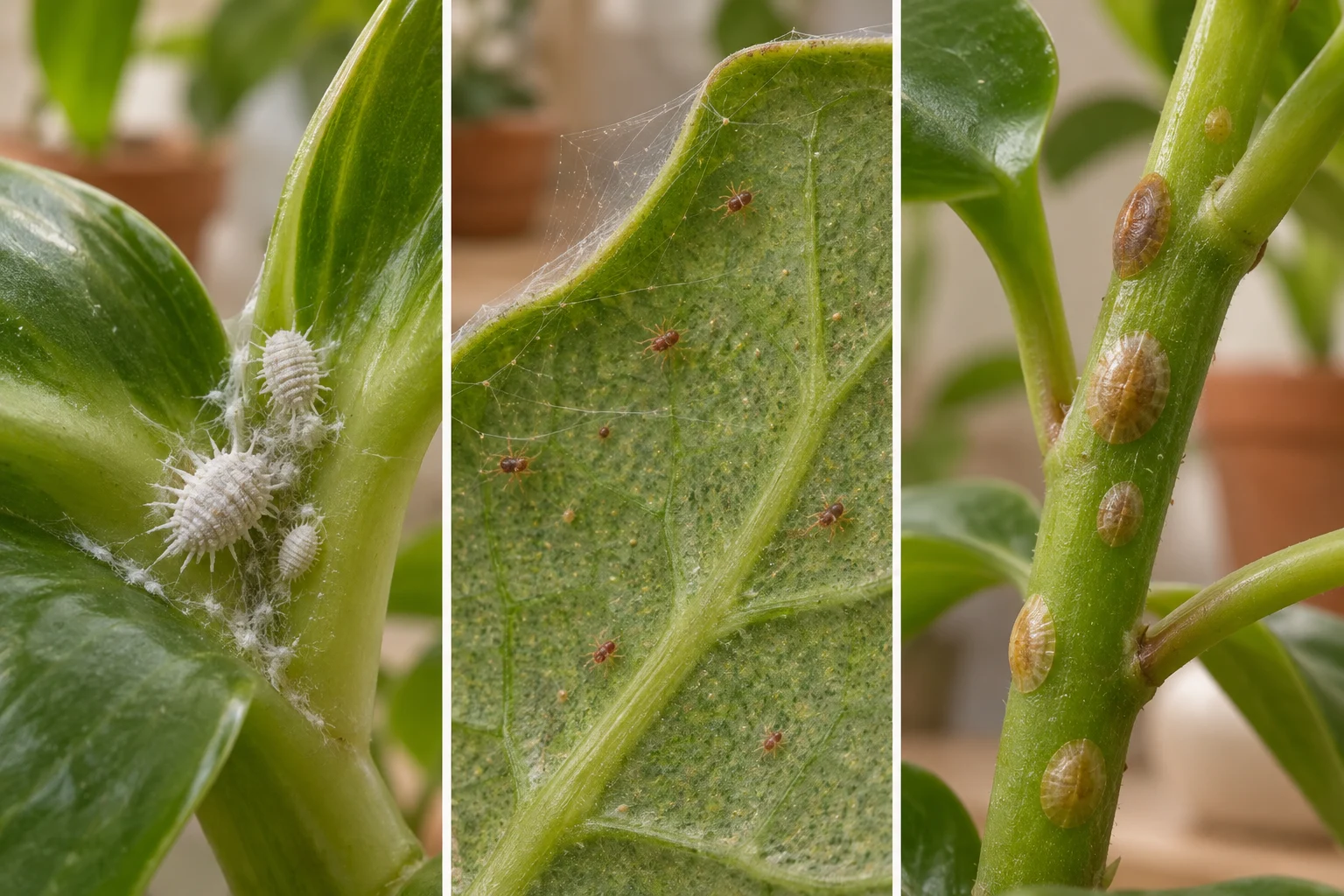
Panels, from left to right
- Mealybugs
- Spider mites
- Scale insects
Separate natural channels from new collapse
A shallow groove running the length of a firm leaf is part of African spear's structure. A newly deepened crease, softer tissue or loss of attachment at the base is a separate finding. Check when it appeared and whether it affects one leaf that was bent or several connected leaves. In a pot of individual cuttings, compare each base; an isolated failure should not automatically produce a whole-pot diagnosis.
The rounded leaf makes orientation useful: a pale patch restricted to the side facing newly introduced sun suggests checking that exposure. Abrasion where two braided leaves rub is more localized than a general root problem. Old dry scars will remain, so observe whether the affected border expands and whether new basal growth is sound. If a spear is flopping because its base is decaying, tying it upright only conceals the symptom. Decide whether an inspection is warranted from moisture and tissue evidence, not from shape alone.
[2][3][4]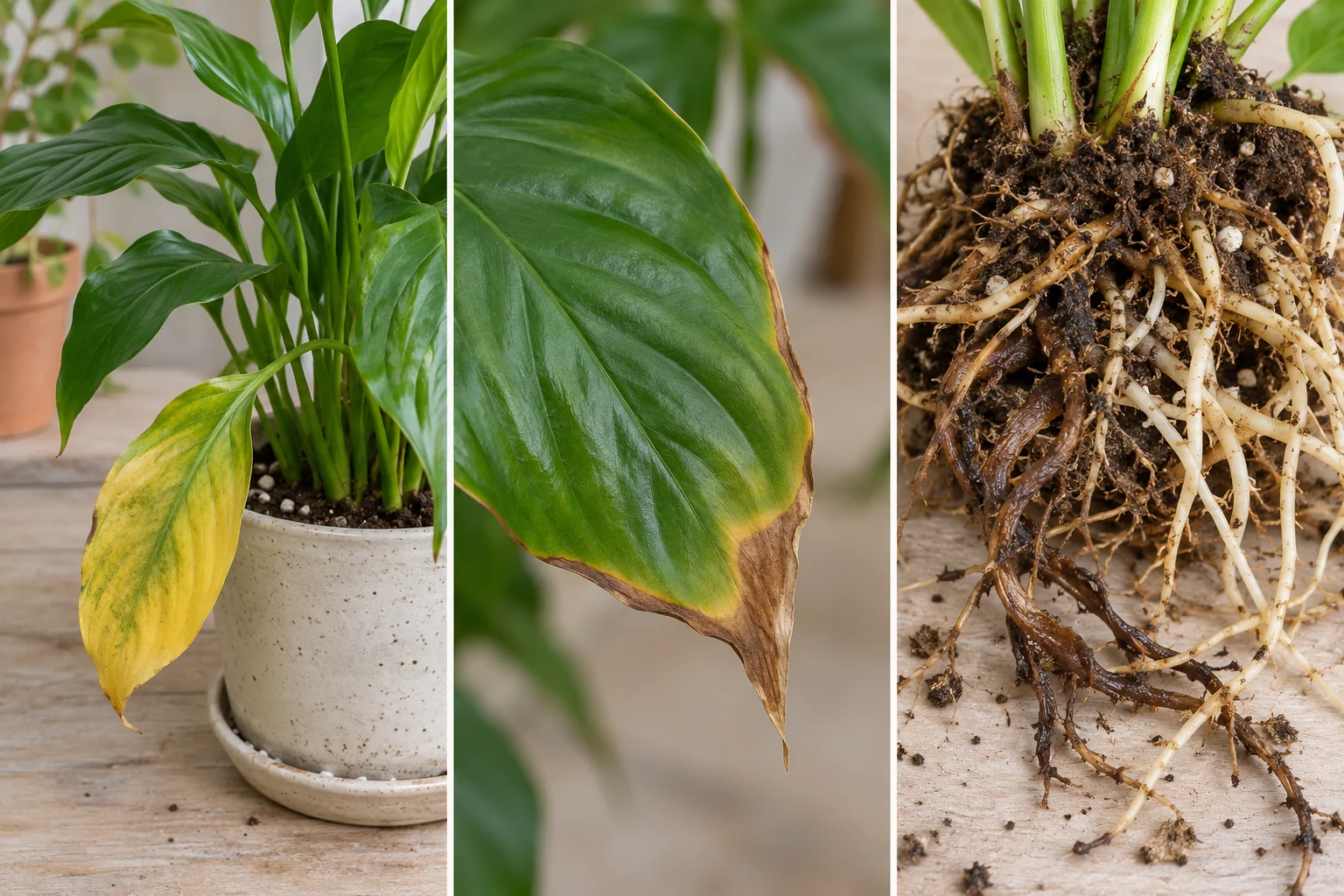
Panels, from left to right
- Yellowing foliage
- Brown leaf edges
- Damaged roots
A cylindrical leaf develops a deeper crease than its normal grooves
- Possible causes
- Possible loss of water supply or local bending damage, rather than the ordinary shallow channels of this species.
- What to check
- Compare the affected leaf with firm neighbors, deep moisture and any recent pressure from ties or transport.
- Next step
- Correct the supported moisture or mechanical issue and watch basal growth; do not treat every longitudinal groove as a call to water.
One spear loosens in an otherwise firm braided arrangement
- Possible causes
- Possible deterioration of an individual rooted cutting or a separate injured base.
- What to check
- Determine whether the pieces share a rhizome and inspect the loose base without assuming the entire display is one plant.
- Next step
- Address the failing component and drainage as justified, avoiding tighter ties that merely hide looseness.
Pale patch appears on one side of a round spear
- Possible causes
- Possible abrupt sun exposure on the previously sheltered side, with abrasions or pests as other possibilities.
- What to check
- Match the patch's direction to the recent window change and inspect its surface and progression.
- Next step
- Reintroduce strong light gradually and assess new fans; obtain advice if tissue softens or lesions spread beyond the exposed side.
Follow the new shoot rather than the season label
A warm bright period can reveal new fans emerging beside the original retail arrangement. Reassess space and drying rate then; a pot that previously held only a few rooted leaves may now contain a more developed plant. This can be a useful opportunity to plan division if it is genuinely crowded, while allowing young tissue to strengthen before manipulation.
During darker, cooler periods, a display of firm spears may remain almost unchanged. Reduce inputs to actual use and keep the bases visible for occasional inspection. If taking the plant outdoors in warm weather, begin with sheltered morning light rather than an abrupt afternoon exposure. On return, examine the pot for hidden pests and move before cold nights. Do not assume a warm room elsewhere in the house describes the climate around a floor-level pot beside an outside door.
[2][3][4]A fragrant raceme can rise among the cylinders
An established plant occasionally produces an upright stalk bearing small tubular whitish flowers, sometimes with a pink or greenish tint. They are fragrant and arranged along a raceme, rather than opening from painted spear tips. The flower stalk is distinct from the cylindrical foliage and need not resemble another fan leaf. Flowering in containers is possible but not a dependable annual event indoors.
Keep the same evidence-based attention to the roots while the stalk develops; neither a dry-pot endurance test nor heavy fertilizer is justified to force flowers. A finished stalk can be removed without shortening the surrounding spears. Fruits may follow successful reproduction, but their appearance does not make them food and does not guarantee viable seed in a room. Division remains easier to interpret for a household that wants another established fan. Keep reproductive material within the same pet and child precautions as the rest of the plant.
[3][2]Pointed leaves create two separate precautions
NC State identifies this exact species as harmful on ingestion, including to cats and dogs, and names saponins. Its account also notes possible skin irritation from sap. Keep cut pieces and rooted spears out of reach of chewing animals, not only the final display. A low-severity classification in a plant reference does not mean that a pet should be allowed to test it or that an individual reaction can be predicted.
African spear has stiff, pointed leaves; choose a position where their tips cannot meet someone’s eyes. Consider eye level, floor traffic and children reaching toward a shelf when choosing a position. This physical concern is independent of ingestion toxicity. Use gloves for cutting, avoid sap in eyes and do not remove every natural point as a substitute for better placement. Suspected ingestion or an injury calls for appropriate poison, veterinary or medical advice, with the scientific name and a photo.
[2]Understand commercial manipulation before experimenting
A rooted spear in a braided pot can live for a long time before a visibly independent plant develops. That fact makes it a poor test of whether a new feeding product or watering gadget has suddenly accelerated growth. Record the number of emerging fans and their attachment to the rooted bases, rather than measuring only the original cut leaves. A photograph from pot level is often more informative than one showing only the tall silhouette.
The straightforward home methods here remain division and appropriately oriented leaf cuttings in draining media. Similarly, water-rooting a cutting is not proof that an established rhizome system belongs in permanent standing water. Keep experimental material separate from the mature fan and avoid changing several variables together.
[2][3][4]Distinguish compact fans from styled cuttings
‘Boncel’ is a compact form illustrated in the NC State account, with a shorter, spreading fan rather than a promise of tall parallel spears. Keep a cultivar label when size matters. A small pot containing shortened or young leaves is not automatically a dwarf cultivar, and a braid is not a botanical variety. The natural fan provides the clearest comparison when deciding what future growth to expect.
RHS records the older name Sansevieria cylindrica var. patula, and Kew includes it among synonyms under Dracaena angolensis. Naming systems can therefore make the same material appear more different than it is. Conversely, other round-leaved dracaenas should not be forced into this species merely because they look cylindrical. For an unusual colored or variegated selection, retain the supplier's full name and avoid promising identical offspring from every leaf cutting. Decorative paint adds no evidence of an inherited trait.
[2][3][1]Frequently asked questions
Why is African spear now Dracaena angolensis rather than Dracaena cylindrica?
Kew accepts Dracaena angolensis and lists Sansevieria cylindrica as its synonym.
[1][2][3]Is the braid on a shop-bought African spear its natural trunk?
No. NC State describes retail arrangements of rooted leaves braided together. The species naturally develops basal fans connected to underground rhizomes, not a woven woody trunk.
[2]Will the new African-spear shoots continue the old braid by themselves?
New plants can arise at the bases of the rooted leaves, but the braid is a human arrangement. Let the emerging fans develop without forcing rigid tissue into the old styling.
[2]Are brightly painted African-spear tips a flowering variety?
NC State records dipped tips as a retail treatment. Paint is not a flower or inherited leaf color; real flowers occur on a separate upright stalk.
[2][3]Do the channels along an African-spear leaf always mean dehydration?
Shallow longitudinal grooves are normal. Compare firmness and whether the groove has changed recently. A new deep crease or soft base requires a different investigation.
[2][3]Why does my ‘Boncel’ African spear spread sideways instead of becoming a tall bundle?
It is a compact fan-shaped selection. Its labeled growth form differs from a pot of long leaves arranged upright; outward spread need not be corrected by tight tying.
[2]Can topping a cylindrical African-spear leaf make side branches?
The spear is a leaf, not a woody stem. Cutting it leaves a cut end; new fans come from the basal system or form through propagation, not from ordinary branching along that leaf.
[2]Why is a new fan appearing beside the original African-spear leaves?
Rhizomes and the bases of viable rooted cuttings can produce additional plants. This is expected development and may change a tidy retail arrangement into a wider clump.
[2][3]Should a very tall African-spear display automatically receive a deep pot?
No. Height does not reveal how many roots are present, especially with individual cuttings. Choose stability and adequate root space without creating an unnecessarily large wet volume.
[2][3][4]Do rooted African-spear cuttings already constitute mature flowering fans?
A long-lived rooted leaf can remain green before its new plant develops. Do not equate the original spear's height with the maturity of the new basal fan.
[2]Why are marks appearing where braided African-spear leaves touch?
Local contact or a tight tie may be involved, while pests can also hide there. Inspect the contact point and living organisms before calling every mark a whole-root problem.
[2][3]Can I put African spear beside a child's play area because it has no flat spiny edges?
African spear has stiff, pointed leaves; choose a position where their tips cannot meet someone’s eyes. Cylindrical shape does not remove the physical tip hazard.
[2]Does changing the label from Sansevieria cylindrica remove its pet risk?
No. The accepted name refers to the same species. NC State flags ingestion risk for cats and dogs and possible sap irritation, including when handling cut leaf pieces.
[1][2]Are African-spear flowers supposed to open from the colored leaf tips?
No. The small fragrant tubular flowers are carried on a separate raceme among the foliage. Colored dipped tips are a retail decoration, not buds.
[3][2]Should home African-spear cuttings follow a published heated tissue-culture protocol?
Not as a household recipe. Controlled culture uses specific sterile media and treatments. The home approach here is division or correctly oriented cuttings with ordinary suitable light and a draining medium.
[2][3][4]Why should I inspect each spear separately in a nursery arrangement?
The pot may contain independent rooted leaf cuttings rather than a single connected mature clump. One damaged base can therefore differ from its neighbors; inspect the actual composition before choosing a whole-pot response.
[2]Compare related plants
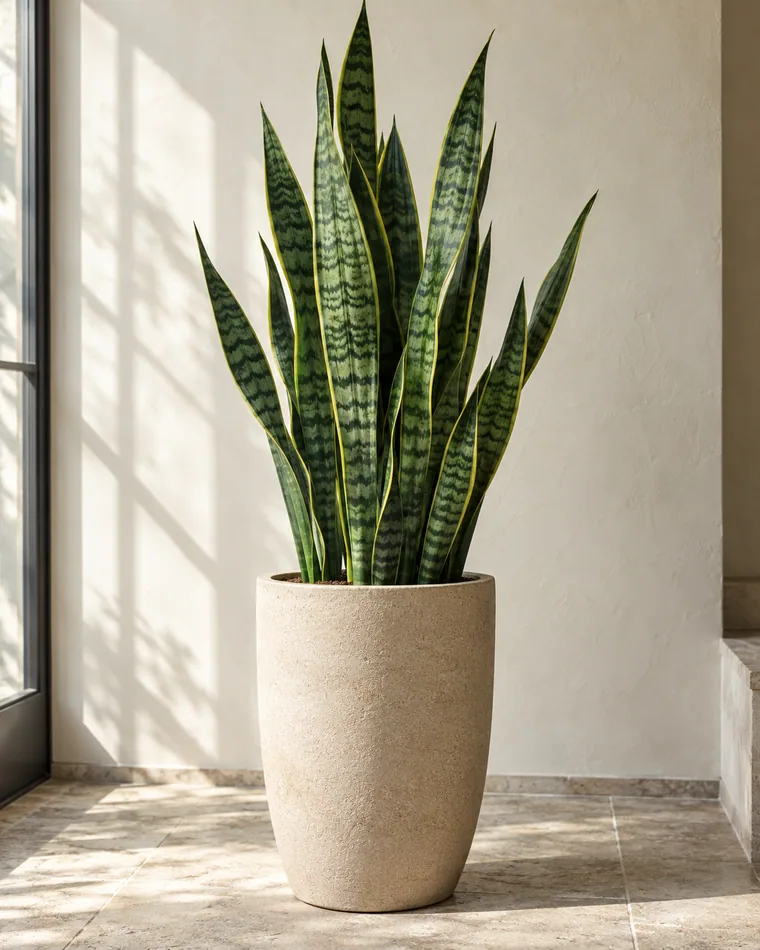
- Snake plant: Common snake plant has flat sword-shaped leaves rather than grooved cylinders. Both have rhizomes, but a braided African-spear retail pot often needs its component cuttings identified before planning care.
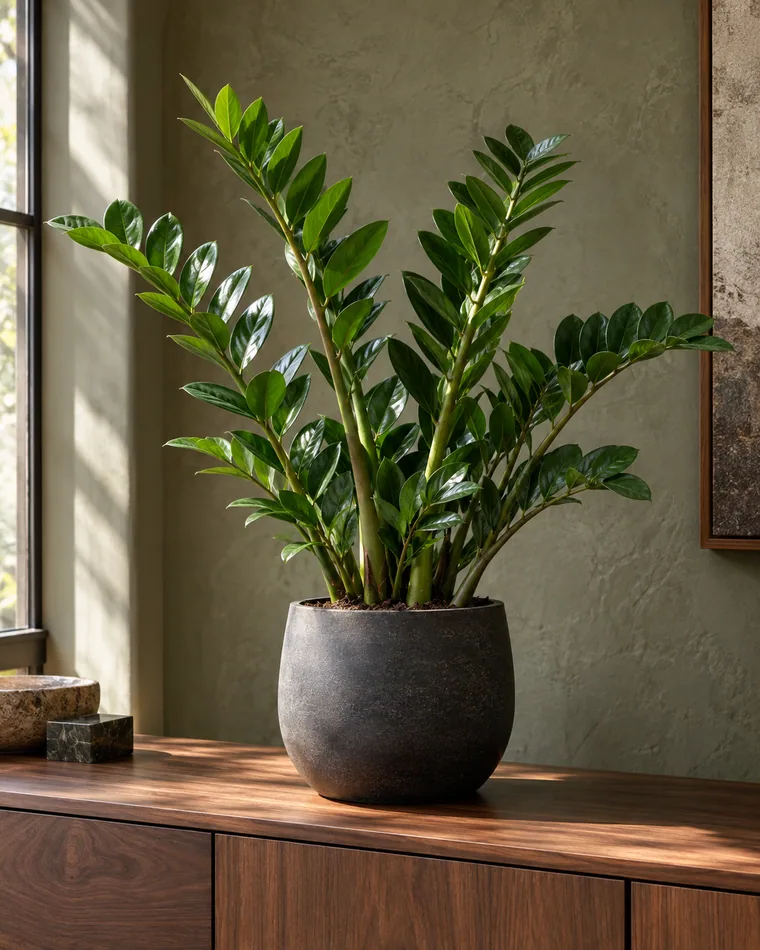
- Whale-fin snake plant: Whale-fin forms broad paddle-shaped blades. Its single-leaf display has a different balance and surface area from African spear's narrow cylindrical fans, even though both can produce new growth below the soil.
Care reminders with PlantPal
Use a PlantPal reminder to inspect African spear's leaf bases and emerging fans before adjusting water to a changing pot.
Set an African spear reminder