 Plant
Giant taro.
Alocasia macrorrhizos
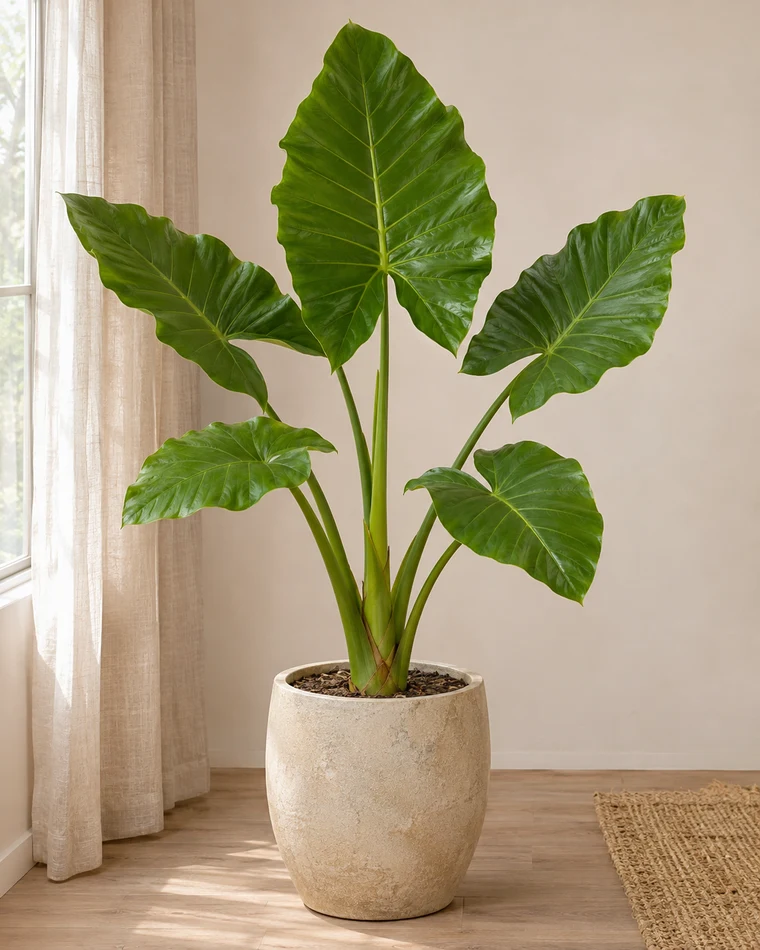
Giant taro brings an architectural canopy of upright, arrow-shaped leaves to a bright room. Alocasia macrorrhizos needs space, warmth and a root zone that stays airy rather than permanently wet. Its dramatic foliage responds to changing seasons, so occasional leaf loss needs context. This guide explains how to distinguish ordinary turnover from problems, divide a rooted offset and handle this irritating, pet-toxic aroid with care.
How to help it thrive.
Checked:
Quick care reference
- Identity: Alocasia macrorrhizos, Araceae.
- Light: bright indirect or filtered daylight.
- Water: in established deep pots, check the upper 5 cm (2 in); always drain.
- Warmth: growing conditions above 16°C (60°F); avoid cold drafts.
- Substrate: airy, moisture-retentive mix in a stable pot with holes.
- Feed: according to the label while actively growing.
- Propagate: rooted offsets or viable rhizome divisions in spring to early summer.
- Safety: irritating sap; toxic to cats and dogs; not an edible houseplant.
Overview and botanical identity
Alocasia macrorrhizos is a perennial member of the arum family, Araceae, commonly sold as giant taro or elephant’s ear. It forms an underground storage organ and eventually a substantial stem. Smithsonian records outdoor plants around 5 m tall, while RHS describes large alocasias around 1.5 m indoors. Its long cultivation across tropical Asia and the Pacific complicates a simple native-range label; do not assume every cultivated occurrence is native.
[4][3][1][2]How to identify this plant
Look for large, upright leaves on long, strong petioles, with a rounded arrowhead outline. The basal lobes leave an open notch rather than joining across the petiole. Smithsonian uses this feature to distinguish it from Alocasia odora, which has a closed sinus. Giant taro can also be confused with Colocasia plants sold under “elephant’s ear”; the shared common name does not establish identical growing needs or food safety.
[5][4]Light and placement
Choose a bright position with filtered or indirect daylight and enough space that leaves do not press against hot glass. Newly purchased indoor foliage can scorch after an abrupt move into strong sun, even though acclimated tropical landscape plants tolerate brighter exposure. In a dim corner, slower growth and a smaller canopy are more realistic than a permanently lush specimen. Rotate gently when growth persistently leans toward a window.
[1][2]Watering without a rigid schedule
For an established, adequately deep pot, RHS uses dryness in roughly the upper 5 cm (2 in) as a watering guide. This is not permission to dry a small offset’s entire root ball. After watering, the deeper mix should remain aerated rather than saturated. Cool conditions and leaf loss reduce demand. Drooping in a wet pot calls for a drainage and root check, not another dose of water.
[1][2]Soil, drainage and repotting
A peat-free houseplant mix with an airy structure is more useful than a dense, waterlogged garden soil. Choose a stable pot because the canopy can become top-heavy. RHS suggests moving up only about 5 cm (2 in) in pot diameter rather than placing a small plant in a huge container. Keep the crown at its previous depth. There is no need to chase an unverified exact pH with household acids.
[1][2]Temperature and humidity
RHS recommends growing-season warmth above 16°C (60°F). Protect foliage and roots from cold drafts and chilly window ledges. Its guide discusses cooler resting conditions above 10°C (50°F), but that is not an ideal target for an actively growing indoor specimen. Maintain comfortable warmth instead of deliberately chilling it. Medium to high humidity helps leaf quality; humidity problems should be checked alongside watering and mites, not inferred from brown edges alone.
[1][2]Feeding during active growth
A large canopy can use nutrients during active growth, but more fertilizer does not compensate for insufficient light. Follow a houseplant fertilizer’s directions while new leaves are developing and reduce or pause feeding when growth slows. Pale growth, damaged roots and accumulated salts can look similar. If a white crust develops or tips worsen after feeding, review dosage, water quality and drainage before adding a different supplement.
[1][2]Growth, cleaning and pruning
Growth emerges from the central crown; this is not a vine that needs training up a moss pole. Leave healthy leaves in place to supply the storage organ. Remove a fully declining leaf at its base with gloves and clean tools, avoiding injury to adjacent petioles or the central growing point. Do not cut every leaf simply to make the plant smaller: assess light, available space and pot stability first.
[1][2]Propagation that suits the species
The most accessible home method is division of an offset that already has its own roots. In spring or early summer, unpot a healthy plant, identify the connection and separate it cleanly with a viable growing point attached. Pot the division in a suitably small draining container at its original depth. Rhizome division is also possible, but tiny unrooted pieces are less forgiving; do not promise success from a leaf and stalk alone.
[1][2]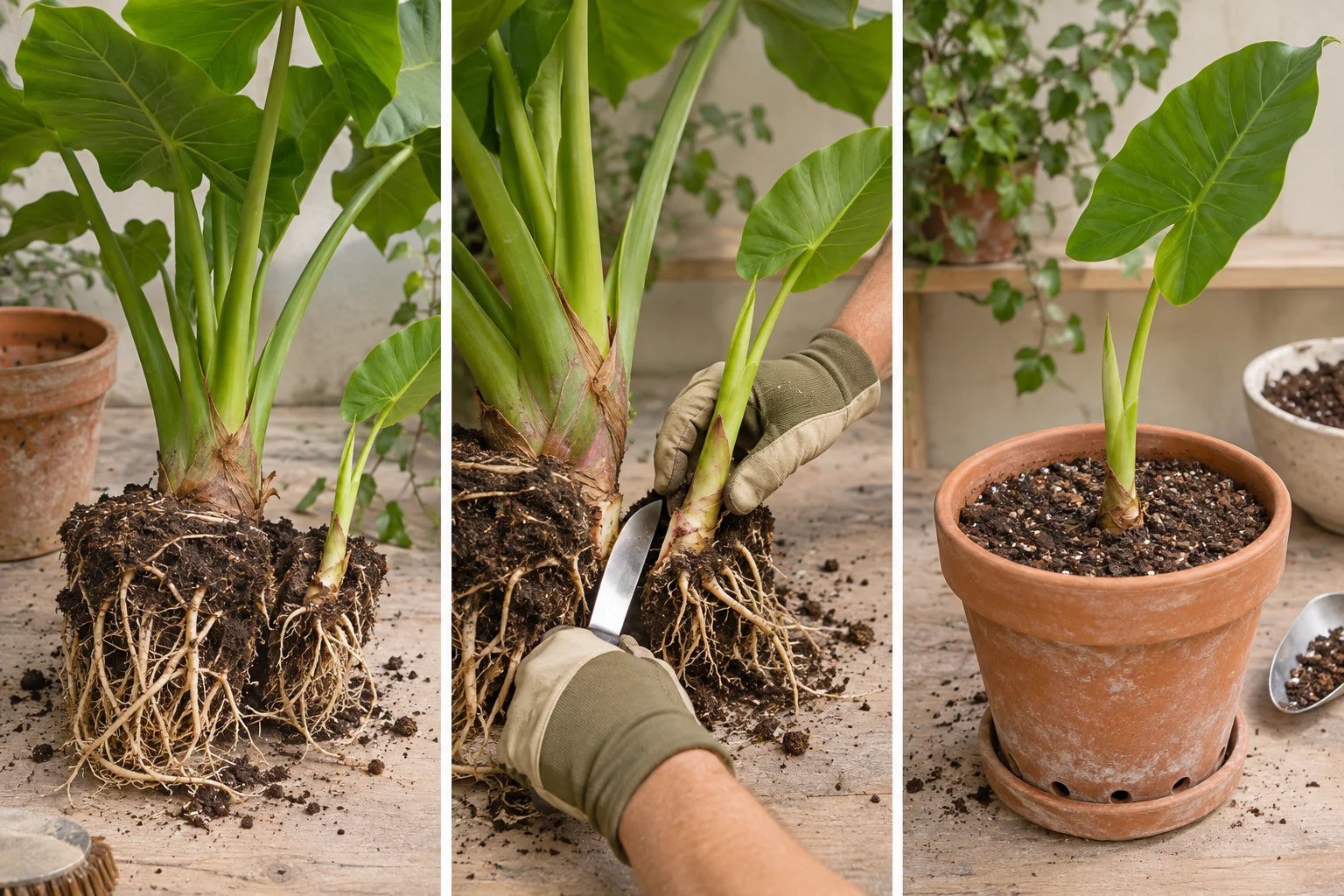
Panels, from left to right
- Unpot a healthy parent during active spring growth and locate an offset with its own roots. Wear gloves.
- Separate the connection with a clean tool, retaining the offset’s roots and a viable growing point.
- Plant at the original depth in a small draining pot; keep warm with indirect light and a moist, airy root zone.
Pests and disease prevention
Spider mites deserve particular attention in dry indoor air; inspect for fine webbing and pale stippling on leaf undersides. Scale and other houseplant pests are also possible, so identify what is present. A decaying corm or soft roots in persistently wet substrate suggests a serious root-zone problem. Remove a plant from shared runoff, improve conditions and seek an informed assessment if decay progresses; pesticide treatment does not repair overwatered roots.
[1][2]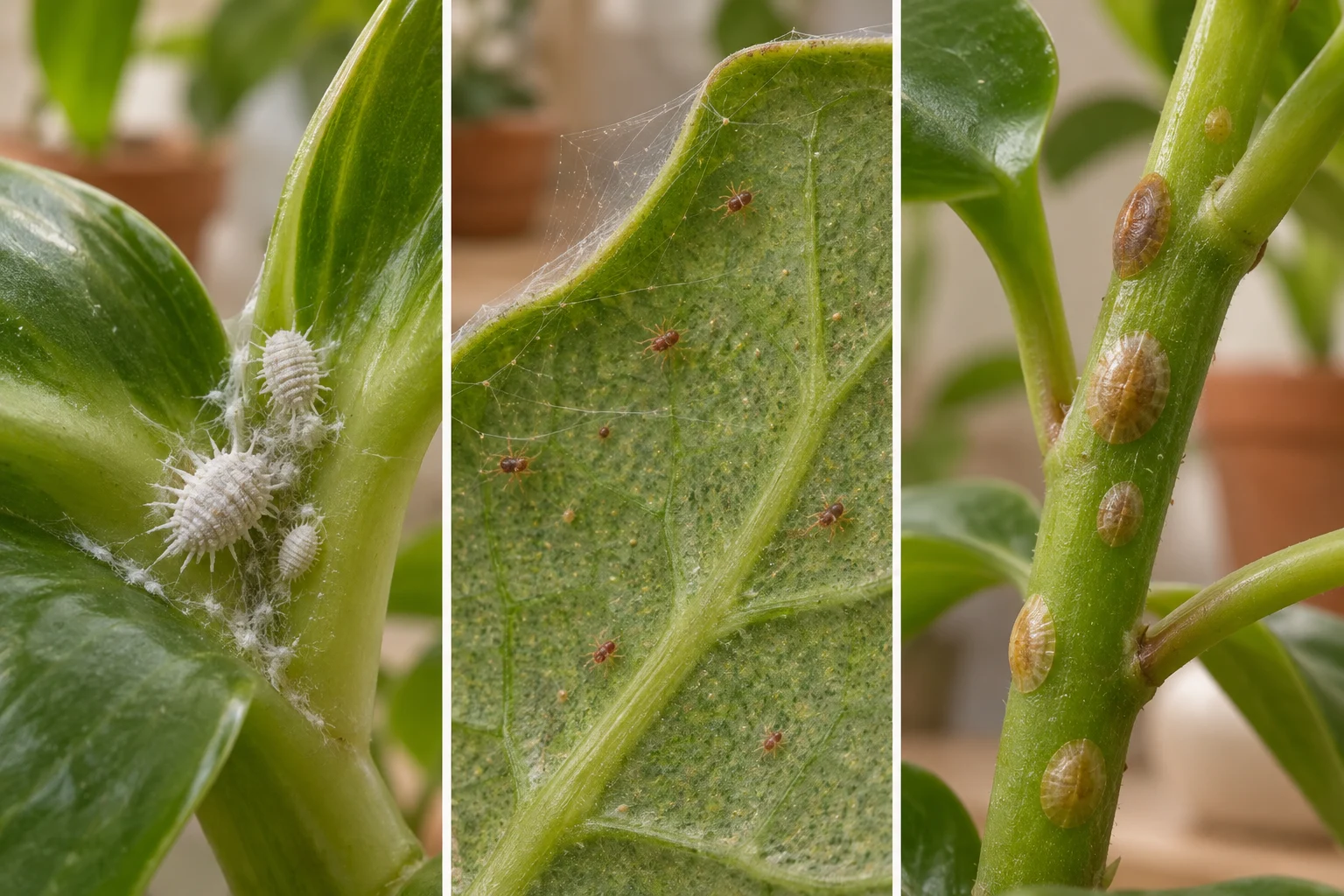
Panels, from left to right
- Mealybugs
- Spider mites
- Scale insects
Troubleshooting: check before treating
One oldest leaf fading while a healthy new leaf opens can be ordinary turnover. Several leaves yellowing rapidly, a soft stem base or a pot that remains heavy and wet needs closer investigation. Brown margins may reflect dry air, inconsistent moisture, salt stress or mites. Curling and drooping are also nonspecific. Compare root firmness, recent temperatures and the distribution of damage before choosing a response.
[1][2]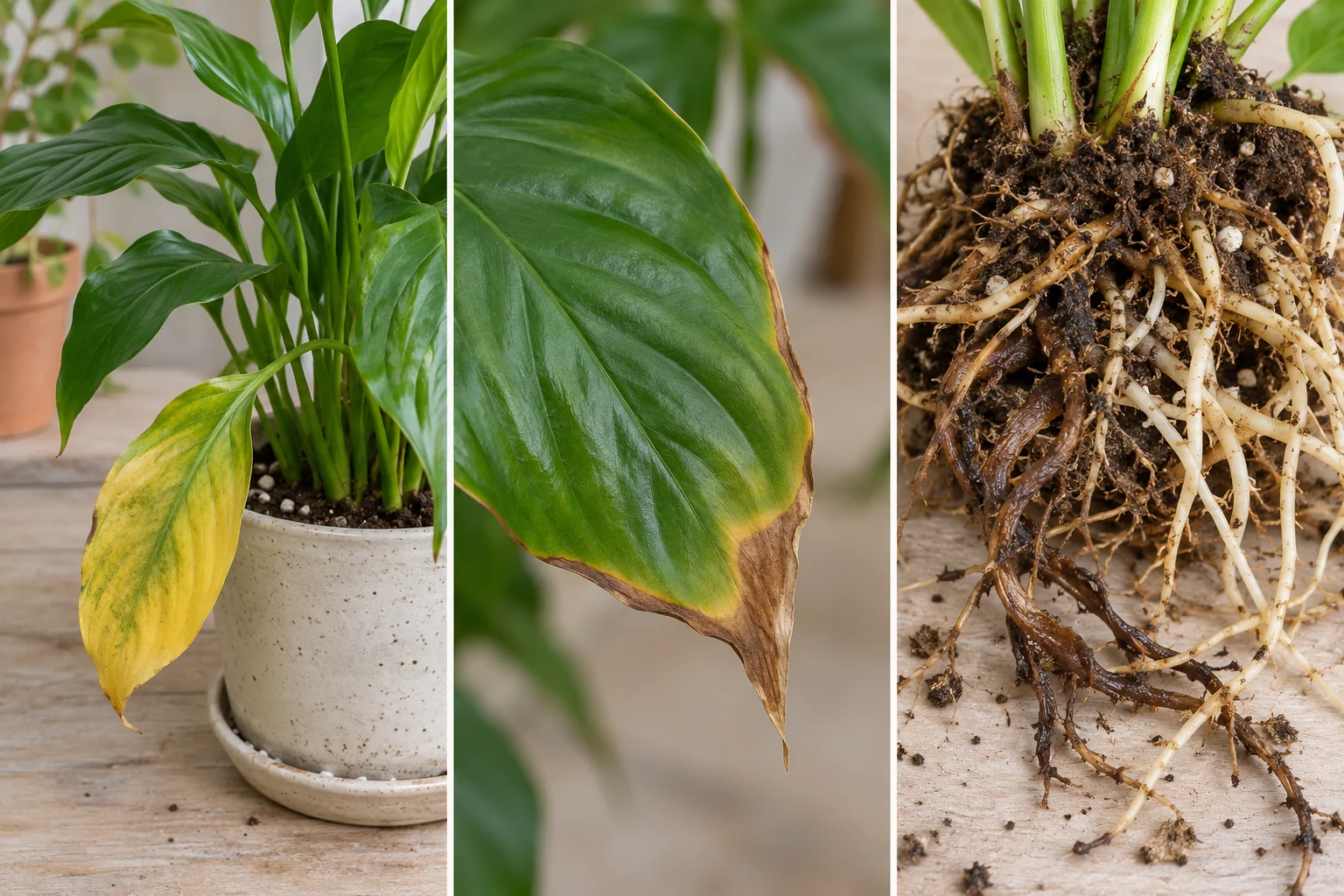
Panels, from left to right
- Yellowing foliage
- Brown leaf edges
- Damaged roots
Yellowing or leaf loss
- Possible causes
- Possible normal aging, prolonged wetness, low light or cold stress.
- What to check
- Compare old and new leaves; feel the substrate and check whether the stem base is firm.
- Next step
- Correct the identified environmental issue; reduce watering if the pot remains wet and seek advice for a soft, deteriorating base.
Brown edges or damaged leaves
- Possible causes
- Possible dry air, irregular moisture, salt accumulation or spider mites.
- What to check
- Inspect undersides for stippling or webbing and review recent fertilizer and watering changes.
- Next step
- Stabilize moisture and humidity; isolate and identify any pest. Judge recovery by new leaves.
Drooping or stalled growth
- Possible causes
- Possible dry roots, waterlogged roots, low temperature or seasonal rest.
- What to check
- Check root-zone moisture and temperature before adding water; a heavy wet pot differs from a dry light one.
- Next step
- Water only when appropriate, improve warmth and light, and avoid feeding a stressed or resting plant.
Seasonal adjustments
In a warm bright growing season, check moisture more frequently as the canopy expands. When light falls and growth slows, increase the interval between watering checks as needed, rather than keeping a summer dose. A resting plant may lose leaves without being dead, provided the storage organ remains firm. Do not keep a leafless, cool plant wet. Resume feeding and increase watering gradually when growth actually returns.
[1][2]Flowers and reproduction
The aroid flower structure consists of a spadix surrounded by a spathe, rather than a conventional flower with showy petals. Smithsonian records red berries after successful reproduction. Indoor flowering and fruiting are unpredictable, and berries must be kept away from children and pets. A plant can be healthy without flowering. Division is usually more practical for a home grower than attempting seed production.
[4][3]Children, pets and handling
This ornamental is not a kitchen taro substitute. NC State Extension classifies Alocasia species as toxic to cats and dogs because insoluble calcium oxalate crystals irritate mouth tissues. Queensland Poisons Information Centre also documents irritating sap. Wear gloves when cutting or dividing and prevent contact with eyes. Suspected ingestion warrants professional advice; mouth pain, marked drooling or difficulty swallowing are concerning, and breathing difficulty requires urgent help. Do not provide homemade ingestion treatments.
[3][6]Advanced growing methods
An evenly lit canopy is more useful than a moss pole for this self-supporting plant. A grow light can supplement a dim room when introduced carefully, with space to prevent leaves contacting a hot fixture. Semi-hydroponic cultivation is an experiment rather than a default recommendation here: roots adapted to one medium may struggle after transfer, and a continuously wet reservoir does not reproduce the drainage needs described for potting mix.
[1][2]Names, forms and cultivars
Variegated forms have pale sectors with less photosynthetic tissue and may respond differently from green plants in the same position. They still need protection from abrupt strong sun; increasing light indefinitely will not turn white tissue green. Check botanical labels carefully because “elephant’s ear” includes several genera and Alocasia odora is a common lookalike. The species-specific identification and toxicity guidance matters more than a dramatic retail name.
[4][3][1][2]Frequently asked questions
Is giant taro the edible taro used in cooking?
Do not treat this ornamental as food. Giant taro is Alocasia macrorrhizos, while plants sold as edible taro may be other taxa. Its irritating calcium oxalates and the risks of misidentification make kitchen experimentation inappropriate.
[3][4][1]How can I distinguish it from Alocasia odora?
Check the base of a mature leaf: giant taro has an open notch between its basal lobes, whereas Smithsonian describes a closed sinus in A. odora. Compare several leaves and the whole plant rather than trusting a single damaged leaf.
[5]Why does it lose an old leaf when a new one opens?
An isolated aging leaf can be normal turnover, especially if the new leaf is healthy. Rapid loss of several leaves, a soft base or persistently wet soil points to a problem requiring moisture, temperature and root checks.
[1]Is a leafless plant dead?
Not necessarily. Alocasias can shed leaves while resting. A firm storage organ may regrow once warmth and growth return; a soft, decaying organ is different. Reduce water demand accordingly and avoid saturating a cool, leafless plant.
[1]Why are the leaf edges brown?
Possible causes include dry air, irregular watering, fertilizer salts and spider mites. Check substrate moisture and leaf undersides before treating. Damaged edges will not recover their original green color, so track whether new leaves emerge healthier.
[1]Should I repot into a very large container?
Usually not. Excess unused substrate can stay wet around a small root system. RHS recommends a modest increase of about 5 cm (2 in) in diameter when repotting is actually needed; choose stability as well as drainage.
[1]Can it go outdoors in summer?
Only with suitable warmth and gradual acclimation to stronger light. A plant raised indoors may scorch immediately in harsh sun. Check local night temperatures and inspect for pests before bringing it back into the house.
[1]Do droplets or one yellow leaf prove a disease?
No isolated sign establishes a diagnosis. Consider the whole plant, the moisture pattern and whether damage spreads. Record observations and inspect roots only when the evidence warrants disturbance; repeated preventive pesticide applications are not a substitute for identification.
[1]Compare related plants
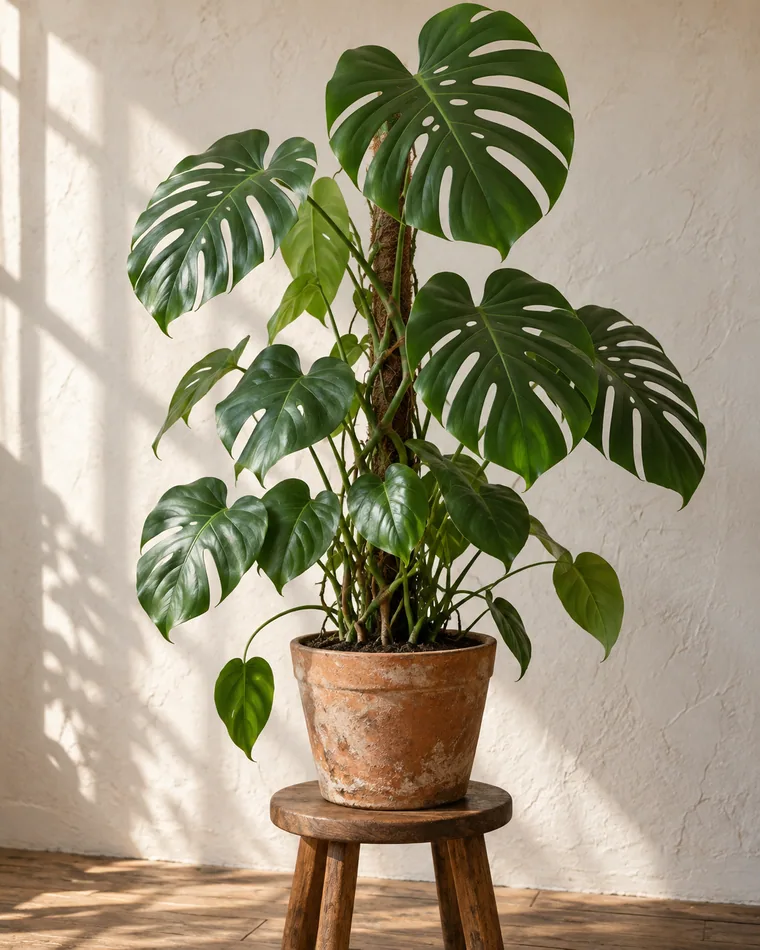
- Monstera: Monstera is another large aroid, but it climbs and develops split leaves; giant taro makes a self-supporting canopy from a central crown.
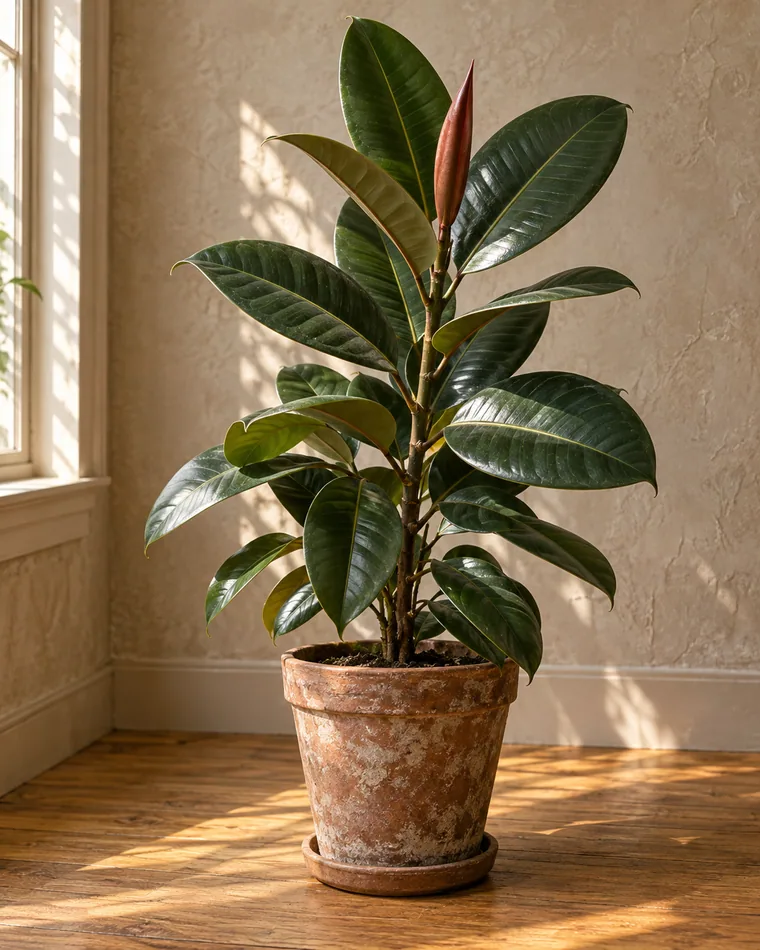
- Peace lily: Peace lily shares the spadix-and-spathe flower structure and calcium-oxalate ingestion risk, while its smaller habit suits different spaces.
Care reminders with PlantPal
Record your giant taro’s drying pattern and emerging leaves in PlantPal so reminders prompt a check of its large pot before watering.
Track this plant in PlantPal