 Plant
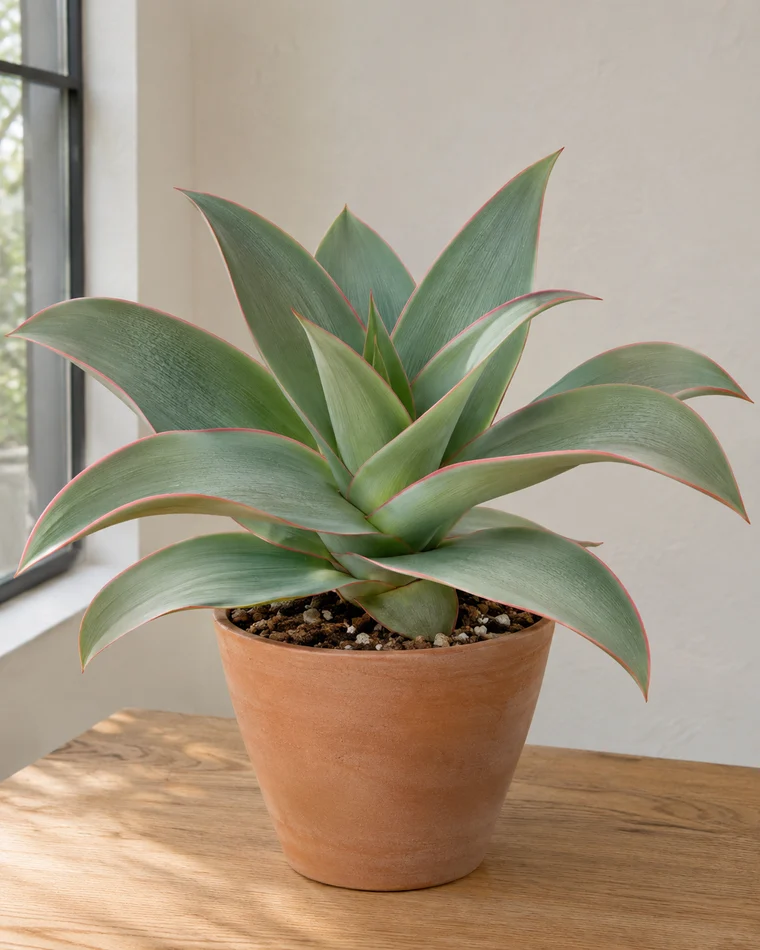
Coral aloe.
Aloe striata
Coral aloe makes a broad, low rosette rather than a spiny tower. Its blue-green leaves carry fine lengthwise lines and a smooth pink border, while a mature plant may lift branching coral-red flowers above them. Aloe striata suits a bright window or protected seasonal outdoor display. The important decisions concern preserving that open rosette, interpreting changes in the pink edge and choosing propagation that matches the plant you actually have.
How to help it thrive.
Checked:
Quick care reference
- Identity: Aloe striata, a Cape-region aloe with toothless pink margins.
- Space: allow for a broad rosette; mature dimensions vary with cultivation.
- Light: substantial brightness, gradually adapting a nursery plant to stronger sun.
- Water: evaluate the root zone; keep irrigation out of the tight leaf center.
- Substrate: an airy draining mix beneath the entire rosette, not just a gritty surface.
- Season: flowering and frost reports are climate-dependent; keep indoor pots frost-free.
- Propagation: shallow seed sowing, or division only when a viable offset exists.
- Safety: exact-species ingestion caution applies to people, cats, dogs and rabbits.
A Cape aloe valued for the whole rosette
Aloe striata belongs to Asphodelaceae and is native to South Africa's Cape Provinces. The name striata refers to the fine lines running along its leaves. Its apparently stemless form is a rosette on a very short central axis, not a collection of separate leaf cuttings. In its native region it occurs on rocky, stony sites, including dry coastal and inland areas. That background helps explain the need for an aerated root environment, but it should not be turned into an instruction to leave a small container permanently without water.
RHS places mature height and spread broadly around 0.5–1 m. A windowsill specimen may remain smaller, and a flowering stem changes the height without making the leaf rosette a tall shrub. Leave space around the entire leaf circle before deciding it fits a narrow shelf. It is an evergreen perennial; the RHS maturity category of 5–10 years describes development, not an expiry date. An undamaged growing center and new leaves of balanced proportions are more useful goals than a fixed annual size target.
[1][2]Smooth margins are a defining clue
Look along the edge before looking only at color. Coral aloe has a continuous, smooth margin without the obvious teeth of Aloe vera or the bristly outline of lace aloe. A pink border surrounds broad blue-green to gray-green leaves; fine darker longitudinal lines may be prominent or subtle. The border can redden in stronger light. Compare more than one mature leaf because a damaged edge or young leaf may obscure the character.
A toothed plant sold as coral aloe needs its identification checked, although a single photograph cannot establish a hybrid's parentage. Keep the seller's botanical label and compare the complete rosette. The similar-looking words striata and striatula must not be treated as interchangeable names. Aloe albocincta, by contrast, is a documented synonym of Aloe striata. None of these naming observations establishes edibility: smooth edges make handling less prickly, not the leaf a food ingredient.
[2][1]Support the broad leaves with substantial light
The open rosette needs room and strong light over its full width. A bright window that illuminates only one side can produce an increasingly one-sided display; a modest turn of the container lets you monitor new leaves without twisting the plant by its outer blades. Sources recommend full sun for cultivated coral aloe, but a recently purchased shade-grown specimen should reach that exposure gradually. The aim is a supported, balanced rosette, not the deepest possible red edge.
Watch the border and blade separately after a move. A stronger pink-red margin is described for this species and can be ordinary light-related color. A new bleached, dry patch within the blade is a different observation and deserves an exposure review. Photograph the same leaf before changing location, then compare newly forming leaves. For winter supplementation, position a suitable grow light to cover the rosette, following the fixture's directions rather than applying a universal distance. A dark decorative corner will not reproduce a sun-grown compact plant.
[2]Reach the roots without filling the leaf bowl
The broad overlapping leaves can channel a careless stream toward the center. Direct water onto accessible substrate around the rosette instead, then confirm that it exits the growing pot. A tightly fitted decorative bowl makes this difficult to check, so use a removable draining inner container. Before the next watering, assess the mixture beneath any gravel top-dressing: a dry surface around a wide rosette can conceal a cool wet core.
RHS advises moderate watering in active growth and much less during winter rest in its setting. Apply that distinction to actual activity, not to the word winter alone. A warm well-lit coral aloe making firm central leaves differs from a cool stationary specimen. Its fleshy leaves buffer temporary dryness, but thinner leaves do not automatically call for more water if the roots remain wet. Deposits on the smooth margins may justify checking water and splash patterns; the pink edge itself is not evidence of mineral damage.
[2][3]Give a wide rosette a stable draining base
A pot must support the horizontal spread without burying the plant's center. Select width and weight for stability while keeping the amount of unused wet substrate modest. The RHS recommends a peat-free cactus medium or a suitable loam-based potting mixture with horticultural grit. The texture should remain open through the pot, not merely look gritty at the surface. A layer of decorative stone does not repair a compressed, airless root zone.
Aloe striata tolerates a range of pH conditions in the RHS account, so exact acid adjustment is not a useful first project. Repot when root occupancy, instability or degraded mix warrants it. Support the container and root ball during handling; the broad leaves are not carrying handles. Preserve the previous level of the short central stem rather than packing wet mix against lower leaves to straighten the plant. If a solitary rosette is healthy with room below, an annual dismantling simply to search for pups is unnecessary.
[2][3]Do not turn garden frost reports into a houseplant test
RHS rates Aloe striata H1C in its UK framework and recommends protected cultivation. For a houseplant, keep a frost-free position and arrange the return from outdoors before threatening cold. A nearby wall or a sunny afternoon does not prove that the overnight root zone is protected.
Coral aloe's thick smooth leaves do not need a humid terrarium. Air should be able to move around the rosette, particularly where lower leaves overlap. Avoid misting in an attempt to intensify the blue-green appearance; it may leave marks without correcting the underlying light or root conditions. Check the temperature beside the actual pot, where window glass can be colder than the room. Neither deliberate chilling nor sudden heat exposure is necessary to maintain the pink border.
[2][3]Use new central growth as the feeding signal
RHS describes monthly general liquid fertilizer during its active growing months. The meaningful part for an indoor coral aloe is the active growth, not copying those British calendar dates worldwide. Look for firm new leaves expanding from the center and account for nutrients already supplied by fresh potting mix. Use a suitable labeled product rather than increasing concentration to make the margin more colorful.
A rosette that is stretching toward the window needs a light assessment before a feeding increase. Likewise, a soft center or deteriorating roots cannot use a rescue dose to rebuild damaged tissue. Keep applications modest and documented, especially when several people care for the same broad specimen. Follow the product instructions and stop unnecessary inputs when growth slows. Flower color is a species trait; extra fertilizer does not guarantee a coral-red display or turn a seedling into a mature flowering plant on a schedule.
[2]Preserve the unbroken outline of the rosette
The ornamental shape comes from whole leaves radiating around a central growing point. Cutting all the broad tips into a smaller circle leaves permanent truncated edges, rather than training a compact shrub. Allow normal older-leaf decline without stripping sound leaves simply because they sit lower than the newest ones. If a leaf is fully dead or badly damaged, remove only the affected material carefully and protect the central tissues.
RHS says routine pruning is unnecessary. A rosette that has outgrown a shelf should move to a suitable surface, not be repeatedly trimmed to fit. Gentle dust removal can help inspection, but do not scrub away the characteristic surface appearance or polish the leaves for a glossy finish. During relocation hold the pot securely and plan clearance for the pink margins. These broad leaves are easy to catch on a doorway even though they lack the conspicuous teeth of many other aloes.
[2]Seed is a practical route when there are no offsets
RHS documents propagation of Aloe striata from ripe seed as well as division of existing offsets. Keep the sowing labeled with the botanical identity and origin. Young seedlings need their own careful moisture management; copying the dry intervals of a large water-storing rosette onto newly germinated plants is inappropriate. Use gentle watering that does not wash seeds into one corner, and provide bright protected conditions while they establish.
RHS also lists division of offsets in spring or early summer, if an offset is actually present. Do not cut a solitary crown apart to manufacture a pup. A separated rooted offset is a different starting point from a detached mature leaf, and these references do not establish leaf cuttings as the routine coral-aloe method. Move an established seedling with its roots intact rather than repeatedly disturbing it to measure progress.
[2]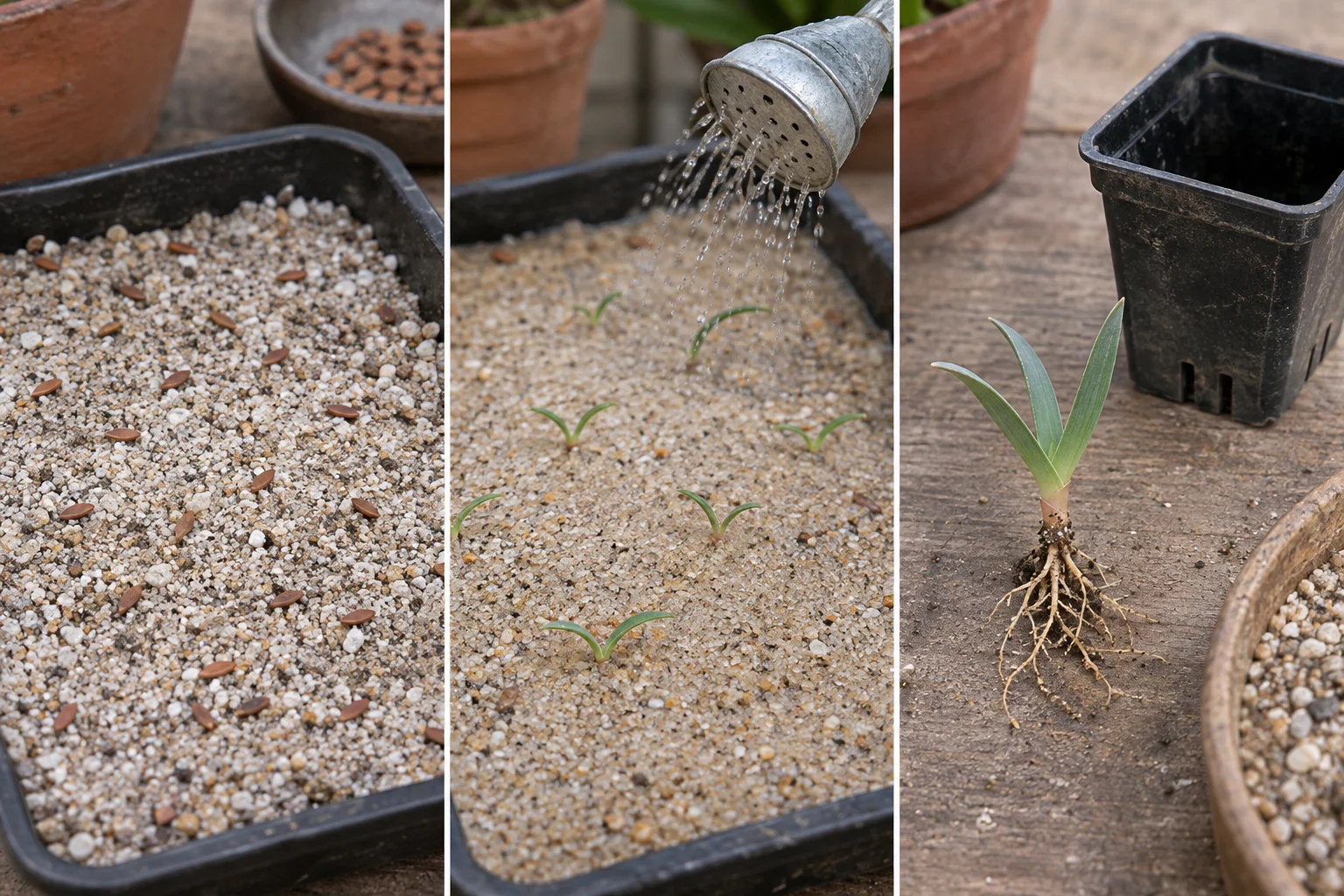
Panels, from left to right
- Scatter correctly identified coral-aloe seed over a well-drained sowing mixture and cover lightly with fine sand.
- Keep the shallow sowing gently moist in protected bright conditions, without washing seeds together or applying an adult rosette's dry interval.
- When a seedling is established, transfer it with its roots intact into a small draining container and increase exposure gradually.
Inspect the protected underside of a broad rosette
Scale and mealybugs may hide where one broad leaf overlaps another or where old leaf tissue meets the base. Look for attached insects or cotton-like clusters rather than treating the smooth pink rim as an infestation. A photograph of one brown spot cannot identify a specific pest or pathogen.
Separate a suspicious specimen and examine the actual damaged location, including accessible lower surfaces. Choose any treatment only after identifying the problem and checking its authorization for the pest and indoor ornamental use. Avoid improvised solvent cleaning on the attractive leaf surface. If the center weakens, look beyond insects to root moisture and tissue condition. Expanding lesions, concealed feeding damage or unexplained collapse deserve horticultural assessment rather than a series of unrelated sprays.
[2]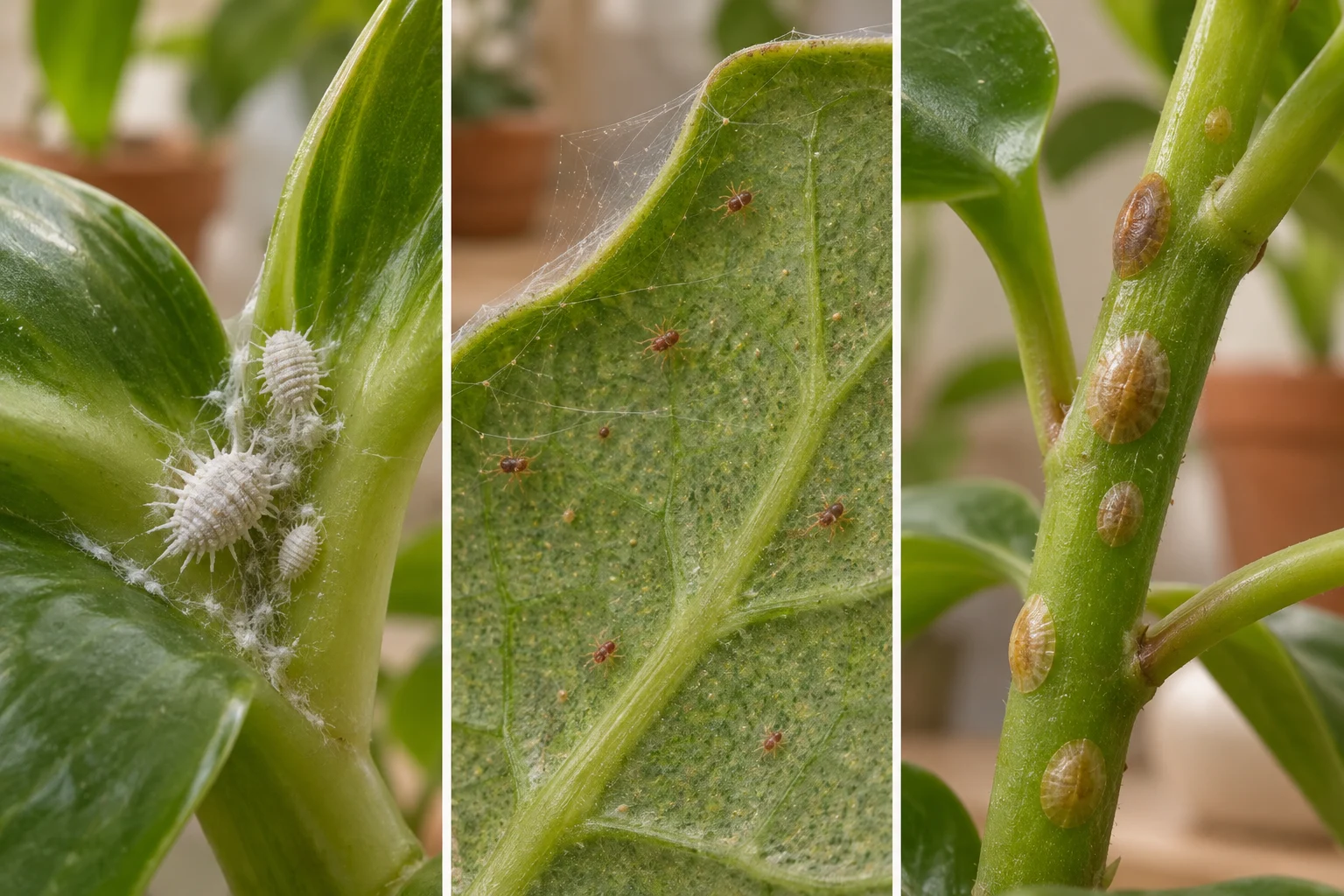
Panels, from left to right
- Mealybugs
- Spider mites
- Scale insects
Read the margin, blade and center separately
A continuous pink edge, an isolated dry patch inside a leaf and a softening central rosette are three different observations. Record which structure changed first. Uniform deepening of the margin after increased light may be the species' ordinary color response; a spreading bleached patch suggests reviewing exposure. A center that loses firmness in a persistently wet pot calls for a root-and-base inspection rather than an attempt to restore color with fertilizer.
Longer, less supported new leaves can make the rosette seem suddenly much wider. Compare their origin with the light history before cutting them back. Older scars will not disappear after a correction, so mark their boundaries in a photo and assess whether damage expands. A stable blemish and healthy central growth can coexist. When a broad outer leaf is bent during transport, the local crease should not automatically be read as a whole-plant thirst signal.
[2][3]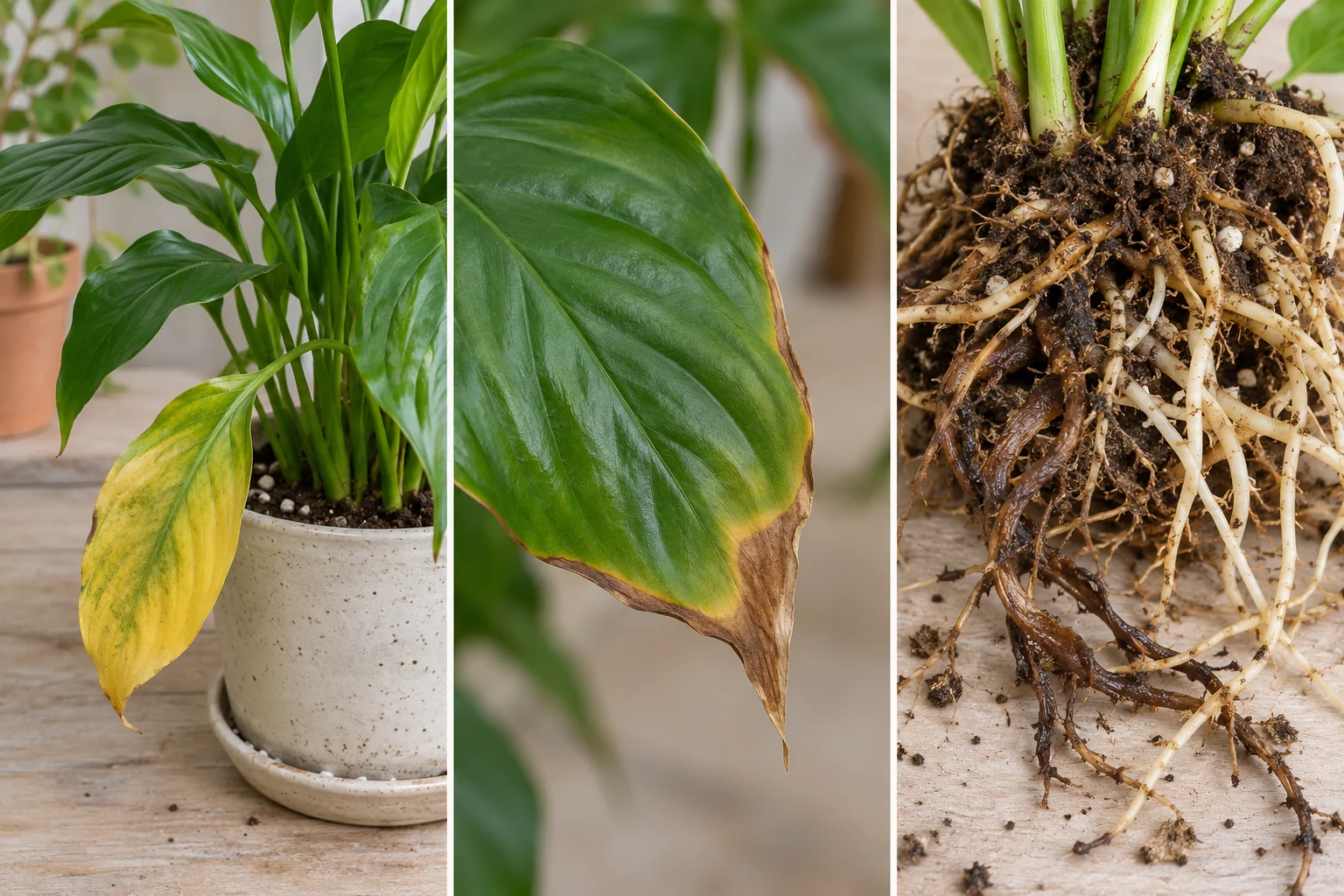
Panels, from left to right
- Yellowing foliage
- Brown leaf edges
- Damaged roots
Pink border deepens but the blade stays firm
- Possible causes
- Potential normal response of Aloe striata's smooth margin to stronger light, rather than injury across the whole leaf.
- What to check
- Compare the continuous edge with the inner blade and note whether pale dry areas have appeared since relocation.
- Next step
- Observe stable healthy color; reduce abrupt exposure if new blade damage develops and judge the next central leaves.
Coral-aloe center softens beneath overlapping leaves
- Possible causes
- Possible moisture retention near the crown or a deteriorating root zone hidden under the broad rosette.
- What to check
- Inspect accessible leaf bases and deep substrate moisture, especially after rain or watering into the center.
- Next step
- Remove standing water, correct the placement and seek horticultural assessment if soft tissue continues to spread.
New coral-aloe leaves make a loose one-sided rosette
- Possible causes
- Possible uneven or insufficient illumination during leaf development; physical damage can create a different localized asymmetry.
- What to check
- Compare leaf ages, the direction of the window and any transport crease before deciding the entire plant is weak.
- Next step
- Improve illumination across the rosette gradually and provide enough display space; do not shorten all healthy leaves to disguise the shape.
Separate flowering season from watering demand
RHS describes spring flowering for coral aloe in its horticultural account; indoor timing depends on conditions. New leaf activity, local daylight and drying rate are more useful for adjusting care than importing a named season from another hemisphere. A bright warm indoor winter can still support activity, whereas a cool dim placement may use very little water.
If the rosette spends a warm season outside, acclimate the whole plant to stronger light and choose shelter from prolonged rain into the center. Before returning it, inspect the undersides and pot rim where pests can remain hidden. A flowering stem also changes the space needed near a window or doorway, so relocate carefully without snapping it. Return before frost becomes a risk; do not use the conflicting garden hardiness descriptions as permission to leave a small wet container exposed.
[2]Coral flowers form a branching display
Coral-red tubular flowers grow in branching clusters above the rosette. The stalk carries many individual flowers and does not replace the leafy centre.
A mature, healthy indoor plant may remain without flowers. Neither a nutrient surge nor deliberate severe dehydration guarantees a display. If blooms occur, continue making water decisions from the root environment. After the stalk has finished, it can be removed carefully without damaging the center. Seed formation requires successful reproduction and is not assured by a floral stalk alone. Seed from uncertain parentage may not reproduce the exact plant you intended, so retain provenance when botanical identity matters.
[2]Toothless does not mean edible
RHS marks Aloe striata itself as harmful if eaten by people and by dogs, cats and rabbits, and recommends gloves and protective handling. This is an exact-species caution, not an assumption based on Aloe vera. The smooth margin removes an obvious tooth hazard but does not change the ingestion warning. Keep leaf fragments and any seed or pruning work away from children and animals that investigate plants by chewing.
Do not transfer advice about isolated Aloe vera gel or commercial preparations to coral aloe. The references here do not establish a food-safe portion or a home extraction method for this species. Avoid harvesting the broad leaves for skin remedies. If material may have been swallowed, provide the name Aloe striata and a photo to an appropriate poison-information service or veterinarian. For handling, support the plant without squeezing or breaking its leaves, and clean up cut material before returning the pot to display.
[2]Use the patterned foliage as a care record
The fine lengthwise lines and pink rim make useful fixed landmarks in repeat photographs. Photograph a leaf from the same angle after a light change, noting whether the border alone intensifies or the inner blade develops damage. Combine this visual record with pot weight and central growth. That approach helps distinguish a desirable color change from a problem without chasing an arbitrary maximum redness.
A coral aloe is a self-supporting rosette, so climbing poles add no biological benefit. Water-reservoir or semi-hydroponic systems alter the root environment and are not the baseline established by the cited species accounts. A separate seed-grown plant is a more appropriate experimental subject than the only mature rosette. Change one environmental factor at a time so the response remains interpretable. No exact lamp-distance formula or reservoir chemistry is supported here; the significant comparison is how this particular rosette grows under its actual conditions.
[2]Check historical names and unverified selections
Aloe albocincta and Aloe hanburiana appear as synonyms in the RHS account, and Kew records additional historical names. A synonym on a nursery label does not automatically mean a separate cultivar with different watering needs. Older publications may arrange related striped aloes differently, so keep the full botanical label rather than shortening every smooth-edged blue aloe to coral aloe.
A redder margin can reflect exposure rather than a named red cultivar. Conversely, a clearly toothed plant should not be accepted as ordinary Aloe striata solely because its border is pink. When a supplier offers a hybrid or named selection, ask for that identity and retain it with propagated plants. This profile describes the species' broad, toothless rosette and coral flowers; it does not assign unverified dwarf sizes, hardiness gains or medicinal properties to trade names.
[2][1]Frequently asked questions
Why does my coral aloe have smooth edges when my Aloe vera has teeth?
A continuous toothless pink margin is characteristic of Aloe striata. Aloe vera has toothed edges. Compare mature leaves and the botanical label rather than expecting every aloe to have the same outline.
[2]Are the fine lengthwise lines on coral aloe a spreading disease?
Longitudinal markings are part of this species' normal foliage. A changing lesion, damaged texture or spreading discoloration needs separate assessment; regular lines alone are not a diagnosis.
[2]Does a redder coral-aloe border mean the whole leaf is sunburned?
The pink margin can intensify in full sun. Check whether the blade remains firm and intact. Bleached dry patches within it are different from a continuous healthy colored edge.
[2]Should a toothed plant labeled coral aloe be accepted as Aloe striata?
The species has smooth margins, so conspicuous teeth warrant rechecking the label and whole plant. Do not identify a particular hybrid or its parents from that clue alone.
[2]Is Aloe albocincta a different coral aloe that needs different care?
It is a recorded synonym of Aloe striata, not by itself a separate horticultural selection. Keep the original label, but do not invent a different watering regime from the older name.
[1][2]Why has my solitary coral aloe not supplied the pups I expected?
RHS documents propagation of Aloe striata from ripe seed as well as division of existing offsets. Do not cut apart the central crown to create a division.
[2]How deeply should coral-aloe seed be covered?
The reviewed RHS account confirms seed propagation but gives no sowing-depth measurement. Follow instructions supplied with identified Aloe striata seed and keep the sowing medium well drained.
[2]Will coral aloe grown from seed flower exactly four years later?
There is no verified four-year flowering deadline for a coral aloe at home. Seedling development and available light vary; a horticultural maturity range is not a promise for an individual pot.
[2]Why do coral-aloe references say both winter and spring flowering?
RHS describes spring flowering for coral aloe in its horticultural account; indoor timing depends on conditions. Use local conditions and the actual stalk, not a universal month copied across hemispheres.
[2]Can winter flowers on coral aloe justify keeping its pot constantly wet?
A flower stalk does not cancel the need for drainage. Assess root-zone moisture and the room's light and temperature rather than converting a flowering-season label into constant irrigation.
[2]Why does the coral-aloe flower head branch above the rosette?
Branching flower clusters are part of Aloe striata’s normal flowering structure. Support the pot securely and leave space above the leaves for the developing stalk.
[2]Can I apply a South African frost report to my small indoor coral-aloe pot?
Not safely as a universal limit. Keep the houseplant frost-free instead of testing a wet container against a generalized claim.
[2]Does coral aloe's smooth pink leaf qualify it for Aloe vera gel recipes?
No. RHS flags Aloe striata as harmful if eaten, including for cats, dogs and rabbits. These references establish no edible portion or home remedy procedure for coral aloe.
[2]Should I polish coral aloe until the blue-green leaves look glossy?
Its characteristic foliage is blue-green to gray-green, not a surface that needs a glossy coating. Remove dust gently for inspection without scrubbing or trying to erase the plant's normal appearance.
[2]Why is a coral-aloe rosette too wide for its original narrow shelf?
The species naturally develops broad radiating leaves and can reach a substantial mature spread. Relocate it with clearance around the margins; trimming every leaf tip will not create a naturally miniature rosette.
[2]Compare related plants
- Aloe vera: Aloe vera has toothed leaf margins and commonly forms offsets. Coral aloe's smooth pink border and seed-based propagation opportunities make identification and planning different; gel advice is not transferable.
- Lace aloe: Lace aloe is Aristaloe aristata, with small densely marked leaves and terminal bristles. It offers a much finer-textured rosette than the broad uninterrupted blades of coral aloe.
Care reminders with PlantPal
Set a PlantPal reminder to inspect coral aloe's central growth and pot dryness after a change in window exposure.
Add a coral aloe reminder