 Plant
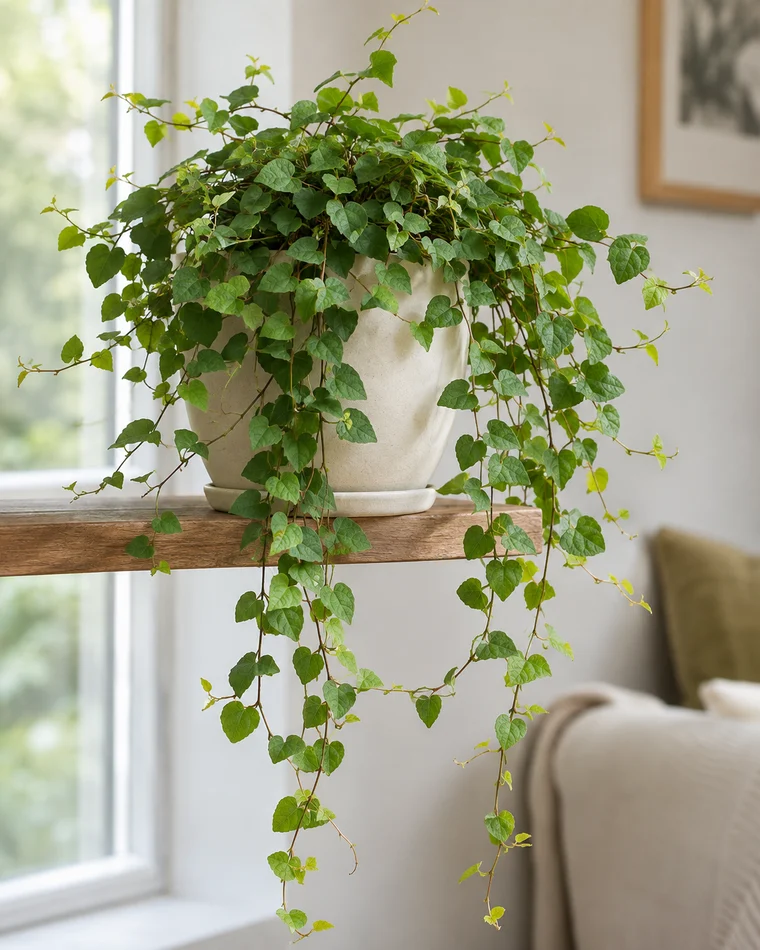
Creeping fig.
Ficus pumila
Creeping fig makes a fine network of small leaves on trailing or climbing stems. The charm of a young Ficus pumila comes with two practical responsibilities: its shallow, busy root ball must not dry unnoticed, and its attaching stems need a surface you are willing to let them occupy.
How to help it thrive.
Checked:
Quick care reference
- Growth phase: fine juvenile vines can later produce coarser adult shoots.
- Placement: use a removable frame or an accessible hanging pot.
- Light: illuminate both the pot and the trailing tips.
- Water: avoid an unnoticed dry core beneath a dense canopy.
- Drainage: inspect liners and cover pots for trapped water.
- Pruning: redirect stems before they attach to room surfaces.
- Propagation: healthy juvenile nodes root more usefully than dried strands.
- Handling: collect latex-bearing clippings and prevent chewing.
A climbing fig in its juvenile form
Ficus pumila is an evergreen member of Moraceae from East Asia. It is a woody climber rather than an herbaceous ivy, even though young stems and small leaves can look delicate. In a container it may trail over the edge or climb a suitable support. Outside in a warm climate, the same species can cover substantial vertical surfaces. The scale of a new hanging pot does not predict its eventual reach.
The usual houseplant display is juvenile growth. Regular trimming can preserve that fine-textured appearance, while an established plant may develop thicker, outward-growing adult branches. Think of it as a maintained vine, not a permanent miniature groundcover. Choose an accessible position where you can inspect the pot and cut back wandering shoots before they find a wall or cabinet.
[2][1]Two leaf forms belong to the same plant
Small, close-set, heart-shaped to ovate leaves line the slender clinging shoots. Older non-climbing growth can carry larger, thicker leaves with a different outline. This change in form is part of maturation and should not automatically be treated as contamination by another species. Compare the stem that carries the leaf as well as the leaf itself.
A green creeping fig is distinct from English ivy and from the larger heart-shaped leaves of climbing philodendrons. Variegated selections add pale margins or patches, but they still need the same attention to attaching stems. Nursery labels can be inconsistent, so retain the cultivar name if supplied and avoid assigning one from a single photograph. Tiny brown attachment roots along a stem are also different from insects clustered at a leaf joint.
[2][1]Light for a dense curtain of small leaves
Bright filtered daylight is a practical indoor starting point. A vine on a high shelf may have its pot in light while the hanging tips sit in shadow; conversely, a small pot close to hot glass can dry rapidly. Evaluate the whole display, including the root zone and the ends of the trailing stems. Sparse new leaves and stretched intervals between them suggest a placement problem.
The species can accept stronger exposure under appropriate outdoor or glasshouse conditions, but do not abruptly move a tender indoor vine into midday sun. Variegated leaves need useful light without scorching the pale areas. When using artificial light, arrange it so the cascade is illuminated rather than assuming a ceiling lamp supplies adequate growing light. Trim only after addressing the reason new stems became weak.
[2][3][4]Do not wait for the whole curtain to crisp
Creeping fig has many small leaves and a root ball that can dry surprisingly fast in a compact hanging pot. Let the surface begin to dry, then check deeper moisture before deciding to water. Avoid both a permanently saturated container and a prolonged dry core. By the time every fine leaf is crisp, watering cannot restore those dead tissues.
When the pot needs water, moisten the growing medium thoroughly and let excess drain away. A dense mat of stems can conceal a dry gap between compost and pot wall, so verify that water has reached the root ball instead of simply running around it. A moisture reading is useful only when interpreted with pot weight, drainage and the condition of the growing tips.
[3][4]A small vine still needs an aerated pot
Use a moisture-retentive, well-drained container mix. A loam-based peat-free compost with an open structure is suitable; avoid compacting it tightly around a fine root system. The pot must drain freely even when it is nested in an ornamental basket. A liner or decorative container can hide standing water, so include that space in routine inspections.
Repot when roots fill the available space or the mix stops behaving predictably. A modest size increase is easier to manage than a large reservoir of wet compost around a small vine. Keep the stems at their previous depth and handle the leafy mat carefully. After repotting, judge moisture from the new container rather than continuing the old watering interval unchanged.
[2][3]Humidity without a sealed wet canopy
This fig appreciates protection from drying air, particularly when a small pot hangs near heating or ventilation. A warm, stable room with useful daylight is easier to manage than a hot draughty shelf. Its outdoor hardiness descriptions should not be read as permission to expose a recently purchased houseplant to freezing conditions.
A terrarium can reduce water loss, but constant condensation is not a care target. Dense shoots still need air movement and access for trimming. If the glass stays wet and the growing medium never starts to dry, change ventilation and watering rather than adding more mist. A plant that outgrows its enclosure may be better moved to an open display than repeatedly compressed into the same space.
[2][4][3]Support a steady flow of juvenile shoots
Feed lightly while the vine is actively making new leaves, using an appropriate houseplant fertilizer at its labelled rate. Small containers and frequent watering can alter nutrient availability, but extra fertilizer is not the first answer to a thin, dark-shelf vine. Check light and root condition before treating poor density as hunger.
A new potting mix may already contain nutrients. Account for that supply and reduce feeding when growth slows. Pale leaf edges caused by variegation will not turn green with fertilizer, and brown dried leaves will not recover. If salts build up, review the product, water and drainage together rather than cycling between strong feed and repeated emergency flushing.
[3]Keep attachment roots off valued surfaces
Ficus pumila can adhere firmly to porous material. Give it a removable frame, a suitable plant support or free hanging space, and keep searching stems away from painted walls, wallpaper and furniture. Do not let a young vine establish on a surface merely because it is easy to pull away today; later removal may damage the finish.
Shorten wandering shoots while they are still manageable. If the goal is a small-leaved display, remove unwanted coarse adult growth selectively and retain healthy juvenile stems. Cutting everything back at once can expose a sparse pot, so work in stages. Wear gloves when pruning and collect fine clippings rather than leaving them where pets can reach them.
[1][3]Use juvenile stem nodes for a new vine
A short healthy leafy shoot with several nodes is a practical starting material. Remove leaves only where the lower stem will enter the rooting medium, keeping a node available for root and shoot development. Maintain protected humidity and gentle light while avoiding a saturated base. A stem that has already dried crisp is poor propagation material.
Layering a flexible shoot into a nearby small pot can keep it attached to the parent until it roots. That can be useful when you want a fuller display without sacrificing a long section immediately. Once roots support new growth, separate the young plant and acclimatize it gradually. The shared guide covers clean tools and enclosure management; creeping fig’s special advantage is its many closely spaced nodes.
[2][3]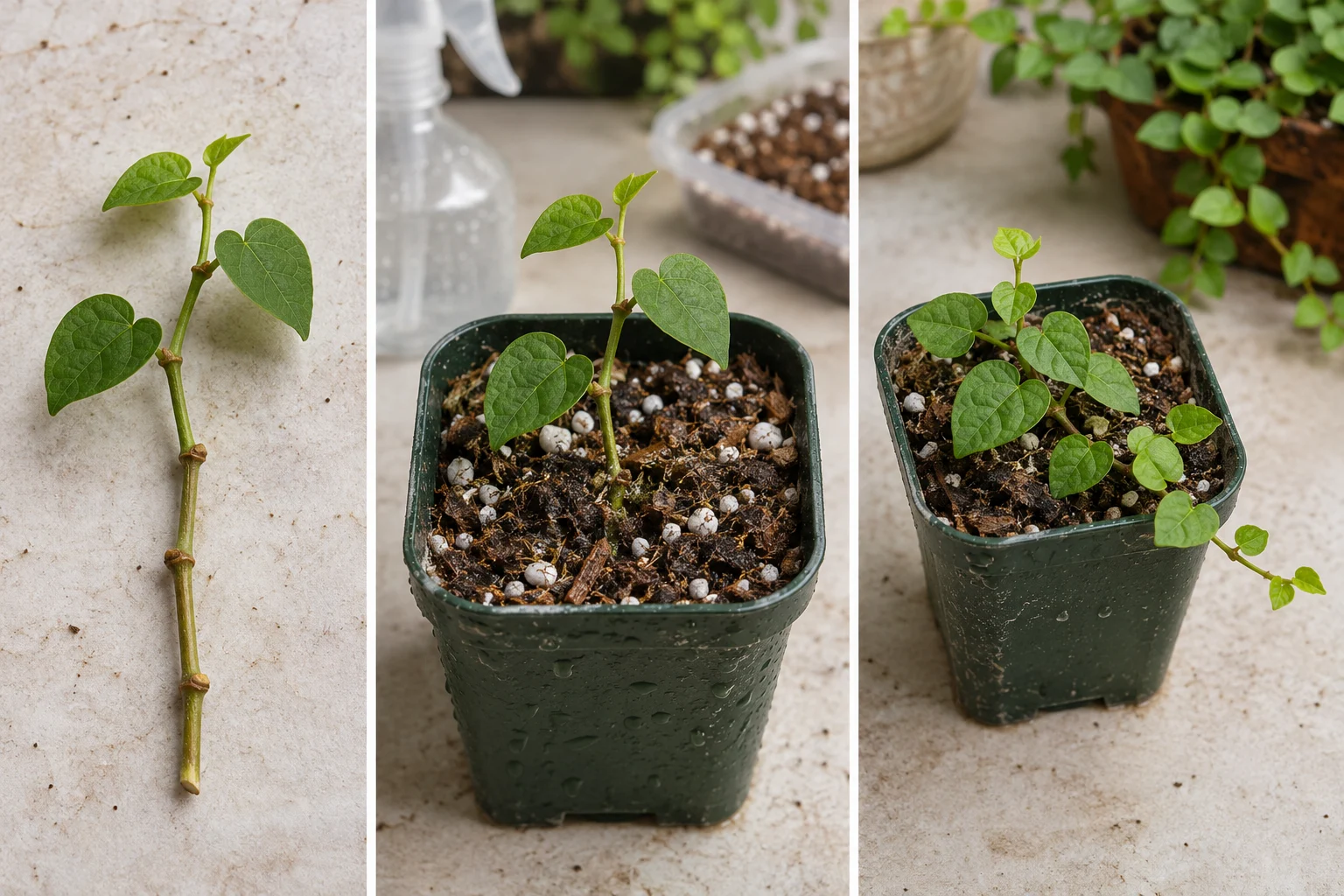
Panels, from left to right
- Select a flexible juvenile shoot with healthy leaves and several intact nodes.
- Set the lower nodes into a small airy rooting pot, keeping foliage above the surface.
- Maintain sheltered moisture until rooted growth allows the new vine to be gradually uncovered.
Search inside the fine leafy network
Mealybugs and scale can be difficult to see in a dense creeping-fig canopy. Fine stippling, distorted new tips or sticky deposits justify a closer look along the stems and leaf undersides. Mites may become more troublesome in a dry display. Inspect a new purchase before intertwining it with other plants, because separating established vines is inconvenient.
Identify the pest before choosing a treatment, and follow a product label suitable for indoor ornamentals. Test a small area when foliage is delicate. Do not assume that dropping leaves prove an infestation: a single missed watering can produce a similar-looking decline. Track whether damage is concentrated near the hottest, driest part of the display or follows visible insects.
[1][2]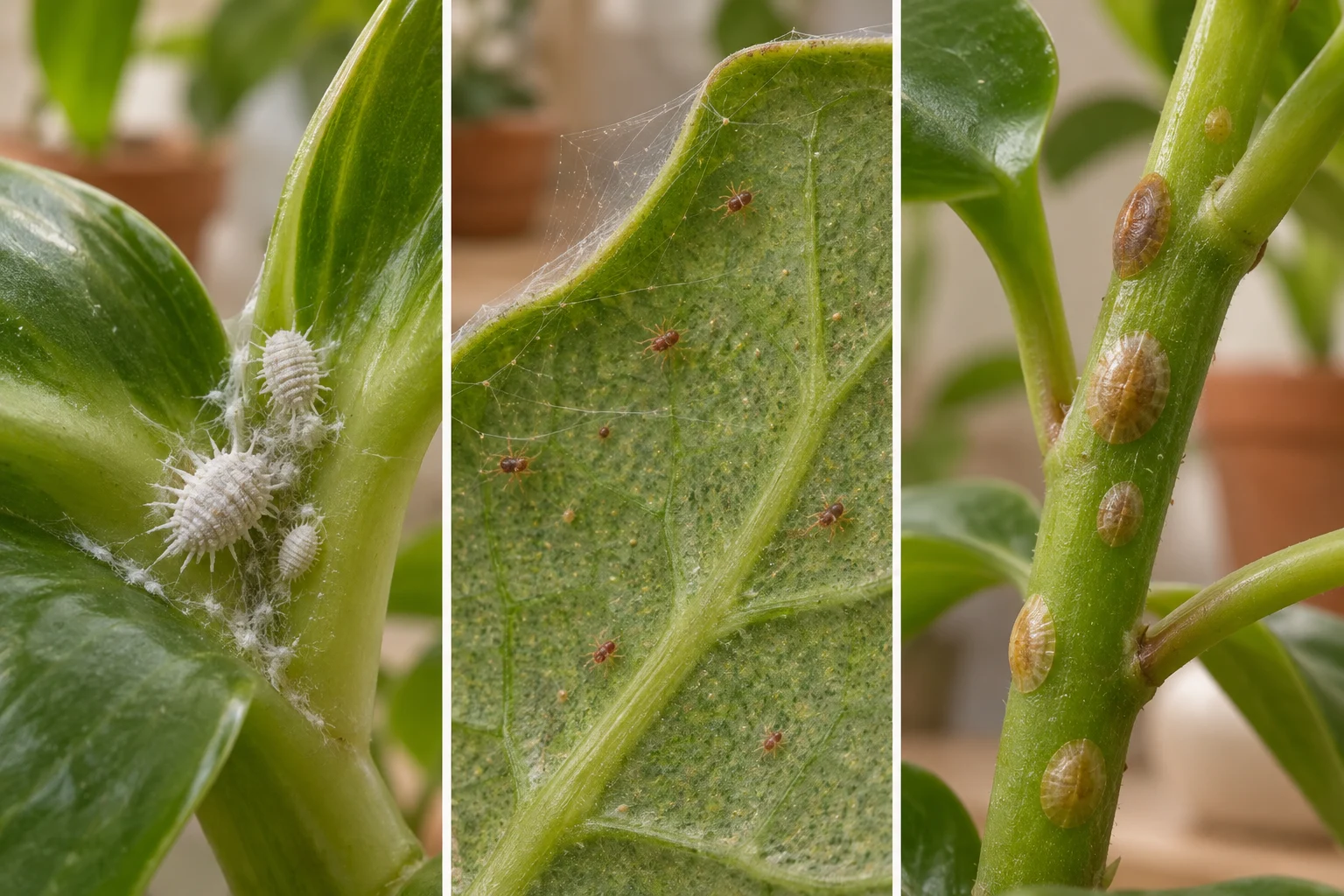
Panels, from left to right
- Mealybugs
- Spider mites
- Scale insects
A crisp vine and a soft vine need different checks
Dry, brittle leaves on a light pot suggest that water was unavailable long enough to damage tissue. Soft dark stems over persistently wet compost suggest another problem, including possible root or stem decay. These are working possibilities, not diagnoses made from a photograph alone. Feel the stems and examine moisture before responding.
After correcting the underlying conditions, look for living flexible shoots and new buds. Remove clearly dead sections gradually; they will not rehydrate into green leaves. A partly bare trailing stem may be better shortened to a healthy node than left as a long empty strand. If the entire base is soft, taking apparently healthy tips does not guarantee they are free of the same problem.
[3]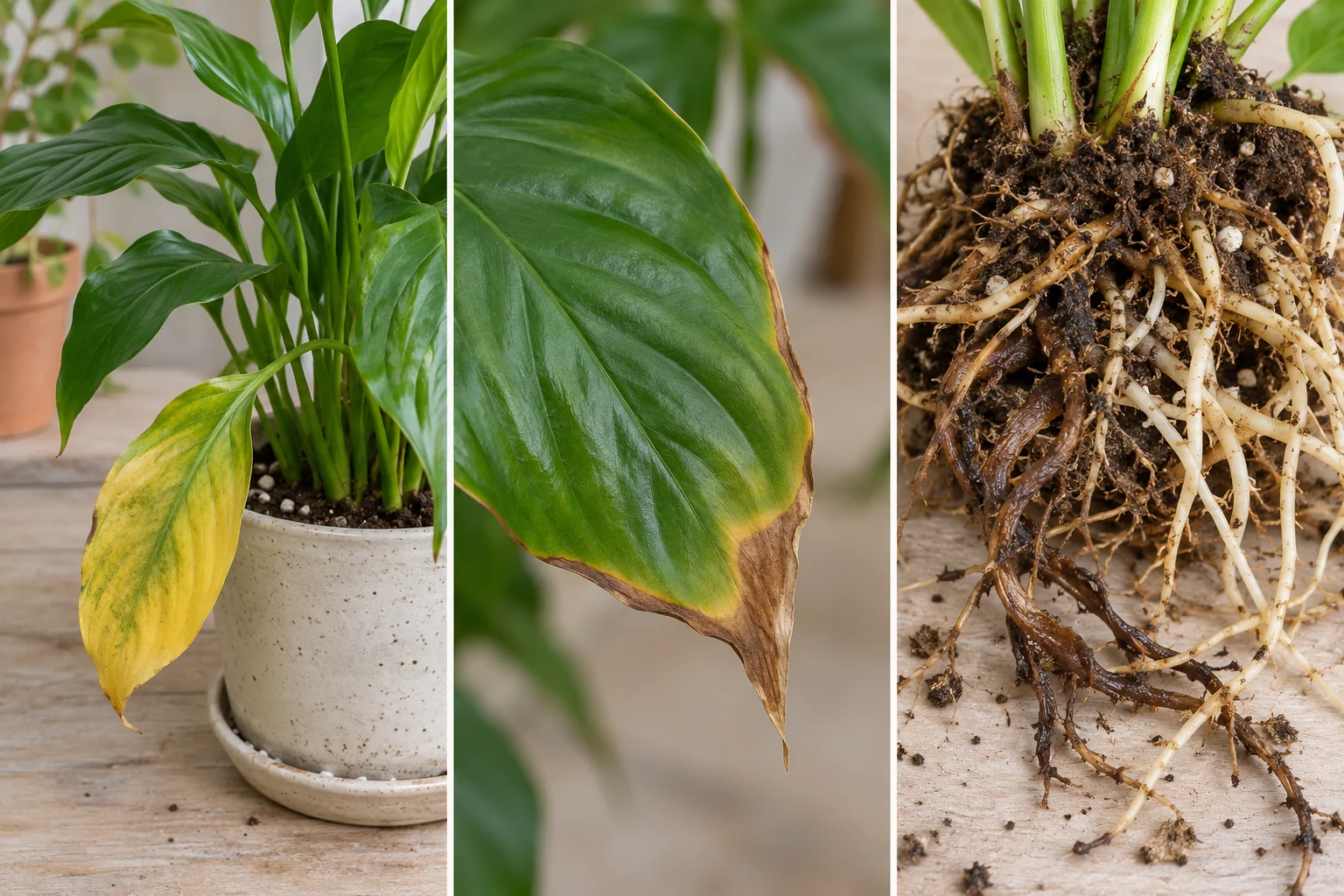
Panels, from left to right
- Yellowing foliage
- Brown leaf edges
- Damaged roots
A crisp curtain after one dry spell
- Possible causes
- A compact root ball may have dried while the dense top concealed the change.
- What to check
- Feel the core and test whether any stem tips remain flexible and alive.
- Next step
- Restore appropriate moisture and trim dead strands; watch for replacement buds.
Soft runners over wet compost
- Possible causes
- Poor drainage or a sealed enclosure can keep the fine-rooted vine excessively wet.
- What to check
- Inspect the basket liner, cover pot and base of affected stems for retained moisture.
- Next step
- Remove trapped water and assess decaying roots before taking further watering action.
Large leathery shoots leaving the support
- Possible causes
- The vine may be entering its adult growth form rather than developing a leaf disease.
- What to check
- Compare coarse outward-growing branches with the small leaves on attached juvenile stems.
- Next step
- Prune selected adult shoots if a fine-textured indoor mat is the intended shape.
Watch the hanging pot as seasons shift
In a brighter or warmer season, a compact pot can dry faster even if the room temperature changes only slightly. Check it more often before increasing the amount or frequency of water. This is also a useful time to redirect stems and refresh an overcrowded container while the vine can make replacement growth.
When daylight falls, reduce feeding and water according to slower drying. Keep the display away from a newly activated heater. If it spends warm weather outdoors, inspect the dense foliage carefully before returning it indoors and prevent stems from attaching to permanent structures. A change in location deserves closer observation for several watering cycles, not an automatic new calendar.
[3]Adult branches carry the reproductive stage
The familiar juvenile mat is not the stage usually associated with fruit. Mature growth can develop fig structures containing tiny internal flowers. An indoor vine kept compact may never reach that stage, and that does not mean its care is deficient. Larger leaves on non-clinging branches may accompany maturity before any fruit appears.
Do not expect the ornamental figs to behave like edible Ficus carica. NC State describes creeping-fig fruit as inedible in the horticultural context. Specialized food uses of particular related forms and preparation methods do not make an unidentified houseplant a food crop. There is no need to encourage fruit by overfeeding a foliage display.
[1][2]Sap precautions apply to this small fig too
Its small leaves do not remove the need for careful handling. RHS identifies the sap as a skin allergen. Wear gloves when cutting a dense mat and avoid touching your eyes before washing your hands. Fine trimmings can scatter widely, so clear the work area before returning the plant to a shared room.
Do not present creeping fig as a verified pet-safe plant. Keep the trailing stems out of chewing reach and seek professional advice if a person or animal has an exposure. A label saying fig does not establish edibility, and ornamental nursery treatments are another reason not to taste foliage or fruit. Use the shared safety guide for identification and response principles.
[2][1]Terrarium scale needs active management
A terrarium is useful only while you can control the vine’s spread. Ficus pumila may cover neighbouring plants and cling to interior surfaces. Plan a removable support and a pruning route before planting, and leave space to inspect the substrate. A beautifully filled enclosure can become difficult to maintain if every shoot is allowed to attach permanently.
For a wall-like display, use a separate plant structure rather than the building itself. In semi-hydro experiments, begin with a rooted cutting and observe its adaptation; transferring a tightly rooted old mat is more disruptive. Keep records of light and moisture changes so a new system can be evaluated without confusing it with recent pruning or relocation.
[1][4]Small-leaved selections still become vigorous vines
Variegated creeping figs may be sold with white or cream leaf margins. RHS describes White Sunny as a cultivated variegated form, while also marking its name status unresolved. That is a reason to keep the nursery label and avoid overconfident naming from an image. The amount of pale tissue and growth rate can differ between selections.
Cultivars do not eliminate the species’ attachment behaviour or its need for moisture checks. All-green shoots can outgrow a variegated canopy, so decide whether to retain or remove them according to the display you want. Do not confuse a compact sales plant with a permanently tiny mature vine; container access and pruning remain part of its long-term care.
[4][2]Frequently asked questions
Why did my creeping fig suddenly grow much larger leaves?
Mature non-climbing shoots can carry larger leaves than juvenile clinging stems. Check the branch habit before assuming another plant has entered the pot.
[2]Can Ficus pumila damage a painted indoor wall?
It can adhere strongly to porous surfaces. Keep it on a removable support and prune searching stems before they establish on finishes you want to preserve.
[1]Will brown crispy creeping-fig leaves turn green after watering?
Dead leaf tissue does not revive. Correct the moisture problem, identify flexible living stems and judge recovery from new buds rather than the old dried canopy.
[3]Are tiny roots along creeping-fig stems a pest?
Attachment roots are normal on clinging shoots. Compare their regular position along the stem with insects, cottony deposits or moving specks before treating the plant.
[1]Can I let creeping fig climb directly over furniture?
A separate frame is safer. Its attachment can become difficult to remove without marks, especially after the vine has been left to grow undisturbed.
[1]Does a creeping fig need to make fruit to be mature enough for pruning?
No. Pruning is guided by the shape and spread you need, not by fruit production. Most small indoor displays are maintained as juvenile foliage.
[3][2]Why are long creeping-fig strands becoming bare near the pot?
Shading, old leaf loss or a previous dry episode may leave bare sections. Check the root ball and light before shortening those strands to healthy nodes.
[3]Can I root a creeping-fig shoot while it remains attached?
A flexible shoot can be layered into a nearby pot. Separate it only after its own roots support growth, rather than cutting it free as soon as it touches compost.
[3]Why does the green shoot on my variegated creeping fig grow fastest?
A reverted all-green shoot may be more vigorous than the pale-marked canopy. Remove it selectively if maintaining variegation is your aim.
[3]Can the climbing fig in my room provide edible figs?
Do not use an ornamental Ficus pumila as an edible common fig. Its identification, fruit type and any specialized preparation are different from Ficus carica.
[1]Should I pull an established creeping vine off a wall to repot it?
Avoid a forceful tug that damages stems or the surface. Plan detachment carefully and move future growth onto a removable support before the attachment becomes extensive.
[1]Compare related plants
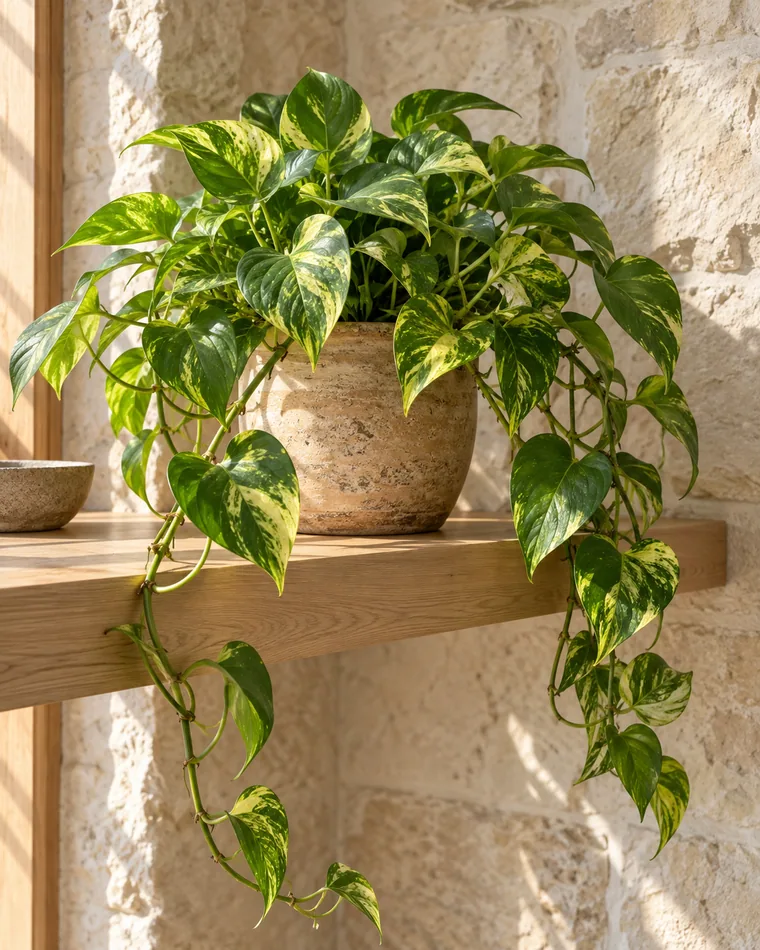
- Golden pothos: Pothos has larger leaves and a more substantial climbing stem; creeping fig makes a finer mat and attaches firmly to porous surfaces.
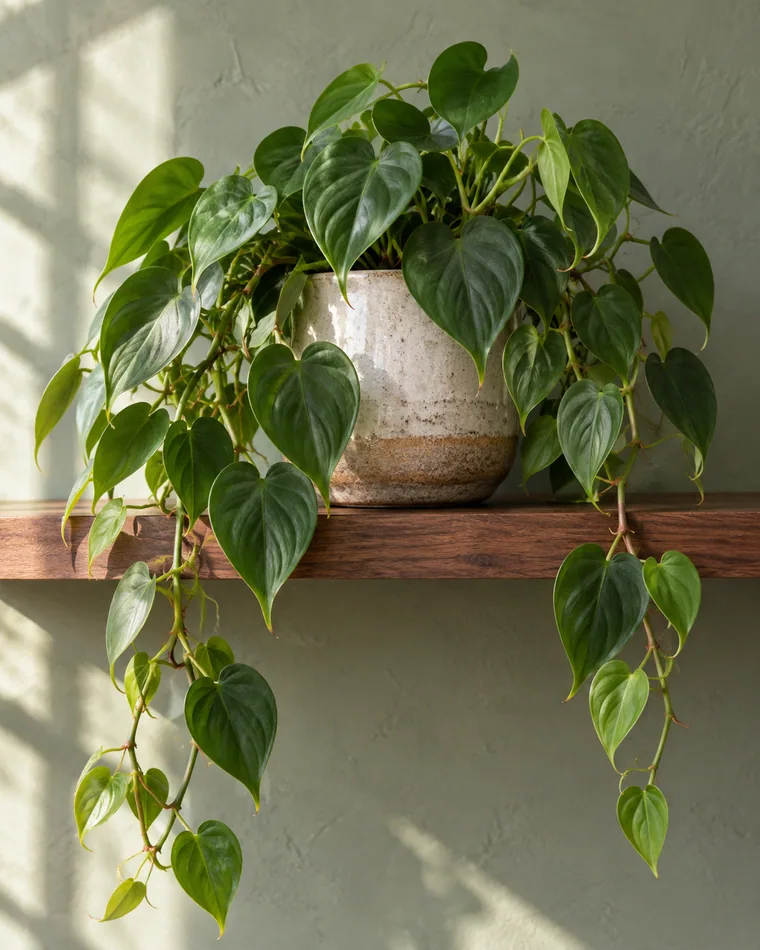
- Heartleaf philodendron: Heartleaf philodendron offers an open cascade of larger leaves, whereas creeping fig forms a dense small-leaved cover that needs closer moisture checks.
Care reminders with PlantPal
Use PlantPal reminders to inspect the hidden root ball and redirect new creeping-fig runners before they reach the wall.
Track my creeping fig